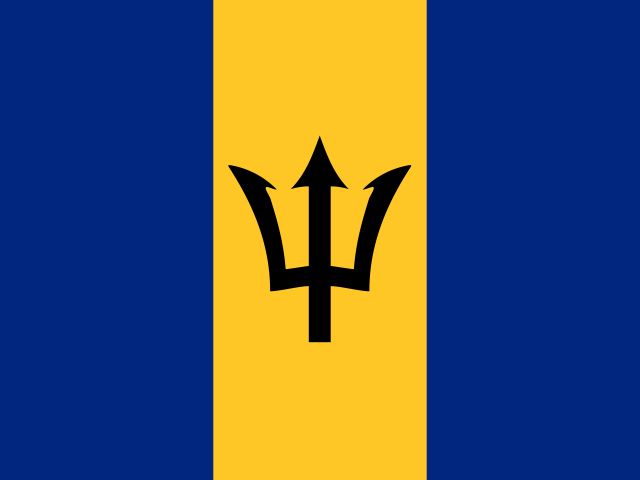
The Flag of Barbados
North America · Adopted 30 November 1966
Barbados adopted its flag on 30 November 1966, the day the island gained independence from Britain, replacing the colonial Blue Ensign defaced with Barbados's badge. The winning design came from a national competition that drew over a thousand entries, judged by a specially appointed committee; the winner, Grantley Prescod, an art teacher at Combermere School, submitted the three-panel ultramarine-gold-ultramarine layout with a black trident head centered on the gold band, and his design was selected over the other finalists specifically for the trident's originality as a national symbol distinct from British heraldic tradition.
The trident head is the flag's defining and most distinctive feature: it is deliberately broken, with its shaft severed just below the prongs, a design decision explained officially as representing Barbados's break from its colonial past — the full trident having appeared for decades as part of the colonial-era Barbadian badge, held by a depiction of Britannia. By snapping the shaft and keeping only the three-pronged head, Prescod's design symbolically retained a recognizable piece of the island's visual heritage while literally severing the connection to British imperial iconography the trident had represented under colonial rule.
The two ultramarine bands represent the sea that surrounds Barbados on all sides, and the central gold band stands for the sand of its beaches — reflecting the same sea-and-sand color logic used by several other Caribbean nations at independence, though Barbados arrived at ultramarine and gold independently through its own competition process rather than copying a neighbor. Black in the trident head is read as representing the strength and heritage of the Barbadian people, most of whom descend from Africans brought to the island under slavery to work its sugar plantations, historically among the most economically significant in the entire British Caribbean.
Barbados created the Order of Neptune in 1989 as a royal-style honor recognizing the flag's trident symbolism, awarded for outstanding contributions to Barbadian maritime and national life, a rare case of a flag's central emblem directly inspiring a subsequent national honor rather than the other way around.
The flag has not been redesigned since 1966, though Barbados underwent a related but separate symbolic transition decades later: in November 2021 the country became a republic, removing the British monarch as head of state and replacing the governor-general with a president, but this constitutional change did not alter the flag itself, which had already broken with British Britannia imagery symbolically 55 years earlier.
Barbadian law protects the flag's proportions and the broken trident's exact form, and government guidance specifies correct display for Independence Day on 30 November, which after 2021 also doubles as the anniversary of the country becoming a republic, giving the date a layered significance in Barbadian civic life.
Because the broken-trident motif is unique to Barbados among sovereign flags, it has essentially no close look-alikes worldwide, a contrast to many Caribbean neighbors whose blue-and-gold or sea-and-sand color schemes overlap more with each other.
Grantley Prescod's win was reportedly a surprise to some of the judging panel precisely because the broken trident departed so sharply from the heraldic conventions most other entrants had followed, many of which incorporated recognizable versions of the colonial badge's full trident-and-Britannia imagery rather than a deliberately fractured emblem; his selection is often cited in Barbadian civic education as an example of independence-era Barbadians choosing symbolic rupture over symbolic continuity, in contrast to some neighboring islands whose post-independence flags retained more visual continuity with their colonial predecessors.
The 2021 transition to a republic was itself steeped in trident symbolism even though the flag stayed the same: outgoing Prince Charles, representing his mother Queen Elizabeth II at the handover ceremony in Bridgetown, formally acknowledged Barbados's full sovereignty, and commentary at the time frequently noted that the flag had effectively anticipated the constitutional change by 55 years, having broken from Britannia's trident in imagery well before the country broke from the British monarchy in law.
Barbadian schools teach the flag's design story alongside the island's broader sugar-plantation history, and the black of the trident head is explicitly tied in that curriculum to the resilience of enslaved and later free Black Barbadians whose labor built the colonial economy the trident, in its unbroken colonial form, had once represented — a direct thread the government draws between the flag's design logic and the island's specific plantation-era past rather than a generic reference to African heritage alone.
The competition that produced the flag was organized by a government committee appointed specifically for the purpose in 1966, with entries judged anonymously and the shortlist narrowed before a final public unveiling; Barbadian press coverage at the time noted that several finalists had proposed keeping some abstracted version of a full trident or a ship's wheel referencing the island's maritime economy, but the committee ultimately favored Prescod's starker, more overtly symbolic break with the colonial badge over designs that read as more decorative continuations of it.
Barbados is unusual among former British Caribbean colonies for having never changed hands between European powers after its initial 1625 English settlement — unlike Grenada, St. Lucia, or Dominica, which passed repeatedly between French and British control, Barbados remained continuously under British rule from 1625 until 1966, a long, uninterrupted colonial period that shaped both the depth of British institutional influence on the island and, by extension, the specific weight the 1966 flag's rejection of British Britannia imagery was intended to carry.
The trident is meant to be broken
- Detail-accurate printed flag — The trident head is shown without its shaft, and a reproduction that quietly restores the shaft is drawing a different emblem. It is one detail to check in the listing photograph.
As an Amazon Associate we earn from qualifying purchases made through these links, at no extra cost to you.
Barbados at a glance
- Capital
- Bridgetown
- Population
- 282,000 (2024)
- Currency
- Barbadian Dollar (BBD)
- Language(s)
- English (official); Bajan Creole widely spoken
Population figure as of 2024, source: UN World Population Prospects (2024 revision). See methodology for how facts are sourced and kept current.