The Flag of Belize
North America · Adopted 21 September 1981
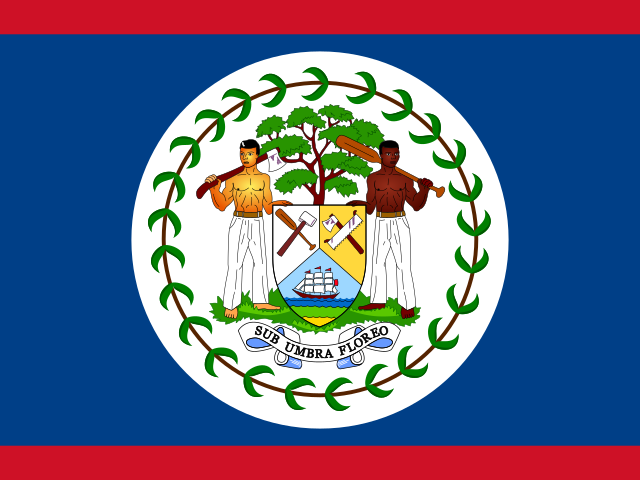
Belize's flag was adopted on 21 September 1981, the day the country — formerly British Honduras — gained independence, though the core of the design is considerably older: the People's United Party had already adopted a blue flag bearing the same central coat of arms in 1950, when the party was campaigning for self-government, and that party banner became the template for the national flag three decades later. At independence the government added a red stripe at the top and bottom of the design specifically to bring in the opposition United Democratic Party's color, a deliberate act of cross-party inclusion rarely seen so explicitly in a national flag's formal design history — the blue came from the ruling party, the red from its rival, joined into a single national symbol.
Belize's flag is widely cited as the national flag with the most colors of any sovereign state, and by some counts the most colors of any flag in the world at all: including the blue field, red stripes, and the many-hued coat of arms — which itself contains green, brown, white, yellow, black, flesh tones, and more across its detailed emblem — official tallies put the total distinct colors at twelve, far beyond the two or three colors most national flags use.
At the center of the design sits Belize's coat of arms, encircled by a wreath of 50 mahogany leaves referencing the 50 U.S. states only coincidentally — the number instead marks the year the design was adopted by the PUP relative to earlier versions, according to some accounts, though the more commonly cited explanation ties the wreath purely to the mahogany tree's historic economic importance to British Honduras, since mahogany logging was the colony's principal export industry for much of its colonial history.
The coat of arms itself depicts two human figures flanking a shield — one a mestizo woodcutter holding an axe, the other traditionally described as a Black Belizean woodcutter or sailor holding a paddle, standing on either side of a shield showing tools of the timber trade (a saw, axe, and squaring axe) beneath a mahogany tree, with the Latin motto 'Sub Umbra Floreo' ('Under the Shade I Flourish') on a scroll below. Belize's flag is one of the very few national flags in the world to depict full human figures as part of its central emblem, a design choice inherited essentially unchanged from British Honduras's colonial-era badge, making Belize's coat of arms one of the rare cases of colonial heraldry carried forward almost intact into an independence-era national flag rather than replaced.
The flag has not been substantially redesigned since 1981, though minor detail refinements to the coat of arms artwork have occurred over the years; the two red stripes and the fifty-leaf wreath remain fixed by law, and Belizean flag specifications are unusually detailed given how visually complex the central emblem is compared with most national flags, which tend toward simpler geometric or single-emblem designs precisely to make mass reproduction easier.
Because the two-red-stripes-on-blue layout with a detailed central coat of arms is distinctive, Belize's flag has few genuine look-alikes among sovereign states, though its structure — a colored field, framing stripes, and an elaborate colonial-derived coat of arms at center — echoes a design pattern once common across British Caribbean and Central American colonial banners before most were simplified or replaced at independence.
The flag flies year-round over government buildings and is especially prominent during Belize's Independence Day celebrations on 21 September and during the country's Garifuna Settlement Day commemorations, reflecting the multi-ethnic composition — Mestizo, Creole, Garifuna, Maya, and others — that the coat of arms's paired figures are meant to gesture toward, even if the emblem's specific imagery predates and doesn't fully capture that full diversity.
British Honduras itself only took that name in 1862, after more than a century as a loosely governed British logwood- and mahogany-cutting settlement disputed with Spain and then Guatemala; Guatemala continued to formally claim Belizean territory even after independence in 1981, a dispute still unresolved in the 2020s and periodically raised in Guatemalan and Belizean politics, which gives the coat of arms's timber-industry imagery an added layer of historical weight, since the same mahogany trade that built the colony's economy is tied up with the territorial dispute that has shadowed Belizean sovereignty since before independence.
The PUP's original 1950 party flag, from which the national design descends, was itself created during a period of intensifying self-government agitation in British Honduras, and party loyalists reportedly resisted diluting the blue field with red at independence — the compromise of adding red stripes only at the top and bottom, rather than any deeper redesign, reflects how narrowly the final 1981 version threaded the needle between honoring the PUP's original banner and formally including the opposition's color.
George Cadle Price, the PUP leader who became Belize's first prime minister and is widely regarded as the father of Belizean independence, campaigned under the blue-and-white party flag for decades before 1981, and his long personal association with that banner is part of why the government resisted more sweeping changes to the coat of arms itself even while agreeing to add the opposition's red as a unifying gesture at the moment of full sovereignty.
Because the coat of arms depicts specific tools of the mahogany and logwood trade rather than a more abstract national emblem, Belize's flag is occasionally described by vexillologists as one of the more literal, occupation-based coats of arms among modern national flags, in the same broad tradition as some older European guild and colonial trading-company emblems, even though Belize's own version was formalized as recently as the 20th century rather than inherited from a much older heraldic tradition.
The most crowded arms on any flag
- Highest-resolution printed flag — Two figures, a shield, tools and a lettered scroll all sit inside one circular device, which asks more of a print than any other national flag does; below a certain resolution it is a white blob.
As an Amazon Associate we earn from qualifying purchases made through these links, at no extra cost to you.
Belize at a glance
- Capital
- Belmopan
- Population
- 410,000 (2024)
- Currency
- Belize Dollar (BZD)
- Language(s)
- English (official); Spanish, Belizean Kriol, and Garifuna widely spoken
Population figure as of 2024, source: UN World Population Prospects (2024 revision). See methodology for how facts are sourced and kept current.