The Flag of Bhutan
Asia · Adopted 1969 (current proportions); design tradition older
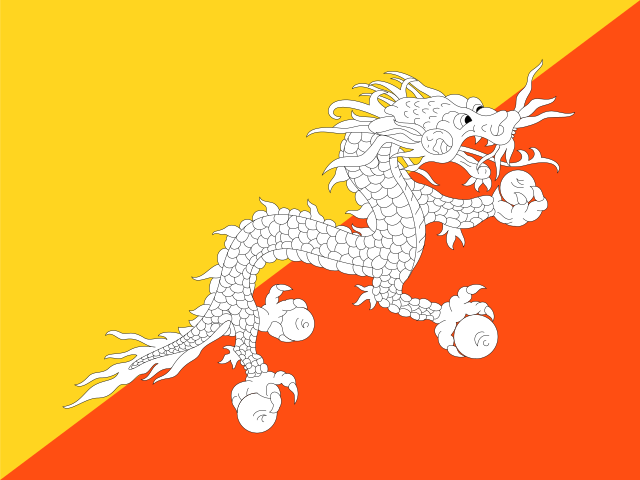
Bhutan's flag is divided diagonally into a golden-yellow upper triangle and an orange-red lower triangle, with a large white dragon — the Druk, or Thunder Dragon, from which Bhutan takes its own name for itself, Druk Yul, 'Land of the Thunder Dragon' — coiled across the boundary and gripping jewels in each of its four claws. The design's current standardized proportions date to 1969, when Bhutan's National Assembly formalized the flag ahead of the country's admission to the United Nations in 1971, but flags using this diagonal-split, dragon-bearing pattern had already been in informal use since at least the 1940s and 1950s under earlier Wangchuck-dynasty rulers, meaning the 1969 change was a standardization rather than an invention of the design.
The name 'Thunder Dragon' itself predates the flag by centuries: it comes from the Drukpa Lineage of Tibetan Buddhism, the dominant school in Bhutan, whose founders in the 12th century reportedly named their monastery after hearing what they took to be dragon's thunder — a peal of thunder over the site during its construction — and the lineage's name and dragon symbolism spread from there to become identified with Bhutan itself as the Drukpa school became the country's state religion.
The dragon is white specifically to symbolize purity, and the jewels clutched in its four claws represent wealth and perfection, understood in the Buddhist context as national prosperity and the security of Bhutan's people rather than material riches in a narrow sense. The dragon's snarling expression is deliberate too, meant to represent the strength of the male and female deities protecting the country and the resolve of Bhutan's defenders, rather than aggression for its own sake.
The two background colors carry their own distinct meanings: gold-yellow in the upper triangle represents the secular authority and temporal power of the Bhutanese monarchy (the Druk Gyalpo, or Dragon King), while the orange-red lower triangle represents the Buddhist religious tradition, specifically the Drukpa Kagyu and Nyingma schools practiced in the country — a visual pairing of state and monastic authority that mirrors the historic dual system of governance Bhutan operated under for centuries before its 2008 transition to constitutional monarchy.
Bhutan is one of the very few national flags to feature a dragon at all, and its version is unrelated in origin to the dragons seen in Chinese, Welsh, or other national or regional iconography — Bhutan's dragon comes specifically from its own Vajrayana Buddhist and Drukpa Kagyu religious tradition rather than from any shared East Asian dragon mythology, even though casual observers sometimes assume a connection to Chinese dragon imagery given regional proximity.
Bhutan's diagonal bicolor-with-dragon layout is distinctive enough that vexillologists rarely list any real point of confusion for it, unlike the crescent-and-star or horizontal-tricolor families that recur across dozens of unrelated countries' flags — a genuine rarity among the world's roughly 200 national designs, most of which share at least a passing family resemblance with one or two others.
Early 20th-century Bhutanese flags, flown under the first two Druk Gyalpo kings after the Wangchuck dynasty's founding in 1907, were noticeably different in detail from today's version: older surviving examples show a dragon that faces the opposite direction, a diagonal split running the other way, and proportions that were closer to square than the roughly 3:2 rectangle used today, evidence that the flag evolved through several informal iterations across the mid-20th century before the 1969 National Assembly standardization fixed a single official version, reportedly informed by a flag brought back from a 1949 diplomatic mission to India that Bhutanese officials wanted to formalize domestically.
The diagonal line itself is understood in Bhutanese explanations as separating and simultaneously joining the two authorities the colors represent — secular and religious — running from the lower hoist corner to the upper fly corner, with the dragon deliberately centered astride that boundary rather than sitting fully within either triangle, a compositional choice meant to show the dragon protecting and unifying both spheres of Bhutanese governance rather than belonging to one alone.
Bhutan is also unusual among modern states for having measured national wellbeing through Gross National Happiness, a policy framework formalized from the 1970s onward under the fourth king, rather than GDP alone as the primary metric of development; while the flag itself predates that framework, Bhutanese officials and tourism materials frequently invoke the dragon's jewels — symbolizing prosperity understood broadly rather than as pure material wealth — as a visual anticipation of that later national philosophy.
The country's 2008 shift from absolute to constitutional monarchy, carried out unusually as a change initiated voluntarily by the reigning king rather than forced by unrest or revolution, left the flag completely unaltered, in keeping with the broader pattern across Bhutan's modern political history of the flag remaining a stable constant even as the structure of government around it has changed twice within living memory.
Bhutan remained one of the most isolated countries in the world well into the 20th century, only opening to foreign tourism in 1974 and television and internet in 1999, a deliberate policy of controlled, gradual engagement with the outside world that the government has linked explicitly to the same philosophy of guarded cultural preservation the flag's dragon and jewels are meant to represent; the country has never been colonized by a European power, a distinction it shares with very few other Asian states, which Bhutanese officials sometimes cite as part of why its flag and other national symbols reflect indigenous Buddhist and Drukpa tradition unmixed with any colonial-era design influence.
A dragon across the diagonal
- Double-sided flag — The dragon is coiled along the diagonal facing one way, so on single-layer cloth it faces the pole instead of the fly when viewed from behind. Two layers keep it pointing the same way from either side.
As an Amazon Associate we earn from qualifying purchases made through these links, at no extra cost to you.
Bhutan at a glance
- Capital
- Thimphu
- Population
- 780,000 (2024)
- Currency
- Bhutanese Ngultrum (BTN), pegged to the Indian Rupee
- Language(s)
- Dzongkha (official)
Population figure as of 2024, source: UN World Population Prospects (2024 revision). See methodology for how facts are sourced and kept current.