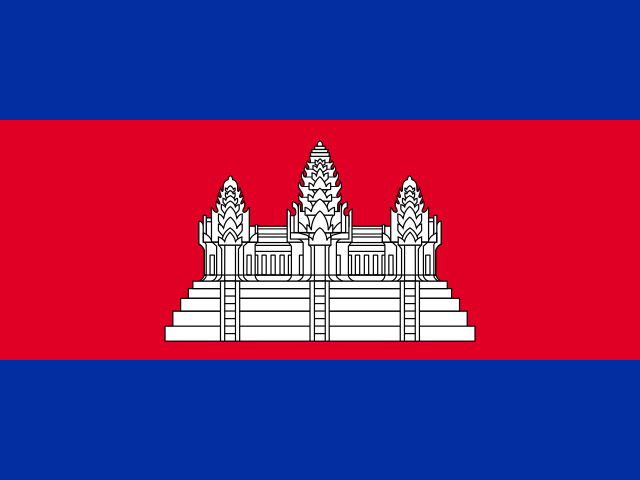
The Flag of Cambodia
Asia · Adopted 29 September 1993 (readoption of the 1948 design)
Cambodia's flag is unique among all current national flags in one specific respect: it is the only one to depict a real building — Angkor Wat, the 12th-century Khmer temple complex, rendered in white silhouette on a red band across the center of a blue-red-blue horizontal tricolor. The current version was readopted on 29 September 1993 when the Kingdom of Cambodia was reestablished as a constitutional monarchy after the UN-supervised transitional period that followed the Khmer Rouge era and the 1980s Vietnamese-backed government, but the underlying design — Angkor Wat on a blue-red-blue field — dates back to 1948, under the Kingdom of Cambodia's earlier monarchy before independence from France in 1953.
Between 1948 and 1993, the flag was changed repeatedly as Cambodia's government changed violently and often: the Khmer Republic (1970–1975) removed Angkor Wat in favor of a three-towered temple silhouette on a different color scheme; the Khmer Rouge's Democratic Kampuchea (1975–1979) flew a plain red flag with a simplified yellow three-towered temple, stripped of the elaborate detail of the earlier design as part of the regime's broader erasure of pre-revolutionary Cambodian institutions; and the Vietnamese-installed People's Republic of Kampuchea (1979–1989) and later State of Cambodia (1989–1993) used their own red-and-blue variants with a yellow temple silhouette. The return to the pre-1970 monarchy's blue-red-blue Angkor Wat design in 1993 was a deliberate act of restoring continuity with the pre-conflict kingdom after two decades of civil war, genocide, and foreign occupation.
Angkor Wat itself, built in the early 12th century under King Suryavarman II originally as a Hindu temple dedicated to Vishnu before later being converted to Buddhist use, is the largest religious monument in the world by land area and remains the most internationally recognized symbol of Khmer civilization's medieval peak — its inclusion on the flag ties the modern Cambodian state directly and literally to that historical high point rather than to any more recent or abstract national symbol.
Blue on Cambodia's flag is generally explained as representing the monarchy (and, more broadly, liberty and prosperity), while red represents the nation and, in some accounts, the courage of the Khmer people — a fairly standard pairing of colors for a constitutional monarchy's flag, though the specific combination with the temple depiction is what makes Cambodia's flag distinctive rather than the color symbolism alone.
Cambodia's flag law, reaffirmed with the 1993 constitution, sets the flag's 2:3 ratio and specifies the exact rendering of Angkor Wat's silhouette — the temple's five towers must be shown accurately rather than simplified, distinguishing the current design from the cruder single- or three-tower silhouettes used by the various mid-20th-century governments.
Because no other country depicts an actual named building on its national flag, Cambodia's flag has no genuine look-alikes among current national flags on that specific basis, even though its blue-red-blue color scheme alone might loosely echo other tricolors.
The 1948 design itself was not invented from nothing: earlier Cambodian royal and protectorate-era flags under French rule had already experimented with depicting Angkor Wat, including a version used from around 1863 that placed a simpler temple silhouette on a plain field as a French-approved emblem for the protectorate, so the modern flag continues a decades-older habit of using the temple as Cambodia's visual shorthand rather than introducing the idea in 1948 for the first time.
Angkor Wat's five towers, arranged with one taller central tower surrounded by four slightly lower corner towers in a quincunx pattern, are meant architecturally to represent Mount Meru, the sacred five-peaked mountain of both Hindu and Buddhist cosmology and the mythical home of the gods — meaning the flag's central image carries a layer of religious-cosmological symbolism well beyond simply depicting a famous landmark, a detail that distinguishes it from flags that use buildings or monuments as purely secular national emblems.
The Khmer Rouge period's stripped-down single-tower version, flown from 1976 under the renamed 'Democratic Kampuchea,' remains one of the starkest examples in modern vexillology of a national flag being deliberately simplified as an act of ideological rupture — the regime's broader Year Zero program sought to erase Cambodia's monarchic and religious past, and reducing Angkor Wat from five detailed towers to one crude silhouette on the flag mirrored that same erasure at the level of national symbolism.
Cambodia's National Flag Day is not separately marked, but the flag is prominently displayed each 9 November for Independence Day, commemorating the 1953 end of French colonial rule, and again each 29 September to mark the 1993 restoration of the monarchy and the current flag — meaning Cambodians observe two distinct annual occasions tied to the flag's two most significant historical moments rather than a single combined holiday.
Angkor Wat's shift in religious use from Hindu to Buddhist temple over the centuries following its 12th-century construction mirrors Cambodia's own broader religious history: the Khmer Empire that built it was heavily influenced by Hindu cosmology imported through Indian trade contact, and the temple complex only gradually became a Theravada Buddhist site as that religion spread through mainland Southeast Asia from around the 13th and 14th centuries onward, meaning the building depicted on the modern flag has itself changed religious identity once already, long before Cambodia's 20th-century political upheavals began.
King Norodom Sihamoni, who has reigned since 2004, presides over ceremonies that pair the national flag with the Cambodian monarchy's own royal standard, and the country's constitutional monarchy — restored in 1993 under UN supervision following the 1991 Paris Peace Accords that ended decades of civil conflict — remains one of the few in Southeast Asia alongside Thailand and Brunei, giving the flag's blue bands a continuing institutional referent in a region where several other former monarchies were abolished outright during the 20th century.
Five towers, drawn accurately
- High-resolution printed flag — The page says the temple silhouette must show its towers accurately rather than as an approximation, which makes the tower count something you can check in the listing photograph.
As an Amazon Associate we earn from qualifying purchases made through these links, at no extra cost to you.
Cambodia at a glance
- Capital
- Phnom Penh
- Population
- 17.4 million (2024)
- Currency
- Cambodian Riel (KHR)
- Language(s)
- Khmer (official)
Population figure as of 2024, source: UN World Population Prospects (2024 revision). See methodology for how facts are sourced and kept current.