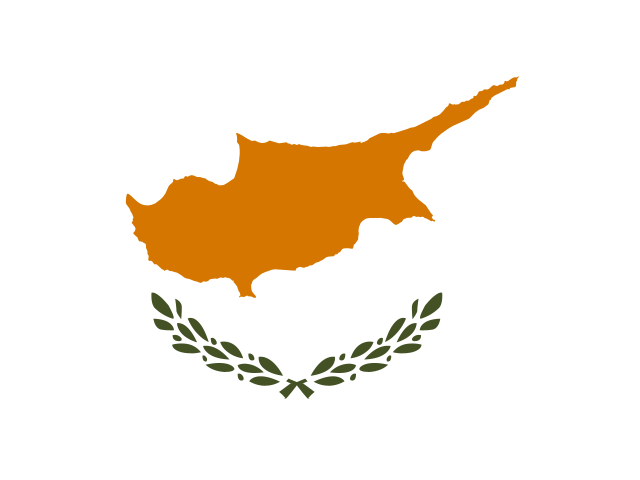
The Flag of Cyprus
Asia · Adopted 16 August 1960
Cyprus's flag was adopted on 16 August 1960, the day the Republic of Cyprus became independent from Britain, and it is one of the few national flags in the world to depict a silhouette of the country's own territory — a copper-colored map of the island of Cyprus sits centered on a white field, with two olive branches crossed beneath it. The design was the deliberate result of a specific political problem: Cyprus's population was, and remains, divided between a Greek Cypriot majority and a Turkish Cypriot minority, and the 1960 independence constitution required a flag that referenced neither the Greek nor the Turkish national flag, since either choice risked signaling that the new state belonged to one community rather than both.
That constraint is why Cyprus's flag avoids the blue and white of Greece or the red and white crescent-and-star of Turkey entirely, opting instead for white (for peace) and a copper-orange color chosen specifically because copper has been mined on Cyprus since antiquity and the island's very name is widely believed to derive from the Latin word for copper, cuprum, itself possibly derived from the island's ancient reputation as a copper source — making the flag's central color a reference to the land's own geology and economic history rather than to either ethnic community's national symbols.
The two crossed olive branches beneath the map represent peace between the island's Greek and Turkish Cypriot communities, an aspiration that has been tested repeatedly and painfully since 1960: intercommunal violence broke out within a few years of independence, and a 1974 Greek-Cypriot coup backed by the military junta then ruling Greece triggered a Turkish military invasion and occupation of the island's northern third, which remains divided by a UN buffer zone today, with the self-declared Turkish Republic of Northern Cyprus (recognized only by Turkey) governing the north under its own separate flag, a red-and-white design closely modeled on Turkey's.
Because the 1960 flag was designed to be scrupulously neutral, it is used relatively rarely by ordinary Greek Cypriots in everyday nationalist display compared to how flags typically function elsewhere; Greek Cypriots have historically been more likely to fly the flag of Greece itself alongside or instead of the Cyprus flag at nationalist gatherings, a pattern that reflects the island's complicated relationship between Cypriot state identity and Greek ethnic identity.
The flag's construction specifications, formalized in the 1960 constitution alongside the rest of Cyprus's founding legal architecture, fix a precise silhouette of the island (deliberately simplified from the coastline's actual complexity for clean reproduction at small sizes) and a specific Pantone-equivalent copper-orange shade, along with a 2:3 ratio, and this design has not been altered since independence despite the island's profound political division after 1974.
Cyprus's flag has no close design look-alikes among world flags — the combination of a white field, a national territorial map, and crossed olive branches is unique to Cyprus, though the self-declared Turkish Republic of Northern Cyprus's flag is sometimes mistaken at a glance for Turkey's own flag rather than for the Republic of Cyprus's, given how closely it mirrors Turkey's red-and-white crescent-and-star design.
Choosing the map itself was not a simple matter in 1960: the independence negotiations, conducted at talks in Zurich and London between Britain, Greece, and Turkey along with Greek Cypriot and Turkish Cypriot representatives, considered and rejected several alternative designs before settling on the neutral map-and-branches concept, and the specific copper-orange shade was reportedly chosen over earlier proposals for a more golden yellow specifically to avoid any resemblance to flags associated with either community's patron nation.
The flag's neutrality was written directly into the 1960 constitution's founding treaties, the Treaty of Guarantee and Treaty of Establishment, which named Britain, Greece, and Turkey as guarantor powers responsible for upholding Cyprus's independence and the constitutional balance between its two communities — an arrangement that, in practice, gave Turkey a legal argument for the 1974 invasion, since Ankara justified the intervention partly by invoking its role as a guarantor power responding to the anti-government coup rather than treating it purely as a war of conquest.
Cyprus joined the European Union in 2004, but only the internationally recognized Republic of Cyprus's government in the island's south is an EU member in practice; EU law is formally suspended in the north under the terms of accession, meaning Cyprus's flag flies over EU institutions in Brussels and Strasbourg for a state whose own government does not control roughly a third of the territory shown on its own flag's central map.
Because the flag was designed to represent shared statehood rather than either community individually, it is one of relatively few national flags in the world with an official reduced or simplified version approved for specific practical uses — a plainer rendering of the map without fine coastal detail is permitted for small-scale printing, distinguishing it from flags whose every version must reproduce full geographic accuracy regardless of size.
Cyprus's ancient copper mining industry that inspired the flag's central color was significant enough in the classical world that archaeologists have traced organized extraction and smelting on the island back to at least the Late Bronze Age, roughly the second millennium BCE, with copper ingots of Cypriot origin found in shipwrecks and trading sites across the eastern Mediterranean; commercial mining continued intermittently into the 20th century before largely winding down, meaning the flag's defining color references an industry that had already been central to the island's identity for more than three thousand years before independence.
An island outline that must be right
- Detail-accurate printed flag — This is one of very few flags carrying a map, and the outline is a simplified but specified silhouette, so a flag whose coastline wanders is simply wrong in a way a stripe never is.
As an Amazon Associate we earn from qualifying purchases made through these links, at no extra cost to you.
Cyprus at a glance
- Capital
- Nicosia
- Population
- 1.36 million (2024)
- Currency
- Euro (EUR)
- Language(s)
- Greek and Turkish (official)
Population figure as of 2024, source: UN World Population Prospects (2024 revision). See methodology for how facts are sourced and kept current.