The Flag of Dominica
North America · Adopted 3 November 1978 (star count revised 1990 and 1988)
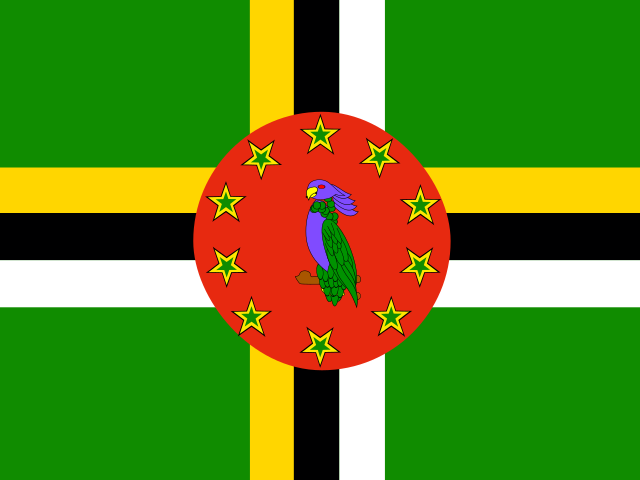
Dominica adopted its flag on 3 November 1978, the day it achieved full independence from Britain, based on a design credited to the artist Alwin Bully working from a concept by the country's independence committee. It replaced the colonial ensign that had flown over the island, and unlike many of its Eastern Caribbean neighbors, Dominica chose green as its flag's dominant field color from the outset — a deliberate reference to the island's exceptionally dense rainforest cover, which remains more extensive and less developed than on most other Caribbean islands and is central to how Dominicans describe their own national identity, marketed today as 'the Nature Island of the Caribbean.'
Centered on the green field is a cross of three stripes — yellow, black, and white — running both horizontally and vertically, a Christian cross whose three colors carry specific meanings: yellow for the sun and for the island's Carib/Kalinago and other indigenous heritage along with the fruits of the earth, black for the rich soil and for the island's African heritage, and white for the rivers and waterfalls that give Dominica its Kalinago name, Wai'tu kubuli, meaning 'tall is her body,' and for purity and unity among Dominica's diverse population.
At the center of the cross sits a red disc bearing a Sisserou parrot, Dominica's national bird and an animal found nowhere else on Earth outside Dominica's mountainous interior rainforest — an endangered species whose inclusion makes Dominica's flag one of a very small number of national flags worldwide to feature a specific, real, non-heraldic animal species native uniquely to that country rather than a stylized or generic creature. Ten green five-pointed stars, arranged in a circle around the parrot, represent Dominica's ten parishes.
Dominica's flag holds a genuinely rare distinction among the world's national flags: it is one of the very few to use purple, appearing in the plumage detail of the Sisserou parrot depicted on the central disc, a color almost entirely absent from national flag palettes worldwide because purple dye was historically expensive and rare, and most flag traditions settled on primary colors and simple heraldic tinctures centuries before purple became cheap to reproduce.
The flag underwent two revisions after its 1978 adoption: in 1988 the shade of the parrot and disc artwork was refined, and in 1990 the ten stars were more precisely standardized in size and arrangement, but the core design — the green field, colored cross, and central parrot disc — has remained unchanged since independence.
Because the green-field-with-cross design is genuinely uncommon worldwide, Dominica's flag has few close look-alikes among sovereign nations, and its combination of a real endangered native species and one of the only uses of purple on any national flag makes it one of the more distinctive designs in the entire Caribbean region, despite Dominica being one of the smallest and least populous countries in the hemisphere.
The flag is flown prominently during Dominica's Independence Day celebrations on 3 November, and the Sisserou parrot's near-extinction — its population was reduced further by Hurricane Maria in 2017, which devastated much of the island's forest habitat — has given the flag's central emblem an added layer of urgency in national conservation messaging in recent years.
Alwin Bully, credited with the flag's artistic execution, was a broader cultural figure in Dominican and wider Caribbean arts, later working in theater, broadcasting, and regional cultural administration across the Eastern Caribbean; his involvement in the flag's design is part of a wider pattern in which several of the era's Eastern Caribbean flags were produced by artists who were also active in other areas of national cultural life rather than by specialist heraldic designers.
The choice of green as the dominant field color set Dominica apart at the moment of independence from several of its Eastern Caribbean neighbors, most of which opted for blue fields referencing the surrounding sea; Dominica's decision to lead with its rainforest instead reflected the island's genuinely different geography — Dominica is more mountainous and far less developed for tourism and agriculture than islands like Antigua or Barbados, and its government has since built an explicit 'Nature Island' national brand around exactly the ecological features the flag foregrounds.
Population estimates for the wild Sisserou parrot have fluctuated sharply over recent decades, falling as low as a few hundred birds after Hurricane David in 1979 stripped large areas of forest canopy, recovering over subsequent decades of conservation effort, and then facing renewed pressure after Hurricane Maria's 2017 destruction of Dominica's interior forest — making the bird depicted on the flag one of the more genuinely endangered species featured on any national flag in the world, its survival directly tied to the same hurricane risk that has repeatedly battered the capital and the country as a whole.
Dominica's full official name, the Commonwealth of Dominica, is sometimes confused internationally with the much larger, unrelated Dominican Republic, a mix-up rooted in the two countries sharing a name derived independently from the Latin word for Sunday — Columbus reportedly sighted the island of Dominica on a Sunday in November 1493, giving it its name, while the Dominican Republic's name instead traces to the Dominican religious order — and Dominican officials have periodically raised the naming confusion as a genuine practical issue for mail, trade, and tourism despite the flags themselves looking nothing alike.
Counting the stars around the parrot
- Detail-accurate printed flag — The star count around the central disc has been revised more than once, so older stock can carry the wrong number; count the stars in the listing photograph before buying.
As an Amazon Associate we earn from qualifying purchases made through these links, at no extra cost to you.
Dominica at a glance
- Capital
- Roseau
- Population
- 73,000 (2024)
- Currency
- Eastern Caribbean Dollar (XCD)
- Language(s)
- English (official); Dominican Creole French widely spoken
Population figure as of 2024, source: UN World Population Prospects (2024 revision). See methodology for how facts are sourced and kept current.