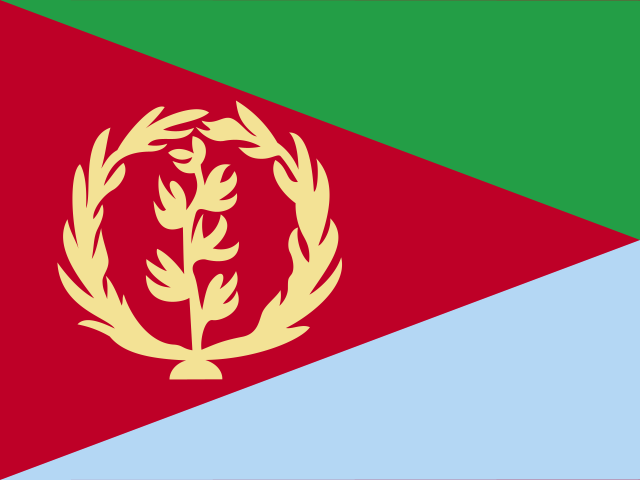
The Flag of Eritrea
Africa · Adopted 5 December 1995 (green and blue fields introduced 1993, current gold-emblem version fixed 1995)
Eritrea's flag is built directly on the banner flown by the Eritrean People's Liberation Front (EPLF) during its three-decade armed struggle for independence from Ethiopia, a war that ran from 1961 to 1991 and stands among the longest independence conflicts in modern African history. A red isosceles triangle, point toward the fly, splits a green upper triangle from a blue lower triangle, with a gold olive-branch wreath — encircling a vertical olive branch — centered on the red.
The design deliberately keeps continuity with an earlier flag: Eritrea's first flag as an autonomous federated territory under Ethiopia, adopted in 1952 under a UN-brokered federation arrangement, was light blue with a gold olive wreath — the same wreath motif that survives on today's flag, tracing back further still to the flag the United Nations itself flew, since the wreath was originally meant to signal Eritrea's UN-sponsored path to self-government before Ethiopia's Haile Selassie unilaterally annexed the territory outright in 1962, the act that triggered the war of independence.
Green represents Eritrea's agricultural wealth and the fertile western lowlands where much of the country's farming takes place; blue represents the Red Sea and Eritrea's roughly 1,000 kilometers of coastline, an unusually long shoreline for a country of its size and a resource central to national identity given how central the war for that coastline's control ultimately was; red represents the blood shed during the independence struggle, an especially weighty color given the war's length and casualty toll, with estimates of the dead on both sides running into the tens of thousands over three decades of fighting.
The gold olive wreath around a vertical branch is a direct descendant of the UN's own 1952 federation-era flag design and, more distantly, echoes the olive branch on the United Nations' own emblem — an unusual case of a national flag's central symbol tracing its lineage to an international organization's own iconography rather than to indigenous or religious tradition.
Eritrea formally adopted its independence flag on 24 May 1993, the day it celebrated a year since its UN-supervised independence referendum, in which over 99% of voters backed separation from Ethiopia; the specific proportions and colors were codified further and legally fixed by a 5 December 1995 law that remains the flag's governing legal document today.
Eritrea's war of independence, and the flag that emerged from it, followed Ethiopia's Derg-era Marxist military government (1974–1991) fighting to retain Eritrea even as it simultaneously fought other internal insurgencies, until the EPLF and Ethiopia's own rebel Tigrayan People's Liberation Front toppled the Derg together in 1991 — after which Eritrea's independence proceeded via the 1993 referendum rather than further conflict, though relations between the two countries later deteriorated sharply into the brutal 1998–2000 Eritrean–Ethiopian border war.
Because Eritrea's flag uses green, and its neighbor Ethiopia's flag also uses green as part of the pan-African tricolor that Ethiopia itself originated, the two are occasionally mentioned together in casual comparison — but the resemblance is superficial: Ethiopia's flag is a horizontal green-yellow-red tricolor with a central blue disc and star, entirely different in layout and color balance from Eritrea's green-blue triangular split with a gold wreath.
Eritrea's flag law is notably strict by regional standards: the government maintains close control over flag manufacturing and display specifications, consistent with the ruling People's Front for Democracy and Justice's broader tight management of public symbols and messaging since independence — Eritrea has held no national elections since 1993 and is frequently described by international observers as one of the most tightly controlled media and civic environments in Africa, a political context that shapes how uniformly and formally the flag is displayed nationwide.
The red triangle's point toward the fly, rather than a simple vertical or horizontal division, was carried over specifically from the EPLF's wartime banner, and Eritrean government explanations tie that pointed geometry to the sense of forward momentum and struggle that defined the independence movement — a deliberate design choice distinguishing it from the simpler rectangular color-block flags flown by some other African liberation movements of the same era.
Independence Day, 24 May, marking the 1991 military end of the war (two years before the 1993 referendum formalized statehood), is the flag's most significant annual occasion, and the flag is also prominently displayed each 20 June, Martyrs' Day, commemorating the tens of thousands who died over three decades of conflict — a day treated with particular solemnity given how central the war's casualty toll is to the flag's own red-triangle symbolism.
The 1998–2000 border war with Ethiopia, fought largely over the town of Badme and other disputed frontier territory, killed tens of thousands more on both sides and left the two countries in a formal state of 'no war, no peace' for two decades, until a surprise 2018 peace agreement under Ethiopian Prime Minister Abiy Ahmed normalized relations — a rapprochement that briefly reopened land borders and direct flights before renewed regional tensions, including Eritrea's later involvement in Ethiopia's Tigray conflict, complicated the relationship again.
Eritrea's national service system, which conscripts citizens for open-ended, often indefinite periods, has been cited by the United Nations and human rights organizations as a major driver of the large-scale emigration that has sent hundreds of thousands of Eritreans abroad since the early 2000s — a demographic outflow that sits in tension with the flag's own wreath-and-unity symbolism, since so much of the population it claims to represent now lives outside the country's borders.
A wreath the size of a coin
- Embroidered-emblem flag — The gold wreath sits on the red triangle at a size where the individual leaves are a few threads wide. Embroidery or a high-resolution print keeps them distinct; a coarse screen turns the wreath into a ring.
As an Amazon Associate we earn from qualifying purchases made through these links, at no extra cost to you.
Eritrea at a glance
- Capital
- Asmara
- Population
- 3.7 million (2024)
- Currency
- Eritrean Nakfa (ERN)
- Language(s)
- Tigrinya, Arabic, and English used as working languages; no single official language declared
Population figure as of 2024, source: UN World Population Prospects (2024 revision). See methodology for how facts are sourced and kept current.