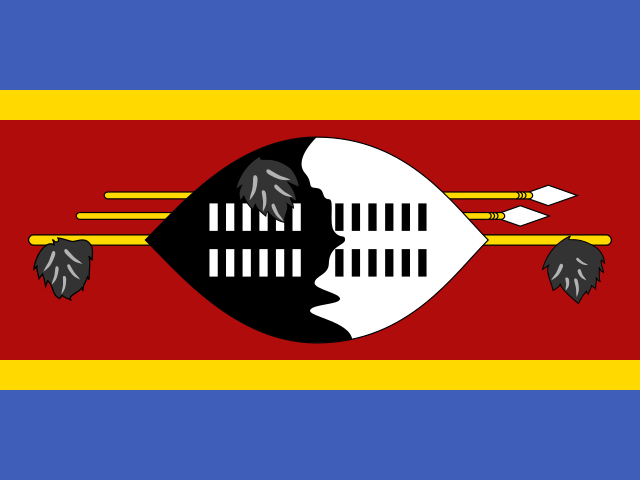
The Flag of Eswatini
Africa · Adopted 6 October 1968 (country renamed from Swaziland to Eswatini in 2018; flag unchanged)
Eswatini's flag was adopted on 6 October 1968, the day the country gained independence from Britain as Swaziland (the name it kept until King Mswati III renamed it Eswatini in 2018 to mark the 50th anniversary of independence and to shed a name he felt was too easily confused with Switzerland internationally — the flag itself was never altered in that renaming). Its design is unusual among African independence-era flags in that it is directly derived from a much older military banner rather than being invented fresh for statehood.
The flag's central image — a black-and-white Nguni shield laid horizontally over two spears and a 'fighting stick' or staff decorated with feather tassels — descends from a banner presented by King Sobhuza II in 1941 to the Swazi Pioneer Corps, a unit of Swazi volunteers who served with British forces during the Second World War. That WWII-era regimental banner, not any pre-colonial national symbol, is the direct visual ancestor of the flag Eswatini still flies today, a lineage the country traces explicitly and proudly rather than treating as incidental.
The flag's five horizontal bands run blue, yellow (narrow), red (wide, carrying the shield and spears), yellow (narrow), and blue again. Blue represents peace and stability; the wide central red band represents past battles and struggles, including colonial-era conflicts; yellow represents the mineral wealth of the kingdom's land. The black-and-white shield specifically is described in Swazi tradition as representing the unity of the country's Black and white populations living together, an unusually direct racial-harmony reading for a design element on an African national flag.
The shield itself is a specific type used in traditional Swazi royal and ceremonial contexts, decorated with tassels of the injobo bird feather (a bird whose feathers only certain high-ranking individuals, including the king, are traditionally permitted to wear), and the two spears alongside it further reference traditional Swazi weaponry rather than any colonial-era or European heraldic tradition.
Eswatini's flag has remained visually unchanged for over five decades, a stability tied to the country's status as one of the world's last remaining absolute monarchies, where King Mswati III (reigning since 1986, following his father Sobhuza II who ruled from 1921 until his death in 1982) retains direct authority over the constitution and government appointments — political parties remain effectively banned from contesting general elections, and national symbols like the flag have not been subject to the kind of contested redesign debates seen in countries with more frequent shifts in ruling ideology.
The country's 2018 renaming from Swaziland to Eswatini (meaning 'land of the Swazis' in siSwati) was a rare case of a modern African monarchy asserting a name change purely on cultural-identity grounds, unconnected to any change of government or independence milestone, and it left every element of the flag itself — colors, shield, spears, staff — completely untouched.
The five-band structure is sometimes compared loosely to other African flags that also use blue-red-blue framing bands, but the shield-and-spears emblem at the center is specific enough to the 1941 Pioneer Corps banner that Eswatini's design is not usually placed in a direct look-alike pairing with any other country's flag the way, say, Chad and Romania's near-identical tricolors are.
The flag is flown with particular ceremony during Umhlanga, the annual Reed Dance held at Lobamba each August or September, and during Incwala, the kingship ritual that reaffirms the bond between the king and the nation — both events draw heavily on the same traditional Swazi royal and ceremonial vocabulary (shields, feathers, weapons) that the flag itself depicts, reinforcing the flag's design as an extension of living court ritual rather than a purely historical reference.
Eswatini's monarchy has faced periodic pro-democracy protests, notably a significant wave of unrest in 2021 in which demonstrators called for constitutional reform and multi-party elections; even amid that unrest, opposition activity did not extend to challenging the flag itself, which remains one of the few national symbols in the country accepted across the political divide between pro-monarchy and pro-democracy factions.
Because the shield-and-spear central emblem sits on a red band that itself is bordered by narrow yellow and then broader blue bands on both edges, the flag is markedly more complex in its internal structure than a simple horizontal tricolor, requiring more precise manufacturing specifications than plain-striped flags — a complexity in keeping with its origin as a detailed regimental banner rather than a flag designed from a blank slate for mass production.
Eswatini's Independence Day, 6 September, commemorates the 1968 transition from British protectorate status, while a separate annual observance, King's Birthday (celebrated around Mswati III's April birthday), gives the flag additional prominence tied directly to the monarchy rather than to the anti-colonial independence narrative that dominates flag ceremony in most other African states — a reflection of how thoroughly Eswatini's national symbolism, including the flag, remains bound up with the person of the reigning king rather than with a separate civic-nationalist tradition.
Eswatini's flag construction ratio is set at 2:3, and government regulations require the shield's black and white segments and the spears' proportions to match the original 1968 specifications precisely, preserving the exact heraldic detail of the 1941 Pioneer Corps banner rather than allowing simplified commercial reproductions to drift from the historical design over time.
Eswatini remains one of the smallest countries in Africa by both population and land area, landlocked between South Africa and Mozambique, and its flag's origin in a colonial-era military honor rather than an anti-colonial independence struggle sets it apart from most other African national flags, whose central symbolism more typically references resistance to or liberation from European rule rather than service alongside it.
Getting the shield proportions right
- Appliqued-emblem flag — The page says the black and white segments of the shield and the shaft proportions are held to the original specification, which is a level of accuracy a stitched applique holds and a stretched print does not.
As an Amazon Associate we earn from qualifying purchases made through these links, at no extra cost to you.
Eswatini at a glance
- Capital
- Mbabane
- Population
- 1.2 million (2024)
- Currency
- Swazi Lilangeni (SZL), alongside the South African Rand
- Language(s)
- siSwati and English (both official)
Population figure as of 2024, source: UN World Population Prospects (2024 revision). See methodology for how facts are sourced and kept current.