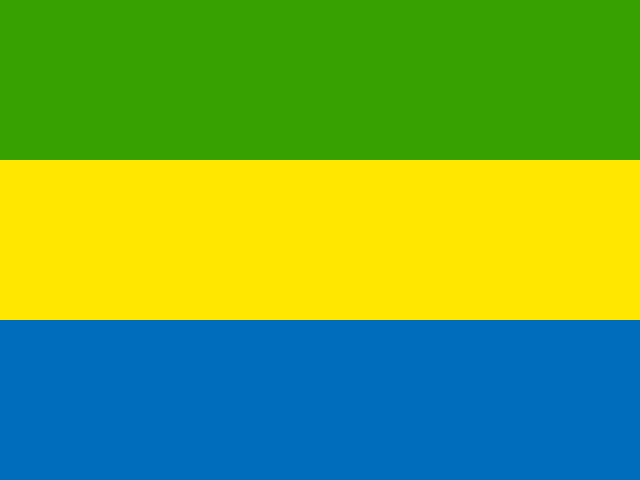
The Flag of Gabon
Africa · Adopted 9 August 1960
Gabon's flag — three equal horizontal bands of green, yellow, and blue — was adopted on 9 August 1960, a week before the country's formal independence from France on 17 August 1960, replacing the French tricolor with a defaced yellow-star canton that Gabon had briefly used as an autonomous republic within the French Community from 1959.
The colors are read straightforwardly against Gabon's own geography rather than against any pan-African or pan-colonial reference palette: green represents the country's dense equatorial rainforest, which covers roughly 85–90% of Gabon's land area, making it one of the most heavily forested countries on Earth relative to its size; yellow represents the sun and, specifically, Gabon's position straddling the Equator, which runs directly through the country; and blue represents the Atlantic Ocean along Gabon's coastline and the country's rivers, including the Ogooué, its principal waterway.
Unlike many neighboring former French colonies that adopted the green-yellow-red pan-African palette explicitly in homage to Ethiopia's independence-era flag, Gabon deliberately chose a different third color — blue instead of red — precisely to keep its flag visually distinct while still using a simple horizontal tricolor format common across the region at independence.
Gabon's flag has not been redesigned since 1960, a rare case of stability among Central African states many of which cycled through multiple flags tied to changes of regime; Gabon's own post-independence political history includes a single-party period under Omar Bongo, who ruled from 1967 until his death in 2009 (one of the longest tenures of any 20th-century African head of state) and was succeeded by his son Ali Bongo, whose own 2009–2023 rule ended in a 2023 military coup — through all of that, the flag itself remained untouched.
During its brief 1959–1960 period as an autonomous republic within the French Community, Gabon flew a version of this same tricolor defaced with a small yellow star in the canton; that star was dropped when full independence was declared in August 1960, leaving the plain three-band tricolor that has flown ever since.
Within Central Africa, Gabon's plain green-yellow-blue tricolor sets it apart from most of its immediate neighbors, nearly all of which use the pan-African red-yellow-green combination in some arrangement — the Republic of the Congo, Cameroon, and the Central African Republic all incorporate red where Gabon uses blue, making Gabon's flag one of the easiest in the region to distinguish at a glance precisely because it declined to follow the regional pan-African trend.
Gabon's low population relative to its land area and its oil wealth (the country has been a significant oil exporter since the 1970s) have made it one of the wealthier nations per capita in continental Africa, a relative prosperity that has coexisted, as in Equatorial Guinea, with a long run of concentrated political power — a backdrop against which the flag's unbroken 1960 design stands out as one of the more stable elements of Gabonese national symbolism.
The August 2023 coup that removed Ali Bongo from power, ending 56 consecutive years of Bongo family rule, was followed by the military transitional government's decision to keep the existing flag entirely intact even while overhauling other state symbols and institutions — a notable contrast with several other African post-coup governments that have used a change of regime as an occasion to revisit national symbols.
Gabon's Independence Day, 17 August, remains the flag's central annual occasion, and the flag is also flown prominently around Libreville's Léon Mba Boulevard and other sites connected to the country's founding president, whose 1960s tenure oversaw the flag's original adoption alongside the rest of Gabon's independence-era state apparatus.
Gabon's forests, the largest share of which are protected within a network of thirteen national parks established in 2002 under Omar Bongo — an unusually aggressive conservation commitment for an oil-dependent economy, covering roughly 11% of the country's total land area — give the flag's green band a literal, still-current backing rather than a purely historical or symbolic reference; Gabon remains one of the few tropical nations to have retained the overwhelming majority of its original forest cover into the 21st century.
Because Gabon straddles the Equator almost exactly at its geographic center, with the line passing near the town of Ntoum not far from Libreville, the flag's yellow band carries a specificity many countries' 'sun' symbolism lacks elsewhere — Gabonese civic material regularly ties the color directly to the country's literal equatorial position rather than treating 'sun' as an abstract, interchangeable reference the way some other flags' yellow bands are explained.
The country's constitution designates the flag's exact specifications, including the precise 3:4 height-to-width ratio used for Gabon's flag, a proportion narrower than the 2:3 ratio common on many other African national flags, giving Gabon's flag a visibly more square silhouette when flown alongside its regional neighbors.
Gabon's small population relative to its neighbors — well under three million people across a land area comparable to the United Kingdom — has meant the flag flies over one of the least densely populated countries in mainland Africa, a demographic fact directly tied to the same rainforest cover the flag's green band represents, since dense equatorial forest across most of the interior has historically limited large-scale settlement outside the coastal and riverine corridors, concentrating most Gabonese citizens in Libreville and a handful of secondary towns such as Port-Gentil, Franceville, and Lambaréné rather than spreading them evenly across the country's vast, sparsely settled national territory.
Why 3:4 is not a stock size
- Flag cut to a 3:4 ratio — Three equal horizontal bands only stay equal if the height is right, and at 3:4 this flag is visibly squarer than the 2:3 most listings assume. Sellers who state the ratio are the ones cutting it properly.
As an Amazon Associate we earn from qualifying purchases made through these links, at no extra cost to you.
Gabon at a glance
- Capital
- Libreville
- Population
- 2.4 million (2024)
- Currency
- Central African CFA Franc (XAF)
- Language(s)
- French (official); Fang, Myene, and other Bantu languages widely spoken
Population figure as of 2024, source: UN World Population Prospects (2024 revision). See methodology for how facts are sourced and kept current.