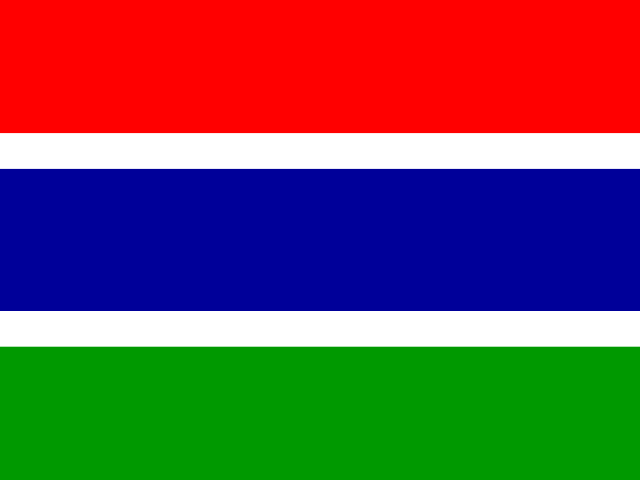
The Flag of Gambia
Africa · Adopted 18 February 1965
The Gambia's flag was adopted on 18 February 1965, the exact day of independence from Britain, and its designer, Louis Thomasi, is credited with a color scheme built specifically to work in black-and-white printing as well as color — a practical design constraint from an era when much official and news documentation was still monochrome, and one that shaped the choice of red, blue, and green bands separated by thin white fimbriations rather than colors that might blur together without white borders between them.
Red, blue, and green run horizontally with narrow white stripes separating each band. Red at the top represents the sun and the savanna to the north of the Gambia River; the blue center band represents the Gambia River itself, the country's defining geographic feature, since the nation is essentially a narrow strip of territory following the river's course through Senegal; and green at the bottom represents the forests and agricultural land along the river's banks and to the south. The white fimbriations stand for peace and unity.
The Gambia's shape and flag are both direct products of the same 19th-century colonial-boundary history: British and French colonial negotiators drew The Gambia's borders to hug roughly 15 kilometers on either side of the Gambia River for its navigable length, carving a narrow country almost entirely surrounded by Senegal, and the flag's central blue river-stripe is a rare case of a national flag encoding the literal shape and defining feature of the country's own borders rather than an abstract symbol.
Notably, The Gambia deliberately avoided using either the pan-African green-yellow-red palette common among neighboring former French colonies or any explicitly religious symbol, despite the country's majority-Muslim population — a choice that set it apart from several regional neighbors at independence and was consistent with founding president Dawda Jawara's stated preference for a secular national identity.
The flag briefly took on additional political weight during The Gambia's 1981 attempted coup, when Senegalese troops intervened to restore Jawara's government under a mutual defense arrangement that subsequently led to the short-lived Senegambia Confederation (1982–1989), a failed attempt at closer union between the two countries that would have made The Gambia's encirclement by Senegal a matter of formal political union rather than just geography — the confederation dissolved in 1989 without the flag itself being affected.
The Gambia's flag has remained unchanged since 1965, surviving both the long rule of Jawara (1965–1994) and the subsequent 22-year rule of Yahya Jammeh (1994–2017), whose government came to power in a coup but did not alter the national flag despite renaming other national institutions and symbols during his tenure.
The specific color sequence and the narrow white separating stripes make The Gambia's flag visually distinct from other West African tricolors, including those of its immediate neighbor and near-total encircler Senegal, which uses the unrelated green-yellow-red pan-African palette arranged in vertical stripes with a central star rather than horizontal bands with fimbriations.
Because The Gambia is almost entirely surrounded by Senegal on three sides, sharing one of the longest and most convoluted land borders in Africa relative to the small size of the enclosed country, the flag's blue river-stripe running the full width of the design functions almost like a geographic signature — a visual shorthand for the one continuous physical feature that gives The Gambia's oddly shaped, elongated borders their logic.
The country's official name retains the definite article 'The' specifically to avoid confusion with Zambia in written and spoken English, a naming quirk unrelated to the flag itself but frequently mentioned alongside it in reference material, since 'Gambia' and 'Zambia' are visually and phonetically close enough that the distinguishing article was adopted as official government style at independence.
The Gambia's flag flies over one of Africa's smallest mainland countries by area, and its river-centered symbolism has taken on additional resonance as the Gambia River corridor has become increasingly central to the national tourism industry, with river cruises and birdwatching along the same waterway the flag's blue band represents drawing a meaningful share of the country's visitors.
Independence Day, 18 February, is marked nationwide with the flag displayed prominently along Banjul's Independence Drive and at the Arch 22 monument, built in 1996 to commemorate Yahya Jammeh's 1994 coup — meaning the country's most visible flag-flying monument was actually erected to honor the very government that later ruled for over two decades under this same unaltered 1965 design.
The Gambia briefly withdrew from the Commonwealth of Nations in 2013 under Jammeh, who called it 'a neo-colonial institution,' before the country rejoined in 2018 following Jammeh's own 2017 election defeat and subsequent exile — a reversal that, unlike the flag itself, marked a genuine and visible shift in the country's formal international alignment even though it left the national symbols untouched.
The Gambia's flag is manufactured to a standard 2:3 ratio, and the country's National Assembly retains formal authority to alter it by ordinary legislation rather than requiring a constitutional amendment, though no government since 1965 — spanning Jawara's, Jammeh's, and current president Adama Barrow's administrations — has moved to change any element of the original 1965 design.
Jammeh's rule ended in dramatic fashion in early 2017, when he initially refused to accept his election defeat to Barrow and only left office after neighboring West African states, under an ECOWAS-mandated intervention led largely by Senegalese troops, moved forces to the border to enforce the result — a peaceful transition ultimately achieved without triggering the kind of prolonged conflict that has affected national symbols and flags elsewhere on the continent.
Keeping the white lines thin
- Sewn-stripe flag — The two narrow white separators are what distinguish this flag from its neighbours' tricolours, and a stitched flag holds a thin band at its stated width where a print lets the dye creep.
As an Amazon Associate we earn from qualifying purchases made through these links, at no extra cost to you.
Gambia at a glance
- Capital
- Banjul
- Population
- 2.8 million (2024)
- Currency
- Gambian Dalasi (GMD)
- Language(s)
- English (official); Mandinka, Wolof, and Fula widely spoken
Population figure as of 2024, source: UN World Population Prospects (2024 revision). See methodology for how facts are sourced and kept current.