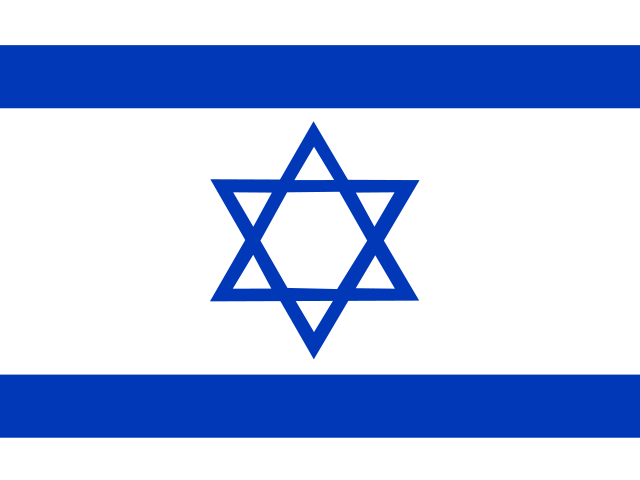
The Flag of Israel
Asia · Adopted 28 October 1948
Israel's flag — a white field with two horizontal blue stripes near the top and bottom edges and a blue six-pointed Star of David centered between them — was formally adopted by the Provisional Council of State on 28 October 1948, less than six months after the country declared independence, but its design predates the state by more than half a century.
The pattern traces directly to a flag designed for the Zionist movement around 1891 by Zionist activists in Boston, popularized more widely after being flown at the First Zionist Congress in Basel in 1897, and consciously modeled on the tallit, the white prayer shawl with blue stripes traditionally worn by observant Jews during prayer. Using a religious garment's coloring as the basis for a national flag was a deliberate choice by early Zionist organizers to root the new movement's symbolism in a shared, recognizable Jewish visual tradition rather than inventing something unconnected to it.
The Star of David — known in Hebrew as the Magen David, 'Shield of David' — had circulated as a general Jewish symbol for centuries before it was attached to this specific flag design, appearing on synagogues and Jewish communal seals in medieval and early modern Europe long before any organized national movement adopted it; its use on the flag formalized what had already become the most widely recognized emblem of Jewish identity by the late 19th century.
Between 1897 and 1948, versions of this blue-and-white design were flown informally by Zionist organizations, Jewish community groups in Mandatory Palestine, and eventually the Jewish Brigade that fought alongside British forces in World War II, so by the time Israel's Provisional Council formally adopted it as the state flag, the design was already deeply familiar rather than newly introduced.
The flag has not been redesigned since 1948; Israeli law fixes its proportions, the exact placement of the star between the stripes, and the shade of blue, though the specific blue has in practice varied somewhat across manufactured flags over the decades without triggering a formal legal change.
Jerusalem's status as Israel's capital is a genuinely disputed matter in international law and diplomacy rather than a settled fact presented the same way everywhere: Israel has treated Jerusalem as its capital since 1950, but the city's final status, including the division between West and East Jerusalem, remains contested, and most countries historically maintained their diplomatic missions in the coastal city of Tel Aviv rather than in Jerusalem, a long-standing norm the U.S. broke in 2018 by relocating its own mission.
Because the Star of David is such a widely recognized standalone Jewish symbol, it appears occasionally on unofficial or historical Jewish community flags elsewhere, but no other current national flag combines a six-pointed star with the specific blue-white tallit-derived stripe pattern, which keeps Israel's flag distinct from any other country's at a glance despite the star shape itself not being unique to this one flag.
The flag's precise legal specification came slightly after its initial 1948 adoption: Israel's Flag and Emblem Law, passed in 1949, set the official 8:11 ratio and formalized the exact placement of the stripes and star, cleaning up minor inconsistencies that had crept into flags produced informally by different Zionist organizations before statehood.
The flag has occasionally been a point of internal debate within Israel itself, including among some Haredi (ultra-Orthodox) communities that have historically been ambivalent or opposed to Zionism as a movement and, in a minority of cases, decline to display the state flag on religious-ideological grounds — a domestic nuance distinct from, and separate from, the flag's more widely known role in the broader Israeli-Palestinian conflict.
David Wolffsohn, a businessman and later the second president of the World Zionist Organization, is widely credited with proposing the blue-and-white tallit-based design around 1897 for use at the First Zionist Congress, reportedly reasoning that Jews already had a flag in a sense — the prayer shawl — and that the movement simply needed to formalize it, a account repeated often enough in Israeli civic education to function as the standard origin story even though, as with many symbols adopted collectively by a movement rather than issued by a single government decree, competing early design proposals also existed at the time.
The Israel Defense Forces uses its own distinct set of unit and corps flags and insignia rather than a modified version of the national flag for combat purposes, unlike some countries that field a separate military ensign; the plain civilian national flag itself is what is raised at IDF bases and ceremonies, keeping military and civilian flag use closely aligned rather than legally separate as in Japan's naval-ensign arrangement.
Israel's national holiday most closely tied to the flag is Yom Ha'atzmaut, Independence Day, observed on the Hebrew calendar date corresponding to 5 Iyar and falling on a different Gregorian date each year, when flags are flown in especially large numbers from apartment balconies, cars, and public buildings across the country, a display pattern that has become one of the most visually distinctive annual civic customs associated with the flag.
Israeli flag manufacturers and civic organizations distribute large quantities of flags ahead of Independence Day specifically for this balcony- and car-flying custom, a relatively recent but now well-entrenched tradition that developed gradually over the decades after 1948 rather than being written into the original 1949 Flag and Emblem Law itself, which addressed proportions and official use rather than popular display customs.
The Jewish Agency and earlier Zionist organizations had also experimented with other blue-and-white flag variants bearing different symbols before the tallit-and-star design became dominant, including versions using a menorah or other Jewish symbols instead of the Star of David, but none achieved the same widespread adoption across Zionist communities that the Wolffsohn-associated design did by the time of the 1948 declaration.
Israel at a glance
- Capital
- Jerusalem
- Population
- 9.9 million (2024)
- Currency
- Israeli New Shekel (ILS)
- Language(s)
- Hebrew (official); Arabic holds special status
Population figure as of 2024, source: UN World Population Prospects (2024 revision). See methodology for how facts are sourced and kept current.