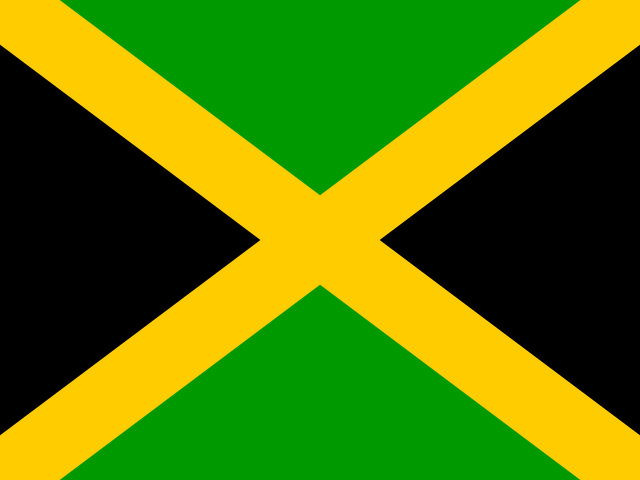
The Flag of Jamaica
North America · Adopted 6 August 1962
Jamaica's flag was adopted on 6 August 1962, the day the island became independent from Britain, and it replaced the Union Jack, which had flown over the colony since England seized Jamaica from Spain in 1655. A parliamentary committee designed the new flag specifically to avoid the colors most associated with the recently dissolved West Indies Federation, whose blue-and-white design Jamaica had flown briefly as a federation member before withdrawing in 1961, a political break that Jamaica's flag committee was explicitly conscious of when it chose an entirely different palette for the independent nation's own symbol.
The result — a gold diagonal cross (saltire) dividing a field of black and green — is often cited as the only national flag in the world that contains none of the three colors most common across all flags globally: red, white, and blue. That claim holds up: Jamaica's flag really is built entirely from gold, black, and green, with no trace of any of the big three, a genuinely unusual palette choice that sets it apart from the vast majority of the world's national flags at a glance.
The three colors were given an official, government-endorsed meaning at independence, often summarized in the phrase "hardships there are, but the land is green and the sun shineth": black represents the strength and creativity of the Jamaican people and a historical acknowledgment of hardship, including the legacy of slavery under British colonial rule; gold represents the natural wealth of the island and the sunlight it enjoys; and green represents the island's lush vegetation and hope for the future. This tripartite framing was written into the government's own independence-era explanatory material rather than assembled later by outside commentators.
The diagonal gold cross itself is a saltire, the same basic geometric structure as the crosses on the flags of Scotland or the pre-1801 Kingdom of Scotland, though Jamaica's use of the shape has no direct historical link to those flags — the choice was primarily a way to divide the black and green fields into four triangular sections (two black, two green) in a visually distinct pattern rather than a stripe or canton arrangement, distinguishing it sharply from the many former British Caribbean colonies that kept a Union Jack canton or a British-derived ensign design after independence.
Jamaica has kept this same design unaltered for over six decades now, a stability that stands in contrast to some other newly independent Caribbean states of the same era that adjusted their flags in the years following independence; the specific gold, black, and green combination and the saltire layout have remained legally fixed by the independence-era design specification throughout.
The flag carries particular resonance in Jamaica because its 1962 design deliberately broke from British colonial heraldic convention — no Union Jack canton, no British coat of arms worked into the field — at a moment when several other former British Caribbean territories retained more visibly British-derived designs; Jamaica's choice to build an entirely original geometric pattern in a palette shared with no colonial predecessor is frequently cited by Jamaican historians as a deliberate visual statement of a clean break.
The design process itself ran on a tight independence timetable: a bipartisan House of Representatives committee, working with input from a broader public design competition, needed to settle on a flag well before the formally scheduled 6 August 1962 independence date, and the black-gold-green saltire was reportedly finalized only after committee members rejected several earlier concepts that leaned more heavily on British heraldic conventions, including versions retaining a Union Jack canton in one corner, before settling on the fully original geometric pattern that became official.
Jamaica's national motto, "Out of Many, One People," adopted at the same 1962 independence moment as the flag, is frequently cited alongside the flag's own black-gold-green symbolism in Jamaican civic education as a paired statement of the new nation's identity — one visual, one verbal — reflecting the island's mixed African, European, Chinese, Indian, and Jewish heritage rather than descent from any single ethnic or colonial tradition, a framing that gives the flag's black band a broader reading than African heritage alone in some official contexts.
Jamaica's flag design was one of the last major decisions finalized ahead of independence, following the island's 1961 referendum in which Jamaican voters chose to withdraw from the West Indies Federation rather than remain in a wider Caribbean political union — a vote that effectively forced Jamaica to design an entirely independent set of national symbols on a compressed timeline of just over a year, rather than inheriting a federation-wide flag the way some proposed Caribbean union scenarios might otherwise have produced.
Jamaica's break from British heraldic convention in 1962 stands out even more clearly when set against Britain's own long colonial administration of the island, which had used a succession of official colonial badges depicting a pineapple, alligator, and the royal coat of arms across various 19th- and 20th-century versions of the colonial ensign — imagery entirely unrelated to the geometric, symbol-free abstraction Jamaica's independence-era flag committee ultimately chose, underscoring just how deliberate the pivot away from figurative colonial iconography toward pure color and shape really was.
Four triangles meeting at the centre
- Stitched saltire flag — A diagonal cross means four cut panels meeting at a single point in the middle, which is where a loosely made flag puckers and where the gold bands stop being even width.
As an Amazon Associate we earn from qualifying purchases made through these links, at no extra cost to you.
Jamaica at a glance
- Capital
- Kingston
- Population
- 2.8 million (2024)
- Currency
- Jamaican Dollar (JMD)
- Language(s)
- English (official); Jamaican Patois widely spoken
Population figure as of 2024, source: UN World Population Prospects (2024 revision). See methodology for how facts are sourced and kept current.