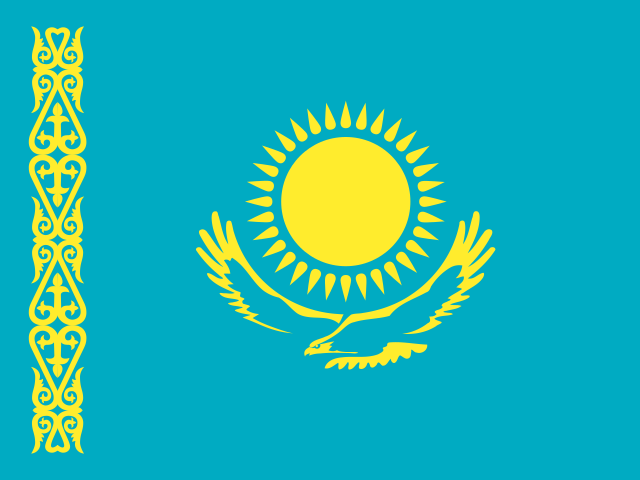
The Flag of Kazakhstan
Asia · Adopted 4 June 1992
Kazakhstan adopted its flag on 4 June 1992, about six months after declaring independence from the dissolving Soviet Union, replacing the Kazakh Soviet Socialist Republic's red-and-blue flag with a design built almost entirely around a sky-blue field, a design choice its own artist has described as a deliberate break from Soviet red toward a color with older, specifically Turkic and Central Asian associations.
The flag was designed by Kazakh artist Shaken Niyazbekov, whose winning submission beat out other entries in a national design competition held as the country moved toward independence. Niyazbekov later described choosing the blue specifically to evoke Tengrism, the sky-worship tradition of ancient Turkic and Mongolic steppe peoples in which a boundless blue sky represented unity, peace, and clarity — a symbolic register distinct from Islam despite Kazakhstan being a majority-Muslim country, tying the flag instead to the region's pre-Islamic steppe heritage.
At the center sits a golden sun with 32 rays, and below it a soaring steppe eagle called a berkut, a bird with deep roots in Kazakh falconry and nomadic hunting tradition. Niyazbekov has explained the sun as representing wealth, abundance, and life itself, and the eagle as a symbol of independence, power, and the ambitions of a newly sovereign state watching over its own territory rather than being watched over by Moscow.
Running down the hoist edge is a narrow vertical band of golden ornamental pattern known as koshkar-muiz, or 'ram's horn,' a motif drawn from traditional Kazakh decorative and applied art historically used on carpets, felt work, and jewelry — its inclusion ties the flag to Kazakh material culture specifically, rather than to pan-Turkic or generic Central Asian symbolism shared with neighboring states.
Kazakhstan's flag underwent one documented adjustment after its original 1992 adoption: a 2022 amendment to the flag law slightly altered the exact shade of blue used, moving it toward a deeper, less cyan-leaning tone, and made small proportional tweaks to the sun and eagle emblem, changes framed by Kazakh officials at the time as refinements for more consistent manufacturing and reproduction rather than a symbolic redesign.
The eagle and sun motif has made Kazakhstan's flag one of the more visually distinctive in Central Asia, since neighboring former Soviet republics that also moved away from red Soviet-era flags mostly chose different central emblems — Kyrgyzstan a sun with a yurt roof pattern, Uzbekistan a crescent and stars — so despite a shared post-Soviet moment of flag redesign across the region in the early 1990s, the resulting designs diverged sharply from each other.
The flag is flown prominently in Kazakhstan's relatively young capital, Astana, whose own name has changed twice since the flag's adoption, and it appears on Kazakh spacecraft launched from the Baikonur Cosmodrome, a Soviet-era facility Kazakhstan still leases to Russia — giving the flag an unusual amount of visibility in a context, space launches, that very few national flags reach.
The berkut depicted on the flag refers specifically to the golden eagle used in berkutchi, a traditional Kazakh and broader Central Asian falconry practice of hunting with trained golden eagles that is still actively practiced today, particularly among Kazakh eagle hunters in western Mongolia — a living cultural practice the flag's designer drew on rather than a purely abstract or historical reference.
Kazakhstan observes 4 June as an official Flag Day, marking the 1992 adoption anniversary with ceremonies across the country, and the flag's blue field has become closely associated with the country's broader post-independence civic branding, appearing in a similar tone on government logos and national institutional identity well beyond the flag itself.
Some early public discussion in the run-up to the 1992 design competition considered emblem options other than the eagle and sun that was ultimately chosen, including symbols more directly tied to Kazakhstan's steppe geography or its role within the wider Soviet Union's dissolution, but Niyazbekov's sun-and-eagle submission was judged to better balance instantly legible national imagery with a genuine break from Soviet-era iconography, and it won the competition decisively.
Kazakhstan's ethnically mixed population — including a large Russian-speaking minority concentrated particularly in the country's north — is sometimes cited in discussions of the flag's blue field as a color intended to read as inclusive rather than tied to any single ethnic group's traditional colors, in contrast to flags elsewhere in the region built more explicitly around a single ethnic majority's historical symbolism.
The flag's designer, Shaken Niyazbekov, remained a recognized public figure in Kazakhstan in the following decades because of his authorship of the flag, and he was awarded state honors later in life specifically for the design; his personal account of the symbolism behind the blue field, sun, and eagle has served as the closest thing Kazakhstan has to an authoritative, named-author explanation of a national flag's meaning, in contrast to flags whose original designers are anonymous or disputed.
Kazakhstan's flag law also specifies exact proportions for the koshkar-muiz ornamental band's width relative to the flag's overall height, and government reproduction guidelines list approved Pantone-equivalent shades for the blue field and gold emblem, a level of technical precision consistent with flags formalized through a modern design competition rather than inherited informally from older custom.
Kazakhstan has used the flag heavily in its broader post-independence effort to build an international brand distinct from its Soviet-era identity, flying it at a number of high-profile gatherings the country has actively sought to host since the 1990s, including regional security summits and, in 2017, the Astana Expo.
26 states within the former Soviet Union redesigned their flags around the time of the USSR's 1991 dissolution, and Kazakhstan's sun-and-eagle design is frequently cited by vexillologists as one of the more successful examples of that wave, both for its distinctiveness relative to neighboring designs and for the fact that its core imagery has needed only minor technical adjustment, rather than any full redesign, in the more than three decades since.
A patterned band down the hoist
- High-resolution printed flag — The gold ornament running down the hoist is a repeating motif with fine internal detail, and its width relative to the flag's height is specified, so both resolution and proportion matter here.
As an Amazon Associate we earn from qualifying purchases made through these links, at no extra cost to you.
Kazakhstan at a glance
- Capital
- Astana
- Population
- 20.3 million (2024)
- Currency
- Kazakhstani Tenge (KZT)
- Language(s)
- Kazakh (state language); Russian (official language of interethnic communication)
Population figure as of 2024, source: UN World Population Prospects (2024 revision). See methodology for how facts are sourced and kept current.