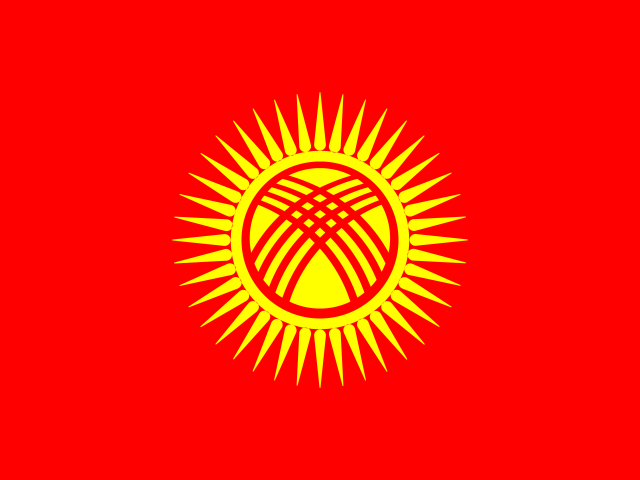
The Flag of Kyrgyzstan
Asia · Adopted 3 March 1992
Kyrgyzstan adopted its flag on 3 March 1992, less than a year after declaring independence from the Soviet Union, discarding the Kyrgyz SSR's Soviet-style flag entirely for a design built around a solid red field — a color choice explained in Kyrgyz civic tradition as honoring the banner of Manas, the legendary hero of the Epic of Manas, the centuries-old oral epic that stands as the closest thing Kyrgyz culture has to a national origin story.
At the flag's center is a golden sun with 40 rays, and inside the sun's disc, rendered as a lighter negative-space pattern, is a stylized depiction of a tunduk — the circular wooden crown structure at the very top of a traditional Kyrgyz yurt, the wheel-like frame that the roof poles converge into, seen here as if looking straight up at it from inside the yurt. Few other national flags reference domestic architecture this directly and specifically.
The 40 rays are read as representing the 40 original Kyrgyz tribes said in the Epic of Manas to have united under Manas to resist Mongol incursions, and by extension the same number is often cited more broadly as standing for the traditional tribal divisions of the Kyrgyz people as a whole — a link between an ancient oral epic and a piece of 1992 civic design that Kyrgyz schools teach as continuous national heritage rather than a coincidence.
The tunduk carries its own separate weight beyond the flag: it also appears as a national emblem on Kyrgyz currency, official seals, and government buildings, functioning as a kind of secondary national symbol in its own right, distinct from but reinforcing the flag's central image, and its selection reflects the tunduk's status in Kyrgyz households as the traditional gathering point of a yurt, historically the piece most associated with home and family unity.
Kyrgyzstan's flag underwent a genuine, dated redesign controversy in the early 2020s: in December 2023, Kyrgyzstan's parliament passed changes to the flag law that were signed by President Sadyr Japarov in January 2024, altering the shape of the sun's rays from a rounder, more floral form — which some Kyrgyz officials and commentators had begun criticizing as resembling a sunflower rather than conveying sufficient national gravity — to a sharper, more angular and geometric set of rays, while keeping the overall red field, 40-ray count, and central tunduk pattern unchanged.
That 2024 revision was framed by supporters as restoring a more dignified, authoritative look befitting a national symbol, while critics questioned the cost and necessity of altering an already internationally recognized flag design just over three decades after its adoption; either way, it stands as one of the more recent documented national flag amendments anywhere in the world.
Because the tunduk-in-sun emblem is unique to Kyrgyzstan, the flag doesn't have a close look-alike among other national flags in the way some of its Central Asian neighbors' flags do; its red field alone invites loose comparisons to other red-based national flags, but the central emblem is distinctive enough to resolve any ambiguity immediately.
The 2023–2024 ray-shape amendment was not the flag's first brush with formal review; Kyrgyz lawmakers and heraldry commissions had periodically discussed adjustments to the sun emblem's proportions in earlier years without passing changes, so the eventual 2024 law represented the first amendment actually enacted since the flag's original 1992 adoption, making it a genuinely rare event in the flag's three-decade history rather than a routine update.
3 March is observed as Kyrgyzstan's State Flag Day, marking the 1992 adoption date, and the tunduk motif's dual role — as both the flag's central image and a widely used standalone national emblem on currency and official seals — means Kyrgyz civic identity leans on this one architectural symbol more heavily than most countries lean on any single element of their flag design.
The Epic of Manas itself, the source of the flag's 40-tribes symbolism, is one of the longest oral epic poems in the world, traditionally performed by specialized reciters called manaschi who memorize tens of thousands of verses without a written text, and UNESCO recognized the epic's oral tradition as part of humanity's intangible cultural heritage in 2013 — giving the flag's central numerical symbolism a documented cultural weight well beyond a simple decorative count.
Kyrgyz flag law specifies exacting geometric rules for the sun and tunduk emblem's placement and proportions relative to the red field, and the 2024 amendment process specifically involved consultation with heraldry specialists over the precise angle and thickness of each of the 40 rays, an unusually granular level of technical revision for a national flag amendment anywhere in the world.
Kyrgyzstan's civil aviation authority and diplomatic missions abroad were required to update flag reproductions on official materials following the 2024 amendment, a rollout Kyrgyz officials described at the time as gradual rather than immediate, meaning older and newer ray-shape versions of the flag were both still visibly in circulation domestically and internationally for some time after the law took effect.
Kyrgyzstan's flag is flown alongside those of fellow Central Asian states at regional summits held under organizations such as the Shanghai Cooperation Organisation and the Commonwealth of Independent States, contexts in which its bright red field and gold tunduk emblem stand out visually against the blue- and green-dominated flags several of its neighbors adopted after independence.
Kyrgyz cultural centers abroad have separately adopted the tunduk motif on its own, apart from the full flag, as shorthand for Kyrgyz identity in contexts ranging from museum exhibits to community organization logos.
The 2023 sun, not the older one
- Current-design flag — The rays were redrawn recently, so a lot of stock still shows the older wavy version. The thing to check in the photograph is whether the rays are straight.
As an Amazon Associate we earn from qualifying purchases made through these links, at no extra cost to you.
Kyrgyzstan at a glance
- Capital
- Bishkek
- Population
- 7.1 million (2024)
- Currency
- Kyrgyzstani Som (KGS)
- Language(s)
- Kyrgyz (state language); Russian (official language)
Population figure as of 2024, source: UN World Population Prospects (2024 revision). See methodology for how facts are sourced and kept current.