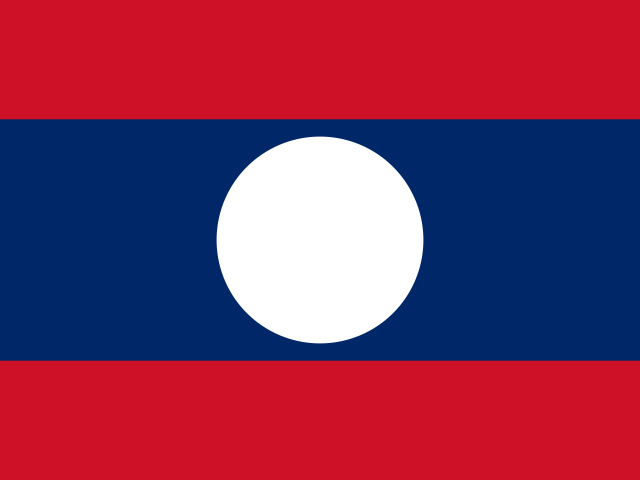
The Flag of Laos
Asia · Adopted 2 December 1975
Laos adopted its current flag on 2 December 1975, the same day the communist Pathet Lao movement formally abolished the centuries-old Lao monarchy and proclaimed the Lao People's Democratic Republic, ending the Kingdom of Laos and, with it, the flag that kingdom had used.
That older royal flag was strikingly different: a red field bearing a white three-headed elephant, called Erawan, standing under a multi-tiered ceremonial parasol on a pedestal. The three elephant heads represented the three historic Lao kingdoms of Luang Prabang, Vientiane, and Champasak, which had been unified centuries earlier as the kingdom of Lan Xang, 'the land of a million elephants,' and the parasol was a traditional emblem of Lao royalty. When the monarchy fell in 1975, that entire elephant-and-parasol design was discarded along with it, since it was inseparable from the royal institution the new government had just abolished.
The replacement design the Pathet Lao adopted had actually been in use by the movement itself since 1950, when it was created as the flag of the Lao resistance during the country's struggle first against French colonial rule and later during the Laotian Civil War, so 1975 was less an invention of a new flag than the promotion of an existing revolutionary movement's banner to the status of state flag once that movement won.
The design is a horizontal triband — red, then a wide blue band exactly double the height of each red stripe, then red again — with a large white disc centered in the blue band. The white disc represents the full moon rising over the Mekong River, the waterway that runs along much of Laos's western border and has historically served as the country's principal transport and trade artery; it also symbolizes the unity of the Lao people under the new government.
The two red bands are explained in official Lao messaging as representing the blood shed in the struggle for national liberation, first from French colonial rule and then during the civil war, while the central blue band stands for the Mekong River itself and, by extension, the prosperity and wealth the river has historically brought to the communities along its banks.
Because Laos is landlocked and shares long borders with Thailand, Vietnam, Cambodia, Myanmar, and China, the flag's direct reference to the Mekong is also a statement of regional geography and identity — the river runs through or borders several of those same neighboring countries, but only Laos places a moon-over-the-Mekong image directly on its national flag.
The flag has not been altered since its 1975 adoption as the state flag, and it is flown alongside the flag of the Lao People's Revolutionary Party — the country's sole legal political party — at most official government functions, a pairing that visually underscores how closely Laos's post-1975 state identity remains tied to the party that brought the current flag to power.
The flag's official construction ratio is 2:3, and government specifications fix the exact diameter of the white disc relative to the blue band's height, along with the precise shades of red and blue to be used on officially produced flags, a level of technical precision typical of flags adopted by 20th-century revolutionary governments seeking to standardize a new state symbol quickly.
The pre-1975 royal elephant-and-parasol flag has not vanished from Lao public life entirely; it survives in some historical and cultural displays, on older monuments predating the 1975 revolution, and among segments of the Lao diaspora abroad who trace their identity to the pre-communist kingdom, making it one of the more visible 'retired' national flags still occasionally seen in circulation outside official government contexts.
The Pathet Lao movement that designed the current flag in 1950 grew out of the broader Indochinese communist movement active across French Indochina, and it fought first against French colonial rule and then, through the 1960s and into the mid-1970s, against the Royal Lao Government and allied forces during the Laotian Civil War, a conflict fought largely as a secondary front of the wider Vietnam War and marked by extensive U.S. bombing of Laotian territory.
Laos holds the distinction of being the most heavily bombed country per capita in history as a result of that conflict, a legacy still visible today in unexploded ordnance across large areas of the country; the red bands on the modern flag, commemorating blood shed for liberation, are read by many Lao officials as referencing that civil-war-era struggle specifically, in addition to the earlier fight against French colonial rule.
Laos observes 2 December as its national Independence Day, marking both the 1975 proclamation of the Lao People's Democratic Republic and, by extension, the same date the current flag became the country's official state flag, making the date a combined commemoration of the political system and its central visual symbol rather than two separately dated events.
The flag is flown alongside the Lao People's Revolutionary Party flag at party congresses held roughly every five years, occasions that receive heavy state media coverage precisely because of how closely the country's post-1975 political system is bound up with the party rather than with competitive multi-party elections.
Because Laos's modern flag broke so completely from the earlier royal elephant-and-parasol design, it is sometimes cited by regional historians alongside Vietnam's and Cambodia's mid-20th-century flag changes as part of a broader pattern across mainland Southeast Asia in which communist or revolutionary movements replaced monarchist-era flags entirely rather than adapting them.
Disc diameter against the blue band
- Geometry-accurate flag — The disc's diameter is specified as a fraction of the blue band's height, which is a proportion you can measure on delivery: too small a circle is the usual fault.
As an Amazon Associate we earn from qualifying purchases made through these links, at no extra cost to you.
Laos at a glance
- Capital
- Vientiane
- Population
- 7.7 million (2024)
- Currency
- Lao Kip (LAK)
- Language(s)
- Lao (official)
Population figure as of 2024, source: UN World Population Prospects (2024 revision). See methodology for how facts are sourced and kept current.