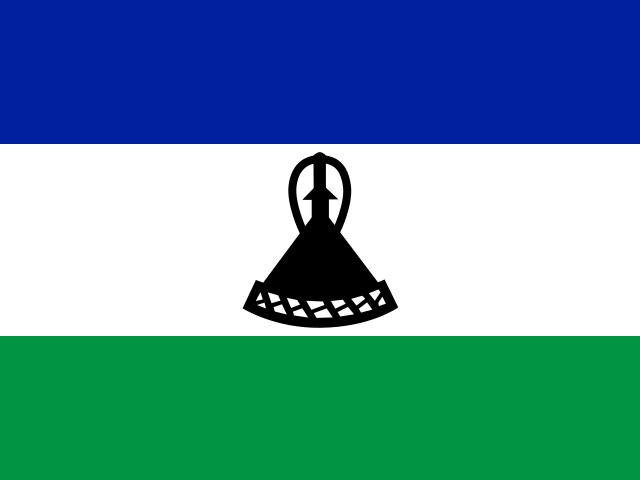
The Flag of Lesotho
Africa · Adopted 4 October 2006
Lesotho's current flag is a relatively recent design, adopted on 4 October 2006 to mark the 40th anniversary of independence from Britain, replacing a flag that had itself only been in place since 1987. That earlier flag — introduced after a 1986 military coup, showing a warrior's shield, spear, and knobkierie against blue, white, and green bands — was closely tied to the military government that adopted it, and its replacement in 2006 was a deliberate move by the restored civilian government to shed a design associated with the coup era and start fresh with a symbol tied to peace rather than military authority.
The centerpiece of the current design is a black Basotho hat, known as a mokorotlo, silhouetted against a white band at the center of the flag — a conical straw hat with a distinctive knob at its peak, traditionally woven and worn across Lesotho, and instantly recognizable as a specifically Basotho cultural symbol rather than a generic African motif. Its shape is said to echo Mount Qiloane, a distinctively pointed peak near the historic royal seat at Thaba Bosiu, tying the hat's silhouette to the country's actual landscape as well as its material culture.
The flag's three horizontal bands carry meanings the government specified at adoption: blue for rain — an unusually pointed symbolic choice for a country whose economy and survival depend heavily on water, since Lesotho exports water to South Africa via the Lesotho Highlands Water Project and rainfall is central to its mountain agriculture — white for peace, and green for prosperity. The switch from the 1987 flag's warrior imagery to the 2006 flag's hat-and-peace symbolism was explicitly framed by officials as marking a transition from a militarized national image to one centered on peace and unity.
Lesotho is one of only three countries in the world entirely surrounded by a single other country (the others being San Marino and Vatican City, both surrounded by Italy), sitting wholly within South Africa's borders — a geographic fact so central to Lesotho's identity that the government explicitly linked the 2006 redesign to reasserting a distinct national identity precisely because of how easily the country's sovereignty could be overlooked given its enclosed position.
Because the flag is comparatively new and features a hat rather than a more common device like a star or crescent, it stands apart from nearly every other African national flag — its highly specific mokorotlo silhouette makes it one of the more instantly identifiable designs on the continent despite being among its most recently adopted.
Lesotho's status as the successor to the 19th-century Basotho kingdom founded by Moshoeshoe I, who unified various Sotho-speaking clans and negotiated British protection in 1868 specifically to fend off annexation by the neighboring Boer republics, gives the country's national identity — and by extension its flag's symbolism of peace and continuity — deep roots in a monarchy that has survived colonization, British protectorate status, and independence with the same royal line still on the throne today.
The country's economy remains tightly bound to South Africa's in ways the flag's water symbolism only partly captures: beyond the Highlands Water Project, a large share of Basotho workers have historically migrated to South African mines for employment, and remittances from that labor have long been a significant component of the national economy, a dependency relationship that predates the 2006 flag redesign by well over a century.
The 1986 coup that produced the flag's short-lived predecessor was itself the product of years of tension between Lesotho's civilian government under Chief Leabua Jonathan and South Africa's apartheid regime, which had grown hostile to Lesotho's tolerance of African National Congress activity within its borders; the military government that seized power in 1986 was widely seen as more accommodating to Pretoria, giving the 1987 warrior-themed flag a specific, uncomfortable political backstory that the 2006 civilian government was explicit about wanting to leave behind.
Lesotho's monarchy today is constitutional rather than executive, with King Letsie III (who has reigned since 1996, following an earlier brief reign in 1990-1995 during his father's exile) serving as a ceremonial head of state while an elected prime minister runs the government — a division of authority that means the mokorotlo hat on the flag references a cultural and royal tradition the country still actively maintains, rather than a monarchy reduced to purely historical memory.
Lesotho is often nicknamed 'the Kingdom in the Sky' because it is the only country on Earth lying entirely above 1,000 metres in elevation, with its lowest point still higher than the highest point of many other nations — a geographic fact that makes the flag's blue band for rain more than a generic symbolic gesture, since the country's mountainous terrain and reliance on the Lesotho Highlands Water Project genuinely depend on the rainfall the band represents. The proportions written into the 2006 flag law are 3:5 rather than the 2:3 shape more common among neighboring African states, and the same legislation pins down the exact blue, white, and green shades to be reproduced on official versions rather than leaving them to manufacturers' discretion.
The mokorotlo hat's silhouette also appears well beyond the flag itself: it is a recurring motif on Basotho coins and banknotes, on the logos of national institutions, and on souvenirs sold to the relatively modest but steady stream of visitors trekking the Maluti and Drakensberg mountain ranges. It sits alongside another distinctly Basotho textile tradition, the seanamarena blanket — thick woven blankets, often patterned with the corn-cob motif linked to Moshoeshoe I's 19th-century dream of prosperity, worn draped over the shoulder as everyday and ceremonial dress — giving Lesotho two separate, internationally recognizable material symbols of Basotho identity that developed independently of the flag but reinforce the same sense of a culture proud of maintaining pre-colonial dress and craft traditions into the present.
A 3:5 cut with a centred hat
- Flag cut to 3:5 — The page gives 3:5 rather than the 2:3 its neighbours use, and the mokorotlo silhouette is centred on that field, so the wrong ratio both changes the shape and pushes the hat off the middle.
As an Amazon Associate we earn from qualifying purchases made through these links, at no extra cost to you.
Lesotho at a glance
- Capital
- Maseru
- Population
- 2.3 million (2024)
- Currency
- Lesotho Loti (LSL), pegged to and used interchangeably with the South African Rand
- Language(s)
- Sesotho and English (both official)
Population figure as of 2024, source: UN World Population Prospects (2024 revision). See methodology for how facts are sourced and kept current.