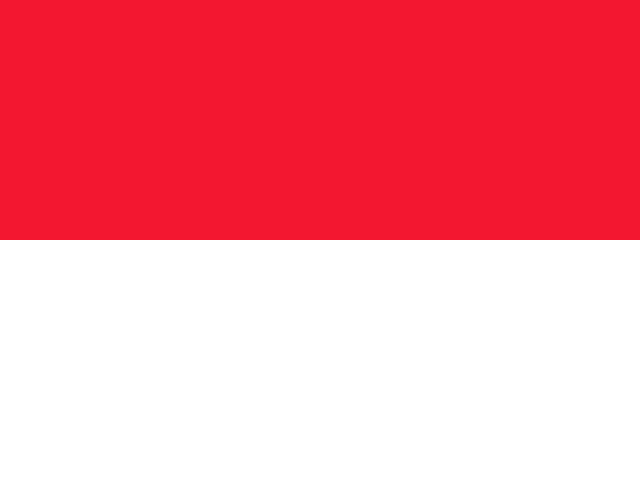
The Flag of Monaco
Europe · Adopted 4 April 1881
Monaco's flag is about as simple as a national flag gets: a horizontal bicolor, red on top and white below, in a 4:5 ratio that makes it noticeably closer to square than most national flags. It was formally adopted on 4 April 1881 by Prince Charles III, though the colors themselves are far older than that decree — they come directly from the coat of arms of the House of Grimaldi, the family that has ruled Monaco continuously (with a few interruptions) since the 13th century, whose shield is patterned in red and white lozenges, or diamonds.
The Grimaldi red-and-white lozenge pattern itself traces to the family's origins among the Guelph faction in medieval Genoa, the Italian maritime republic the Grimaldis originally hailed from before establishing themselves in Monaco. François Grimaldi famously seized the fortress of Monaco in 1297 by disguising himself and his men as Franciscan monks to gain entry — a story commemorated on Monaco's coat of arms, which still features two hooded, sword-bearing friars as supporters flanking the shield, though that emblem is separate from the plain bicolor flag itself.
Because the flag carries no crest, crown, or badge of any kind, it is visually about as minimal as a sovereign state's flag can be, which has made it a recurring source of mix-ups. Indonesia's flag, adopted in 1945 during its declaration of independence from the Netherlands, uses the exact same red-over-white color pairing; the two nations arrived at the combination through entirely separate histories — Indonesia's red-white draws on much older Majapahit-era royal banners rather than anything connected to Monaco or the Grimaldis — and the resemblance is coincidental rather than derivative. The practical difference is proportion: Monaco's flag is close to square at 4:5, while Indonesia's is a more elongated 2:3 rectangle.
Poland's flag is the mirror image of Monaco's rather than a near-duplicate — white on top, red below — which is a different kind of confusion: two flags using the same pair of colors in reversed order rather than the same order in different proportions. Monaco's government has at times fielded queries and minor diplomatic notes over the decades about the Indonesia resemblance specifically, given how close the color match is, though no formal dispute over the design has ever been pursued by either country.
As one of the world's smallest sovereign states — under two square kilometers, expanded somewhat over the decades through land reclamation from the Mediterranean — Monaco has never needed a flag design that distinguishes complex geography or numerous regions; its simplicity reflects a compact principality where the ruling family's own heraldic colors have been sufficient as a national symbol for well over a century without revision.
Monaco's civil, state, and merchant flags are all the same plain red-over-white bicolor, with no separate government or naval version bearing the coat of arms — unlike many small European states that reserve an emblem-bearing 'state flag' for official use while the public flies a plain version. The Monegasque coat of arms with its shield, crown, and Franciscan-monk supporters appears instead on official seals, currency, and government letterhead rather than on any version of the flag itself.
The flag is flown year-round from the Prince's Palace atop the Rock of Monaco and is especially prominent during the National Day celebrations on 19 November, which honor Saint Devota, Monaco's patron saint, alongside the reigning prince.
Monaco's modern compactness — the very smallness that makes its plain two-color flag feel proportionate to the country it represents — is itself the product of a 19th-century territorial collapse rather than an original design choice. Until 1861, the principality controlled a much larger stretch of coastline including the towns of Menton and Roquebrune, but a local revolt against Grimaldi taxation, combined with pressure from an expanding France, led those two towns to break away and eventually be formally ceded to France in exchange for a payment to the Grimaldi family. That treaty shrank Monaco to roughly its current tiny footprint, a reduction of well over ninety percent of its former territory, several decades before the 1881 flag decree formalized the plain bicolor as the reduced principality's official symbol.
Because Monaco is so small, its flag rarely needs to distinguish administrative regions or historical provinces the way larger countries' flags sometimes evolve to do — the same plain red-over-white field has represented the entire sovereign territory, largely unchanged in area since the 1861 cession aside from later land reclamation, for close to a century and a half.
Monaco's tiny size has not stopped its flag from becoming internationally recognizable well beyond its physical footprint, largely through the Monaco Grand Prix, first run in 1929 and now one of the most prestigious fixtures on the Formula 1 calendar, broadcast to a global audience that in many cases has never otherwise had reason to encounter a Monegasque national symbol.
Monaco's small size also means the flag rarely appears without the country itself being mentioned in the same breath, unlike larger states whose flags circulate somewhat independently of any specific news story; most international audiences encounter the red-and-white bicolor specifically in the context of the principality's wealth, its casino at Monte Carlo, or its motor racing rather than through any broader diplomatic or cultural presence, a narrower set of associations than most sovereign flags carry.
Closer to square than most
- Flag cut to 4:5 — At 4:5 this is much stubbier than any standard cut, and stretched to a normal length the two bands stop being the near-square halves the page describes.
As an Amazon Associate we earn from qualifying purchases made through these links, at no extra cost to you.
Often confused with
- Indonesia — predates Indonesia's flag by 64 years — Monaco's 1881 decree came generations before the 1945 declaration that produced a near-identical bicolor, the only lookalike close enough to have ever drawn a query from Monaco's government. Compare side by side →
- Poland — traces its white-over-red order to the white eagle of Polish heraldry rather than to any dynastic shield like the Grimaldis', a coincidence of matching colors with no shared origin at all. Compare side by side →
Monaco at a glance
- Capital
- Monaco
- Population
- 38,000 (2024)
- Currency
- Euro (EUR)
- Language(s)
- French (official)
Population figure as of 2024, source: UN World Population Prospects (2024 revision). See methodology for how facts are sourced and kept current.