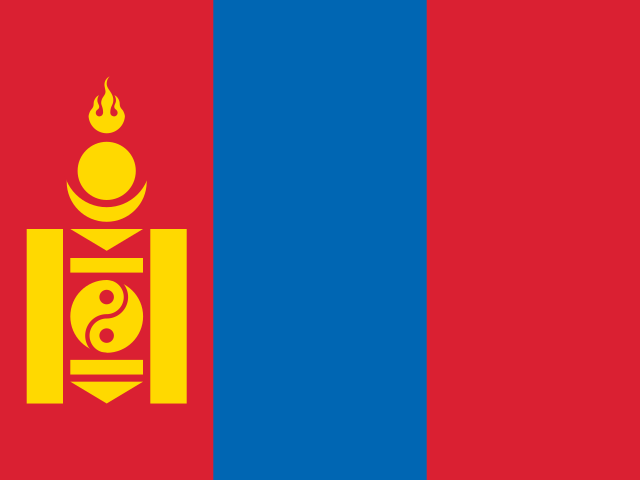
The Flag of Mongolia
Asia · Adopted 12 February 1992
Mongolia's current flag was formally adopted on 12 February 1992, a few weeks after the country's new post-communist constitution took effect, but the central symbol running down its hoist stripe — the golden Soyombo — is centuries older than the modern flag and even older than the flag it replaced. The 1992 redesign kept the same blue-red-red vertical tricolor used since the late 1940s but stripped away the communist five-pointed star that had sat above the Soyombo emblem since 1949, leaving the older religious and cultural symbol standing alone for the first time on a national flag.
The Soyombo itself was designed in 1686 by Zanabazar, the first Bogd Gegeen (head of Mongolian Buddhism) and a noted sculptor and calligrapher, as part of a new vertical script he created for writing Sanskrit and Tibetan Buddhist texts. It is not a single symbol but a stacked composition: flame at the top representing prosperity and growth; sun and crescent moon below it representing the eternity of the Mongolian nation; two triangles pointing downward representing the defeat of enemies; two horizontal rectangles representing honesty and justice; a yin-yang-like taijitu symbol representing the mutual dependence and vigilance of men and women; and two vertical rectangles flanking the whole design, said to represent the strength and unity of citizens standing together, drawn to resemble the walls of a fortress.
The Soyombo first appeared on a national flag in 1911, when Mongolia declared independence from the collapsing Qing dynasty and adopted it as a state symbol under the theocratic government of the Bogd Khan. It survived the 1921 revolution and the 1924 founding of the Mongolian People's Republic, and was retained — with a communist star added above it in 1940 and again standardized in 1949 — through nearly seven decades of one-party socialist rule, making it one of the few pre-communist symbols the socialist government chose to keep rather than replace outright.
Blue is the color most tied to specifically Mongolian identity: it references the 'eternal blue sky,' Tengri, the central object of veneration in traditional Mongolian shamanism and a concept that predates both Buddhism and communism in Mongolia by many centuries. Red, appearing as the two outer stripes, represented progress and prosperity under the pre-1992 socialist government and is generally read today simply as symbolizing Mongolia's ability to prosper and thrive, without the explicit communist framing the color carried before 1992.
The 1992 change removing the star was not the flag's last adjustment. In 2011, Mongolia's parliament passed a law standardizing the exact shade of gold used for the Soyombo, replacing a more orange-tinted gold that had crept into varied printed and manufactured versions of the flag with a brighter, more precisely specified yellow-gold — a small but legally binding correction aimed at making official Mongolian flags visually consistent regardless of who manufactured them.
Mongolian law treats the Soyombo as more than decorative: it also appears on the national emblem, on currency, and on the ceremonial banners used by the Mongolian armed forces, and desecrating the flag carries legal penalties, a level of protection consistent with how central the symbol is to Mongolian national identity across its shamanist, Buddhist, and post-socialist eras alike.
Because the flag's vertical blue-red-red tricolor with a central gold emblem is visually distinctive, Mongolia has no close national-flag lookalike; the Soyombo does appear, in adapted form, on the flag of Kalmykia, a Buddhist-majority republic within Russia populated by ethnic Oirat Mongols, but as a subnational flag rather than another country's national one it is not treated here as a genuine lookalike.
The flag is flown across government buildings and at major state ceremonies, most visibly during Naadam, the country's midsummer festival of wrestling, archery, and horse racing held every July, which doubles as a celebration of the 1921 revolution the modern flag ultimately descends from.
The Soyombo is not Mongolia's oldest military or state banner tradition — that distinction belongs to the sülde, the horsehair spirit banners historically carried by Mongol khans and their armies, including Genghis Khan's own black-and-white sülde standards, which represented war and peace respectively and were venerated as containing the spirit of the ruler or the state itself. Those spirit banners fell out of active use centuries before Zanabazar's 17th-century Soyombo design, but they remain a distinct and much older strand of Mongolian flag and banner symbolism that the modern national flag does not directly incorporate.
The 1992 removal of the communist star was part of a broader wave of post-Soviet symbol changes across Mongolia's new democratic constitution, adopted the same year, which also introduced a new national emblem and reformed state institutions following the peaceful 1990 pro-democracy protests that ended nearly seven decades of one-party rule — a transition Mongolia carried out largely without the violence seen in some other former Soviet-aligned states during the same period.
The Soyombo symbol extends well beyond the flag itself: it appears on Mongolian tögrög banknotes, on the national emblem, and on the uniforms of Mongolian athletes at international competitions including the Olympics, where wrestlers and archers competing in sports with deep roots in Mongolian tradition carry the symbol into arenas far from the flag's original 17th-century religious context.
A columnar emblem down the hoist stripe
- Double-sided flag — The emblem runs vertically down the stripe nearest the pole, so a single-layer flag puts it at the fly from behind, where it spends most of its time hidden in the folds.
As an Amazon Associate we earn from qualifying purchases made through these links, at no extra cost to you.
Mongolia at a glance
- Capital
- Ulaanbaatar
- Population
- 3.45 million (2024)
- Currency
- Mongolian Tögrög (MNT)
- Language(s)
- Mongolian (official, written in Cyrillic script domestically)
Population figure as of 2024, source: UN World Population Prospects (2024 revision). See methodology for how facts are sourced and kept current.