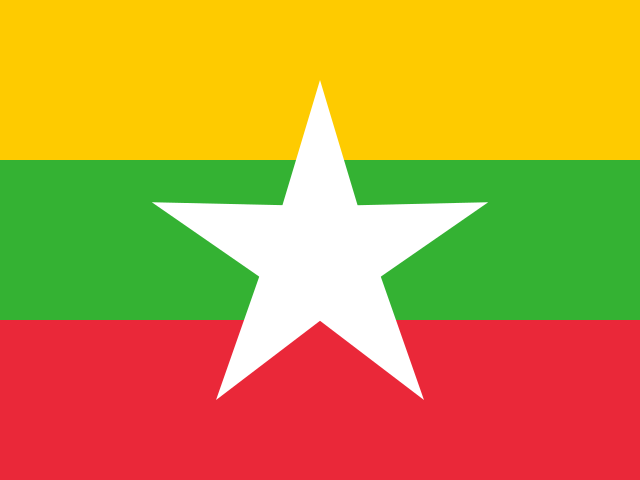
The Flag of Myanmar
Asia · Adopted 21 October 2010
Myanmar's current flag flew for the first time on 21 October 2010, timed to arrive just weeks ahead of the country's first general election in two decades, held that November under the military-drafted 2008 constitution. It replaced a red flag with a blue canton bearing a cogwheel encircled by rice stalks that had represented the socialist and later military-run state since 1974 — a design so tied to one-party and military rule that adopting a new flag was itself treated as a symbolic marker of the transition the 2008 constitution claimed to be starting.
The new design is a plain horizontal tricolor of yellow, green, and red with a single large white five-pointed star centered across all three bands, a marked simplification compared to the elaborate cogwheel-and-rice emblem it replaced. Official government explanations tie yellow to solidarity, green to peace, tranquility, and the country's natural environment, and red to courage and decisiveness, while the white star is described as representing the union of Myanmar's constituent states and regions — a pointed message in a country whose post-independence history has been repeatedly disrupted by ethnic-minority insurgencies contesting the terms of that union.
Myanmar's flags before 1974 tell a more layered story. The flag used from independence in 1948 until 1974 combined a dark blue canton bearing a large white star and five smaller stars with a red field, a design meant to echo both the country's revolutionary independence movement and a general regional convention of stars-and-stripe layouts; before that, under British colonial administration, the territory then called Burma flew a version of the British Red Ensign defaced with a peacock, a Konbaung-dynasty royal symbol the colonial government retained as a concession to local identity even while ruling the territory as part of British India and later as a separate colony.
The country's own name for itself changed alongside its 2010 flag reforms: the military government had already renamed the state from Burma to Myanmar in 1989 and its then-capital from Rangoon to Yangon, changes that remain disputed internationally, with some governments and media organizations still using the older names to signal non-recognition of the 1988–90 military junta that imposed them.
Myanmar's political history since the current flag's adoption has been turbulent rather than settled: the 2010 election was followed by a period of partial civilian government and international re-engagement through the 2010s, then a military coup on 1 February 2021 that removed the elected government and triggered widespread armed resistance across much of the country — through all of this the 2010 flag itself has remained unchanged, used by the military government exactly as it was used by the brief civilian administration it deposed.
The rice-stalks-and-cogwheel flag of 1974–2010 is still occasionally seen in older photographs, murals, and archival military insignia, but it carries strong associations with the one-party Burma Socialist Programme Party era and the subsequent military crackdowns of 1988, which makes it a politically loaded image rather than a neutral historical curiosity within the country today.
Because horizontal yellow-green-red tricolors are relatively uncommon worldwide, Myanmar's current flag does not have a widely cited close lookalike among other national flags, distinguishing it visually from the far more common red-white-blue or pan-African green-yellow-red color families used elsewhere.
The 2010 flag change was not universally welcomed, particularly among Myanmar's many ethnic minority communities, some of whom noted that the 1948 flag's arrangement of stars had at least gestured toward the country's constituent states and divisions, while the single central star of the 2010 design reads to critics as emphasizing a unitary Burman-dominated state rather than genuine federal union — a criticism that has only sharpened since the 2021 coup, as numerous ethnic armed organizations and resistance groups operating in contested territory fly their own distinct flags rather than the national one.
Myanmar's 2010 State Flag Law fixed the design to precise legal measurements rather than leaving it to custom: the width-to-length ratio is set at 5:9, an unusual proportion compared with the far more common 2:3 used across most of the world's flags, and the law specifies exact hoist-to-fly placement of the central star along with government reference colors for the yellow, green, and red bands so that flags manufactured for schools, ministries, and the military can be checked against a single legal standard. The same law sets out ceremonial protocol still followed today, including that the flag must be raised briskly and lowered slowly at official flagpoles and must never touch the ground during either movement.
Opposition to military rule has produced its own rival flag tradition rather than simply rejecting the state banner outright. Student-led protest movements going back to the 1988 uprising against the earlier military government revived the 'Fighting Peacock' — a gold peacock in an aggressive stance on a red field, drawn from the pre-1974 independence-era peacock symbolism the British colonial administration had itself once used — as an anti-junta emblem distinct from any officially adopted national flag. That peacock banner reappeared widely again after the 2021 coup at protests and among resistance groups aligned with the shadow National Unity Government, which has continued using the 2010 tricolor as its own claimed national flag even while opposing the military administration that also flies it, leaving both sides of Myanmar's post-2021 conflict flying the identical 2010 design for legitimacy while reserving the peacock flag specifically as a protest symbol rather than a state one.
The referendum that approved the 2008 constitution underlying the 2010 flag change was held just days after Cyclone Nargis devastated the Irrawaddy Delta in May 2008, killing well over 100,000 people; international observers and Myanmar's own opposition at the time criticized the government for proceeding with the vote amid the disaster response, adding to long-standing doubts about how freely that constitutional process, and by extension the flag adopted under it, actually reflected public consent.
The same 2008 constitution that introduced the national flag also formally granted each of Myanmar's seven states and seven regions its own separate flag and emblem for the first time, a nominal recognition of subnational identity that sits uneasily alongside the criticism that the national flag's single centered star understates the country's actual ethnic diversity and the extent of self-rule many of those states and armed ethnic organizations have actually sought.
Myanmar at a glance
- Capital
- Naypyidaw
- Population
- 54.5 million (2024)
- Currency
- Myanmar Kyat (MMK)
- Language(s)
- Burmese (official); over 100 ethnic minority languages spoken across the country's states
Population figure as of 2024, source: UN World Population Prospects (2024 revision). See methodology for how facts are sourced and kept current.