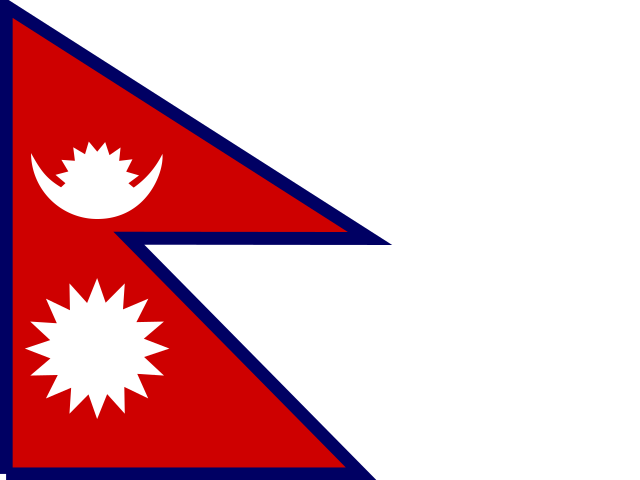
The Flag of Nepal
Asia · Adopted 16 December 1962
Nepal is the only country in the world whose national flag is not a rectangle. It is instead made of two stacked triangular pennants, a shape formally fixed by precise geometric construction rules written directly into the constitution adopted on 16 December 1962, which specifies the exact angles and proportions with mathematical instructions rather than leaving the shape to a manufacturer's approximation.
The double-pennon shape did not begin as a single deliberate design. It descends from the historical practice of combining two separate triangular pennants once flown by rival branches of the Nepali royal family — one associated with the ruling Shah dynasty, the other with the Rana family that held hereditary power as prime ministers for over a century — merged into a single two-triangle banner sometime before the 20th century as the country's various royal and princely standards were consolidated into one national symbol.
The crimson red field is Nepal's national color, drawn from the rhododendron, the country's national flower, and it is also read as a symbol of victory in war and the bravery of the Nepali people, including the Gurkha soldiers whose military reputation extends well beyond South Asia. The blue border framing the two pennants represents peace.
The moon and sun that appear inside the two triangles — moon in the upper pennant, sun in the lower one — were, before 1962, drawn with human faces, an older and more folk-art style of depiction. The 1962 constitutional redesign replaced those anthropomorphic faces with plain geometric moon and sun symbols, a change made to modernize and standardize the flag's official appearance rather than to alter its meaning: Nepalis still describe the wish behind the two symbols as hoping the nation will last as long as the moon remains cool and calm in the sky, and as long as the sun continues to blaze with heat.
Because Nepal is home to eight of the world's ten highest peaks, including Sagarmatha (Mount Everest) on its border with Tibet, the flag's jagged double-triangle silhouette is popularly read by Nepalis as an echo of the Himalayan mountain range itself, even though the shape's actual documented origin lies in the merged royal pennants rather than a deliberate mountain-shaped design brief.
Nepal was never colonized, a point of national pride that distinguishes its flag history from many neighboring South and Southeast Asian states: there was no colonial-era flag to replace, and no independence-day redesign, because the flag's lineage runs continuously back through the Shah-dynasty kingdom rather than through a break from foreign rule.
The monarchy itself did not survive as long as the flag's design: Nepal abolished its centuries-old monarchy in 2008 following a decade-long Maoist insurgency and became a federal democratic republic, yet the flag — whose triangular shape long predates the republic — was kept unchanged, one of the few national symbols the new republican constitution chose not to touch.
Because no other country uses a non-rectangular flag, Nepal has no genuine lookalike; its closest visual cousins are simply other flags that also use a crimson field, such as several regional and historical Himalayan banners, none of which share its distinctive double-pennon shape.
Nepal's constitution is unusually literal about how the flag must be constructed: rather than describing the design in prose alone, the schedule attached to the constitution provides a step-by-step geometric method — a series of numbered instructions for drawing arcs and straight lines with a compass and straightedge from a starting baseline — that any draftsperson can follow to reproduce the exact shape and proportions by hand, a level of technical precision almost never seen written directly into a country's founding legal document.
Triangular pennants and pennons were historically common across South Asia as military and princely standards, flown by regiments, forts, and noble households well before Nepal's unification, but Nepal is the only case where that older regional pennant tradition survived intact into a unified nation's single official national flag rather than being replaced by a rectangular design, as happened almost everywhere else in the subcontinent during the 19th and 20th centuries.
The flag has been physically carried to the summit of Mount Everest by Nepali climbers repeatedly since Tenzing Norgay, a Nepali-born Sherpa mountaineer, first reached the top alongside Edmund Hillary in 1953 — a detail Nepalis take particular pride in, since the flag's mountain-peak silhouette and the country's identity as home to the world's highest summit reinforce each other even though, as the flag's actual documented history shows, that connection to the Himalayas was never the design's original stated purpose.
Because the two pennants are not mirror-symmetric, Nepal's constitution goes a step further than most flag laws by specifying how the design must appear on both the front and back of the physical cloth: the moon and sun symbols are drawn so that the flag reads correctly whichever side is facing the viewer, a construction detail that rectangular flags never have to solve since a plain rectangle looks identical in reverse, but that a genuinely non-rectangular, asymmetric shape like Nepal's makes unavoidable. Manufacturers occasionally get this wrong on souvenir or novelty versions, producing a flag that is technically reversed from the constitutionally correct orientation, an error vexillologists say is more common with Nepal's flag than with almost any other national design precisely because of its unique shape.
The crimson used on Nepal's flag is also, by long-standing custom rather than law, the color traditionally applied to the vermilion powder (sindoor and tika) used in Hindu religious ceremonies across Nepal, giving the flag's dominant color a devotional resonance in daily life well beyond its official meaning tied to the rhododendron and to military courage, in a country where Hinduism remains the majority religion practiced by most of the population alongside a significant Buddhist minority, particularly across the Himalayan north.
Two pennants, not a rectangle
- Correctly shaped pennant flag — Most listings sell this printed onto a rectangle with the shape shown as an image, which is a picture of the flag rather than the flag. The real article is cut to the stacked-pennant outline.
- Double-sided flag — Because the outline is not symmetric, the page notes the construction rules specify how the sun and moon appear on the back as well as the front, which a single printed layer cannot satisfy.
As an Amazon Associate we earn from qualifying purchases made through these links, at no extra cost to you.
Nepal at a glance
- Capital
- Kathmandu
- Population
- 29.7 million (2024)
- Currency
- Nepalese Rupee (NPR)
- Language(s)
- Nepali (official); over 120 languages recognized nationally
Population figure as of 2024, source: UN World Population Prospects (2024 revision). See methodology for how facts are sourced and kept current.