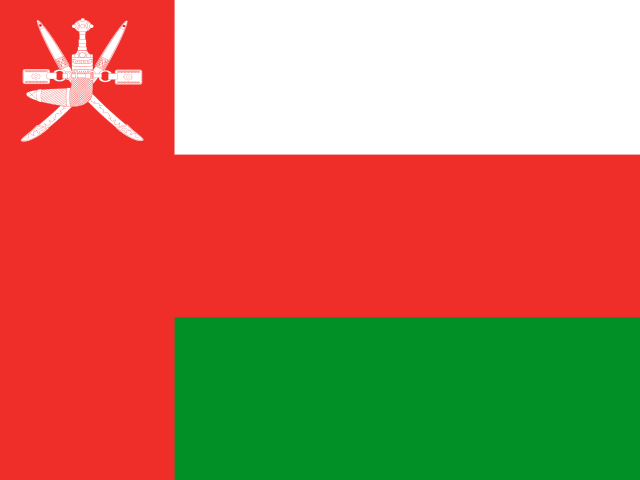
The Flag of Oman
Asia · Adopted 18 November 1995
For most of its history, Oman flew nothing more elaborate than a plain red flag, a color long used across the Arabian Gulf by ships and forts to mark their home port and, in Oman's case, tied specifically to the Ibadi Muslim identity and martial tradition of the Omani sultanate. That simple red banner served as Oman's flag for generations, right up until 1970.
Everything changed on 23 July 1970, when Qaboos bin Said overthrew his own father, Sultan Said bin Taimur, in a palace coup that ended one of the most isolated and insular periods in the country's modern history. Said bin Taimur had kept Oman largely closed to the outside world, restricting travel, modern education, and infrastructure to a degree unusual even by regional standards of the time; Qaboos's accession opened the country to rapid modernization, a shift so significant it is still referred to in Oman as the Nahda, or Renaissance. A new flag, adding white and green horizontal stripes above a vertical red hoist band bearing the national emblem, was introduced that same year as a visible symbol of the new era.
The flag reached its current, precisely standardized form on 18 November 1995, adjusted to mark Qaboos's 25th anniversary on the throne and to fix its exact proportions and color specifications in law. Red remains tied to the historic battles fought to defend the sultanate from foreign and tribal incursions over the centuries; white is associated with peace and, in some readings, specifically with the historical Imamate period of Omani governance; and green refers to the fertility of Oman's landscape, particularly the Jebel Akhdar ('Green Mountain') range in the country's interior, as well as to Islam generally.
The national emblem in the flag's hoist-side canton is the khanjar, the traditional curved Omani dagger worn ceremonially by Omani men, shown crossed with two swords and a belt. The khanjar appears not only on the flag but on Omani currency, military uniforms, and government seals, making it one of the most immediately recognizable national symbols in the Gulf region and a far more central emblem in Omani iconography than any comparable symbol in most neighboring states.
Oman's flag transition — from a single-color banner used for centuries to a modern tricolor with a national emblem, adopted almost overnight following a single political rupture — is unusually compressed compared to most countries' flag histories, which tend to accumulate changes gradually across multiple political transitions rather than concentrating the entire modern design into one coup and one 25th-anniversary refinement twenty-five years later.
Sultan Qaboos died in January 2020 after a 50-year reign, the longest of any ruler in the modern Middle East, and was succeeded by his cousin, Haitham bin Tariq; the flag adopted in the earliest days of Qaboos's rule and finalized at its midpoint has remained unchanged through the transition to the new sultan.
Because a red field paired with a national dagger or weapon emblem recurs in several Gulf state flags in loosely similar form, Oman's flag is occasionally confused with those of its neighbors at a glance, even though the specific combination of a vertical red hoist band, horizontal white and green stripes, and the crossed-khanjar emblem is unique to Oman.
Oman's red flag tradition predates the modern sultanate's current borders by a wide margin: at its height in the 18th and 19th centuries, the Omani Empire controlled territory stretching across the Gulf and down the East African coast, including Zanzibar, which briefly served as the seat of an Omani sultan's own separate branch of the ruling family until the two territories formally split in 1856 — meaning the plain red banner that eventually evolved into today's flag once flew over a maritime empire considerably larger than present-day Oman.
Oman marks National Day on 18 November, a date that does double duty by also commemorating the birthday of the reigning sultan under whichever monarch currently holds the throne, a link between the person of the sultan and the national calendar that has persisted from Qaboos's reign into that of his successor, Haitham bin Tariq, and one that keeps the flag's most prominent annual display tied directly to the modern monarchy the 1970 and 1995 flag versions were designed to represent.
Oman's 1996 Basic Statute of the State, the closest document Oman has to a written constitution, formally codified the flag's description and legal status alongside the country's system of governance, embedding the 1995 flag specifications into the same foundational document that defines the sultan's powers and the structure of the Omani state more broadly.
Each November, in the run-up to National Day, Muscat and other Omani cities are decorated with flags and lights on a scale that is unusual even by the standards of Gulf national celebrations: giant Omani flags and portraits of the sultan are hung across cliff faces and mountainsides overlooking the capital's harbor and highways, a practice that has grown steadily since the 1990s and turns the flag's red, white, and green into one of the most visually dominant public displays anywhere in the country for several weeks each year.
Oman's flag takes a 1:2 shape, with the vertical red hoist band occupying roughly a quarter of the flag's length and the khanjar-and-swords emblem sized and centered according to specifications set out alongside the 1995 legal description — proportions distinct from the roughly square or 2:3 ratios used by several neighboring Gulf states, giving Oman's flag a visibly more elongated shape than Saudi Arabia's, the UAE's, or Qatar's.
A long field with a hoist band
- Flag cut to 1:2 — The page gives a 1:2 shape with the red hoist band at about a quarter of the length, so the ratio and the band width are tied together: the wrong cut widens the band as well as shortening the flag.
As an Amazon Associate we earn from qualifying purchases made through these links, at no extra cost to you.
Oman at a glance
- Capital
- Muscat
- Population
- 4.7 million (2024)
- Currency
- Omani Rial (OMR)
- Language(s)
- Arabic (official); English widely used in business and government
Population figure as of 2024, source: UN World Population Prospects (2024 revision). See methodology for how facts are sourced and kept current.