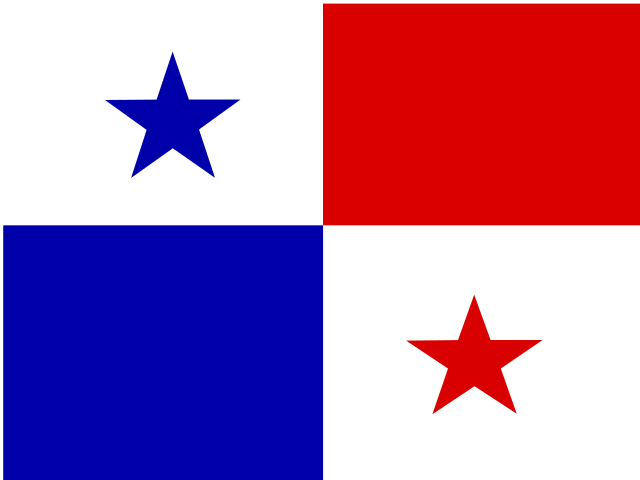
The Flag of Panama
North America · Adopted 20 December 1903
Panama's flag was adopted on 20 December 1903, weeks after the country declared independence from Colombia on 3 November 1903 — a separation that happened with direct and deliberate encouragement from the United States, which had just been rebuffed by Colombia's senate in negotiations over building a canal across the isthmus and moved US naval forces to block Colombian troops from suppressing the Panamanian secession. The flag's design is credited chiefly to María de la Ossa de Amador, who is said to have sewn the first flag, working from a design attributed to Manuel Encarnación Amador (her son) with input from Panama's first president, Manuel Amador Guerrero — accounts of exactly who contributed which elements vary between sources, but the Amador family's central role in both the independence movement and the flag's creation is well documented.
The flag is divided into four rectangular quarters: white in the upper hoist and lower fly, red in the lower hoist, blue in the upper fly, with a blue five-pointed star centered in the white upper-hoist quarter and a red star in the white lower-fly quarter. The two colors, red and blue, are generally explained as representing Panama's two dominant political parties of the independence era — the Conservatives (blue) and the Liberals (red) — with the white quarters representing the peace between them, a genuinely party-political origin story that is unusual among national flags, most of which avoid encoding specific domestic political factions into their permanent national symbol.
The stars carry a separate, civic meaning layered on top of the party symbolism: the blue star is generally read as representing purity and honesty, and the red star as representing authority and law, a pairing meant to describe the values of the new republic rather than repeat the party reference already carried by the color fields themselves.
Panama's 1903 independence, and by extension its flag, cannot be separated from the canal project that prompted it: the United States, having failed to secure canal rights from Colombia, recognized Panama's independence within days and quickly negotiated the Hay–Bunau-Varilla Treaty, granting the US control of a Canal Zone that bisected the new country for most of the 20th century. That arrangement — and the fact that Panama's independence was so directly enabled by American interests — has made the flag's founding story a genuinely contested one within Panama itself, discussed by some historians as authentic national liberation and by others as a US-engineered secession serving American strategic interests rather than a purely Panamanian revolutionary movement.
The flag has not been formally redesigned since 1903, though its exact proportions and shade specifications were codified more precisely in later 20th-century law, consistent with the broader mid-century regional trend of legally fixing flag details that earlier generations had left to custom and improvisation.
Because the US Canal Zone divided Panama physically until the canal's full handover to Panamanian control in 1999 under the Torrijos–Carter Treaties, the Panamanian flag itself became a recurring flashpoint for national sovereignty disputes — most notably the 1964 Flag Riots, sparked when Panamanian students attempting to fly their flag alongside the US flag at a Canal Zone school were blocked, leading to violent clashes that killed more than twenty people and remain a defining episode in modern Panamanian national memory, still marked annually as Martyrs' Day on 9 January.
Panama's four-quarter, two-star layout is visually distinctive enough that it has few close look-alikes among other national flags; its closest resemblance in general structure — four rectangular fields with centered stars — is more a shared geometric approach than a design any other country's flag borrows directly, and Panama is not commonly confused with another specific country's flag the way some regionally clustered tricolors are.
The exact roles played by the three named designers remain a point of genuine disagreement in Panamanian historical accounts: some sources emphasize Manuel Encarnación Amador as the original conceptual designer working from sketches, others give more weight to his father's role in finalizing the political symbolism of the party colors, and María de la Ossa de Amador's contribution as the seamstress who physically produced the first flag is documented with more consistency across sources than the question of who first proposed the four-quarter layout itself.
9 January's Martyrs' Day observance, commemorating the 1964 Flag Riots, remains one of Panama's most solemn annual national holidays, distinct in tone from the more celebratory 3 November Independence Day and 20 December Flag Day observances, and Panamanian schools teach all three dates as connected chapters of the same broader national story about sovereignty, from the flag's 1903 creation through the contested decades of the Canal Zone to the 1999 full transfer of the canal itself.
Panama had actually attempted to separate from Colombia once before, in an earlier and unsuccessful 1903-adjacent wave of isthmian unrest, and the region had a long-running history of periodic secessionist movements dating back to Panama's original union with Gran Colombia after independence from Spain in 1821 — meaning the 1903 split, while decisively enabled by US intervention, was not without genuine local precedent of Panamanian dissatisfaction with rule from Bogotá.
Four quarters, two stars
- Geometry-accurate flag — The field is divided into four equal rectangles with the stars in diagonally opposite white quarters, so both the quartering and which corner each star sits in are checkable at a glance.
As an Amazon Associate we earn from qualifying purchases made through these links, at no extra cost to you.
Panama at a glance
- Capital
- Panama City
- Population
- 4.5 million (2024)
- Currency
- Panamanian Balboa (PAB), circulates alongside and at par with the US Dollar (USD)
- Language(s)
- Spanish (official)
Population figure as of 2024, source: UN World Population Prospects (2024 revision). See methodology for how facts are sourced and kept current.