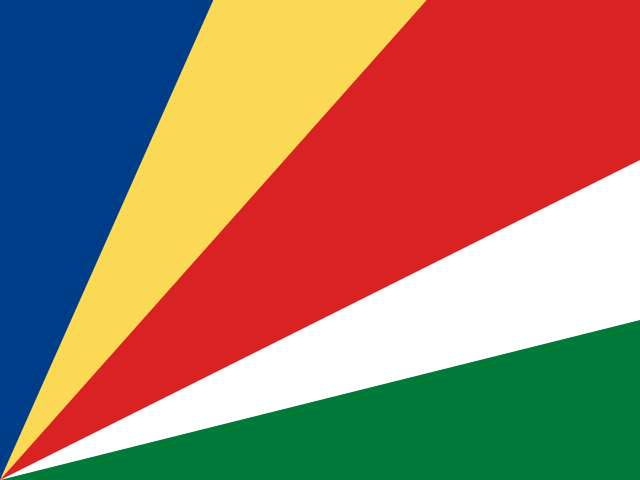
The Flag of Seychelles
Africa · Adopted 18 June 1996
Seychelles has cycled through more national flags in its short independent history than most African states, and the current design, adopted 18 June 1996, is actually the third since independence from Britain in 1976. The first post-independence flag, flown from 1976, was a horizontal design in the colors of the ruling Seychelles People's Progressive Front's predecessor party; it lasted barely a year before a coup in June 1977 brought France-Albert René to power and, with him, a new flag reflecting his one-party socialist government, a design featuring green, white, and red fields with a coconut palm frond, flown for nearly two decades.
The current five-band design was introduced as Seychelles transitioned back to multiparty democracy, following a new constitution approved by referendum in 1993 that ended 16 years of one-party rule and restored competitive elections. The flag was deliberately timed and designed to visually represent that political opening: rather than simple horizontal or vertical stripes, it uses five bold bands — blue, yellow, red, white, and green — that radiate diagonally outward from the bottom-left corner of the flag like rays, an unusual and genuinely distinctive layout among world flags.
Each color was given an explicit meaning tied to the new democratic era rather than to any single party: blue represents the sky and the surrounding Indian Ocean, yellow represents the sun and the light it brings, red represents the people of Seychelles and their determination and unity of purpose, white represents social justice and harmony, and green represents the land and its natural environment — a palette meant to describe the nation and its people directly rather than to signal allegiance to a governing party, in visible contrast to the 1977 flag it replaced.
The diagonal, radiating band structure is itself part of the intended symbolism: government explanations of the design describe the bands as representing a dynamic, forward-moving young nation, with the fanning-out shape suggesting progress and possibility rather than a static, fixed arrangement — a conscious design choice distinguishing it from the more conventional horizontal-stripe layouts of the two flags that preceded it.
Because Seychelles is an archipelago of 115 islands with a population concentrated overwhelmingly on a handful of the larger ones, particularly Mahé, Praslin, and La Digue, the flag's ocean-and-sun symbolism is grounded directly in the country's actual geography and economy, both still dominated by tourism and fishing tied to its Indian Ocean setting.
The flag is flown on Constitution Day, 18 June, marking the date the current design and the 1993 constitution both formally took effect, and on Liberation Day, 5 June, commemorating the 1977 coup — a date whose continued official observance, even after the coup-era flag was itself replaced, reflects the more complicated way Seychellois politics has continued to reckon with the one-party period even after moving past it symbolically.
The 1976 independence-era flag, in use for barely a year before the 1977 coup, is comparatively little documented today, overshadowed both by the longer-lived 1977–1996 René-era flag and by the current design; contemporary Seychellois flag history displays and government references tend to treat the 1977 and 1996 flags as the two defining designs of the post-independence period, with the original 1976 flag noted mainly as a brief transitional footnote.
Seychelles' 1996 flag redesign was decided by a specially convened National Flag and Emblem committee rather than through an open public design competition of the kind used by several other African states at independence, a process that reflected the relatively short timeline between the 1993 constitutional referendum and the flag's formal adoption three years later, as the government worked through the wider set of symbolic and institutional changes tied to the return of multiparty politics.
Seychelles' economy has shifted substantially since the current flag's 1996 adoption, moving further toward high-end tourism and, since the 2010s, a growing 'blue economy' emphasis on sustainable fisheries and marine conservation across its vast exclusive economic zone — one of the largest in the world relative to the country's tiny land area — a shift civic messaging has sometimes tied back to the flag's blue and green bands as representing the ocean and land resources the country now actively markets as central to its national identity and economic strategy.
France-Albert René, the president who led the 1977 coup and whose government's flag preceded the current one, remained in power until 2004 and personally oversaw the 1993 constitutional reforms that ultimately led to the current flag's adoption — meaning the same leader presided over both the one-party flag Seychelles is moving away from telling its history through and the multiparty flag that replaced it, an unusual continuity of leadership across a genuine symbolic and political transition.
As one of the smallest UN member states by population, Seychelles nonetheless maintains a disproportionately high diplomatic profile on ocean-governance issues, and its flag appears regularly at international climate and marine-conservation forums, where Seychellois officials have specifically cited the flag's blue and green bands, representing sea and land, as a fitting emblem for a nation whose economic and environmental future is unusually tightly bound to ocean health compared with most other countries. Seychelles pioneered the world's first sovereign 'blue bond' in 2018 to finance marine protection, a financial innovation frequently cited in the same government messaging that ties the flag's colors to ocean stewardship.
Five bands radiating from one corner
- Garden banner — The five bands fan out from the lower hoist rather than running parallel, a geometry with no small detail in it, so it survives reduction to a garden banner better than an emblem- bearing flag would.
As an Amazon Associate we earn from qualifying purchases made through these links, at no extra cost to you.
Seychelles at a glance
- Capital
- Victoria
- Population
- 130,000 (2024)
- Currency
- Seychellois Rupee (SCR)
- Language(s)
- Seychellois Creole, English, and French (all official)
Population figure as of 2024, source: UN World Population Prospects (2024 revision). See methodology for how facts are sourced and kept current.