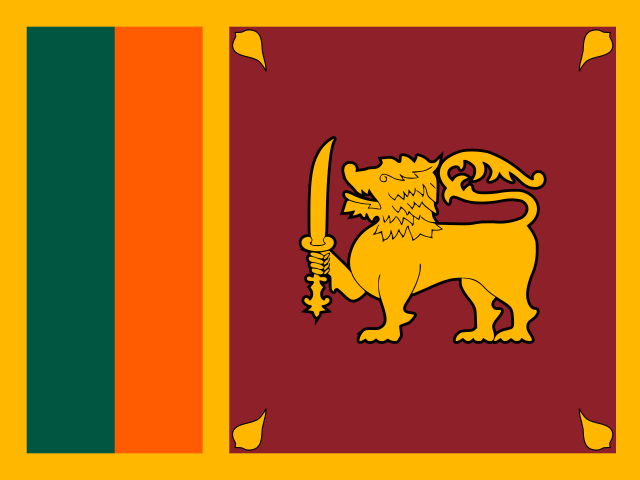
The Flag of Sri Lanka
Asia · Adopted 22 May 1972 (lion design dates to 1948 independence; stripes added 1951, refined 1972)
Sri Lanka's flag, sometimes called the Lion Flag, is built around one of the most iconographically dense national emblems anywhere in the world: a golden lion holding a kastane, a traditional curved Sinhalese sword, standing upright on its hind legs within a deep maroon field, itself bordered by a mustard-yellow frame and flanked by two vertical stripes, saffron and green, at the hoist. Almost none of this is decorative filler — each element was chosen to represent a specific community or historical claim, which is part of why the flag is frequently cited by vexillologists as one of the most detailed in active national use.
The lion itself is drawn from a founding legend of the Sinhalese people, who trace their ancestry to a mythical exiled prince named Vijaya, said to be descended from a lion (sinha), giving the ethnic group and the island's ancient name — Sinhale — a shared linguistic root. A lion holding a sword had already appeared on the flags of pre-colonial Kandyan kings, the last independent Sinhalese kingdom, before it was suppressed under British colonial rule after 1815; the modern flag's lion is a direct revival of that royal symbol rather than a postcolonial invention.
Four stylized bo leaves, one in each corner around the lion, represent the sacred fig tree (Ficus religiosa) under which the Buddha is said to have attained enlightenment, a direct reference to Buddhism's central place in Sri Lankan history and to the majority Sinhalese-Buddhist population, since the bo tree at Anuradhapura is itself venerated as a direct cutting from that original tree, said to have been brought to the island in the 3rd century BCE.
The two vertical stripes — saffron/orange for Tamils and green for Muslims — were added in 1951, three years after independence, specifically to represent the island's principal ethnic and religious minorities alongside the Sinhalese-Buddhist majority represented by the lion and bo leaves; the maroon field itself is generally read as representing the Sinhalese people's own identity distinct from the minority stripes. This makes the flag unusually explicit, compared with most national flags, about naming specific communities within the design rather than using abstract colors alone.
That inclusion has not resolved the deeper political tensions the flag gestures at: Sri Lanka fought a brutal 26-year civil war (1983–2009) rooted substantially in Sinhalese-Tamil tension, and the flag's lion-centered design — with the minority stripes added almost as an afterthought alongside a much larger, more elaborate Sinhalese-Buddhist emblem — has been criticized by some Tamil political voices as symbolically subordinating minority identities rather than genuinely equally representing them, even though the stripes are formally part of the constitutional design.
The current precise proportions and color specifications were fixed in the 1978 constitution following the country's 1972 shift from Dominion status to a republic (when the country was renamed from Ceylon to Sri Lanka), though the core lion-and-stripes design itself dates to the 1951 addition of the minority stripes onto the lion flag first adopted at independence in 1948.
Before 1948, Ceylon flew the British Union Jack with a colonial badge, as was standard across British colonial territories; independence in February 1948 saw the immediate adoption of a lion flag closely modeled on the historic Kandyan royal standard, before the 1951 and subsequent 1972 revisions added the minority stripes and formalized the modern design.
The flag is protected under Sri Lankan law against desecration, and it is flown prominently on Independence Day (4 February) and Republic Day (22 May), the latter marking the 1972 transition to a republic under the current design's formal codification.
The kastane sword the lion grips is not a generic weapon but a specific traditional Sinhalese short sword with a distinctive curved blade and ornate hilt, historically carried by Kandyan nobility and warriors as both a functional weapon and a status symbol; including it in the flag's design was a deliberate choice to root the lion emblem in concrete Sinhalese material culture rather than leave it as an abstract heraldic beast holding an unspecified blade.
Sri Lanka's flag also carries a mustard-yellow border framing the entire design, officially explained as symbolizing the nation's Buddhist heritage and moral discipline, distinct from the golden-yellow used for the lion figure itself — a deliberate two-tone use of yellow within the same flag that Sri Lankan flag specifications treat as legally distinct shades rather than interchangeable.
Debate over the flag's design has occasionally resurfaced in Sri Lankan political life, particularly around whether the minority stripes proportionally represent Tamil and Muslim communities fairly relative to the much larger, more elaborate lion-and-bo-leaf emblem, and whether a design created in the shadow of a still-recent, deeply scarring civil war can function as genuinely unifying — a live discussion rather than a settled matter, and one the flag's design has not resolved by itself.
The specific maroon shade used for the lion's field is distinct from the more common red used on many national flags, a choice some Sri Lankan sources connect to the deeper red-brown tones traditionally associated with Kandyan royal textiles and regalia, rather than the brighter reds used on flags built around European heraldic or revolutionary color conventions.
A dense emblem at flag scale
- High-resolution printed flag — The lion, the blade it holds and the four corner leaves are more separate elements than almost any other flag packs in, so print resolution is the difference between a lion and a gold blur.
As an Amazon Associate we earn from qualifying purchases made through these links, at no extra cost to you.
Sri Lanka at a glance
- Capital
- Sri Jayawardenepura Kotte
- Population
- 23.2 million (2024)
- Currency
- Sri Lankan Rupee (LKR)
- Language(s)
- Sinhala and Tamil (official); English widely used in administration
Population figure as of 2024, source: UN World Population Prospects (2024 revision). See methodology for how facts are sourced and kept current.