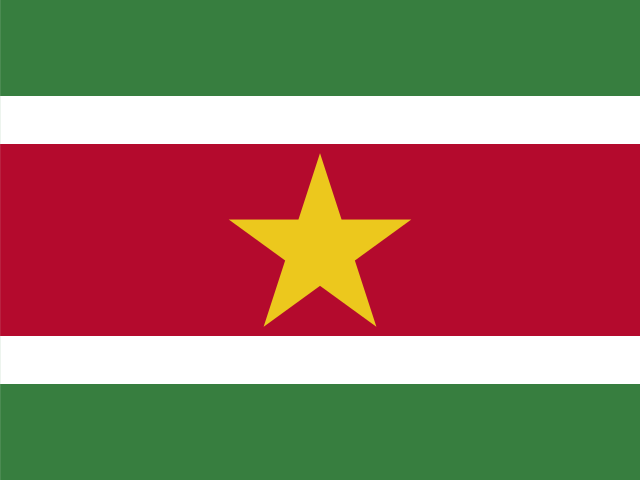
The Flag of Suriname
South America · Adopted 25 November 1975
Suriname's current flag flew for the first time on 25 November 1975, the exact day the country became independent from the Netherlands, replacing a design that had represented Suriname only as an autonomous Dutch territory rather than a sovereign state. That earlier flag, used from 1959, was white with a black five-pointed star ringed by palm branches — a design tied specifically to Suriname's colonial status, which made it unsuitable to carry forward once full independence was on the table.
The 1975 replacement uses five horizontal bands — green, white, red, white, green, with the central red band twice the width of the others — and a single large yellow, five-pointed star centered in the red field. The proportions and the wide central red stripe are deliberate: they make sure the flag reads clearly as a distinct design even at a distance, rather than blending into the green-white-red combinations several other nations also use.
Each color was assigned a specific meaning at independence. Green, appearing at both top and bottom, stands for Suriname's fertility and its agricultural land, a large share of which lies in dense Amazonian rainforest that still covers most of the country's interior. White represents justice and freedom. Red, dominating the flag's center, stands for the country's progress and the love its people hold for the nation. The gold star is read as a symbol of unity — specifically the unity of Suriname's genuinely unusual ethnic composition, which includes descendants of Dutch settlers, enslaved Africans, indentured laborers brought from British India and the Dutch East Indies (Java), Chinese migrants, and Indigenous and Maroon communities, one of the most ethnically layered populations of any country in South America.
Suriname remains the only Dutch-speaking country in South America, a direct legacy of a 1667 territorial swap between England and the Netherlands in which the Dutch traded their claim to New Amsterdam — the settlement that would become New York — for full control of the Suriname colony, then considered the more valuable sugar-producing possession. That colonial history explains why Suriname's flag, unlike almost every other South American nation's, carries no visual debt to Spanish or Portuguese revolutionary tricolor traditions; its design vocabulary developed independently, shaped by Dutch rather than Iberian colonial administration.
The flag has not been redesigned since 1975, and its adoption is treated as inseparable from the independence moment itself — Surinamese Independence Day and Flag Day fall on the same date, 25 November, unlike most countries where a flag's adoption and the nation's founding are commemorated separately.
Because Suriname's color palette and star motif don't closely echo any other national flag currently in use, it stands out as one of the more visually distinct designs in South America, in contrast to the tightly related yellow-blue-red family shared by Colombia, Ecuador, and Venezuela farther north on the continent.
No single individual is widely credited as the flag's sole designer; the 1975 design emerged from a national preparatory committee formed in the lead-up to independence, tasked with settling on colors and a layout that could represent the new republic's diverse population rather than any one ethnic or political faction — a deliberately collective process, in keeping with the emphasis the star's 'unity' symbolism was meant to carry.
Suriname's government revisited the flag's official color specifications around 2015, formalizing exact Pantone-equivalent shades for the green, red, and gold used in government-issued flags — a technical update aimed at consistency across official production rather than any change to the design itself, which has otherwise remained exactly as adopted in 1975.
Suriname's Independence Day ceremonies in 1975 were bittersweet for a significant share of the population: fearing instability after Dutch rule ended, roughly a third of Surinamese citizens emigrated to the Netherlands in the years surrounding independence, meaning the new flag was raised in Paramaribo even as tens of thousands of Surinamese watched from a country the flag no longer represented — a demographic split still visible today in the large Surinamese-Dutch community that remains concentrated in the Netherlands.
Because Suriname's star sits on red rather than on a blue field, as is more common among flags using a single central star (Vietnam, Somalia, and Ghana's flags all place a star on different background colors), the specific green-white-red-white-green banding is usually cited by vexillologists as the flag's most genuinely distinguishing feature, rather than the star alone, which by itself is a common enough device across many unrelated national flags worldwide.
Suriname's interior, still overwhelmingly forested and home to Maroon communities descended from enslaved Africans who escaped Dutch plantations and established independent settlements deep in the rainforest starting in the 17th and 18th centuries, is rarely depicted directly on the flag, but the green bands are commonly explained in Surinamese civic material as covering both the agricultural coastal strip most of the population lives on and the vast, sparsely populated forest interior that makes up the majority of the country's total land area.
The flag's stability through instability is notable in its own right: Suriname endured a 1980 military coup led by Sergeant-Major Dési Bouterse that installed seven years of military rule, followed decades later by Bouterse's own return to power as elected president from 2010 to 2020 despite a 1999 in-absentia conviction related to a 1990s drug-trafficking case — a turbulent political arc across which the 1975 flag itself was never altered or replaced, unlike some of Suriname's regional neighbors that changed flags alongside changes in government. The 1975 independence ceremony in Paramaribo was attended by Princess Beatrix of the Netherlands, representing the Dutch crown in the formal transfer of sovereignty, and Suriname's first prime minister, Henck Arron, addressed the crowd as the new flag was raised for the first time in place of the 1959 colonial-era banner — a handover that, unusually among former Dutch colonies, both countries' governments describe to this day as having been negotiated and executed without significant violence.
A centre band wider than the rest
- Proportion-accurate flag — The page says the wide red band exists specifically so the flag reads at distance, which means a version cut with even bands loses the property the proportions were chosen for.
As an Amazon Associate we earn from qualifying purchases made through these links, at no extra cost to you.
Suriname at a glance
- Capital
- Paramaribo
- Population
- 0.61 million (2024)
- Currency
- Surinamese Dollar (SRD)
- Language(s)
- Dutch (official); Sranan Tongo widely used as a lingua franca
Population figure as of 2024, source: UN World Population Prospects (2024 revision). See methodology for how facts are sourced and kept current.