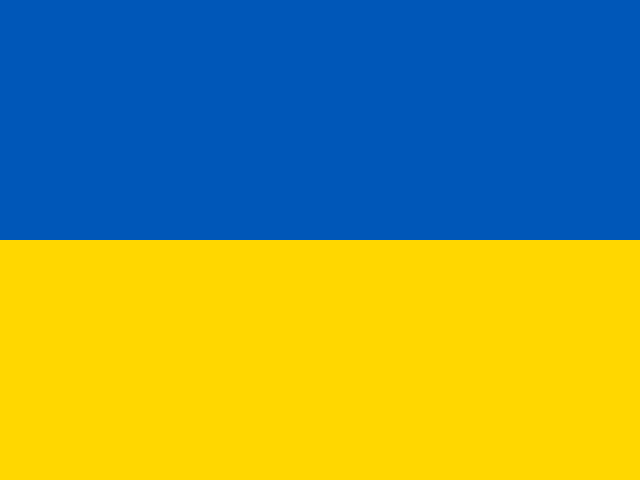
The Flag of Ukraine
Europe · Adopted 4 September 1991 (raised over parliament); law formalizing colors and proportions passed 28 January 1992
Ukraine's flag is a plain horizontal bicolor, sky-blue over golden yellow, and the sky-over-wheat-fields reading most people know it by is genuine and widely used inside Ukraine itself — but it sits alongside an older, heraldic explanation that historians treat as at least as important: the colors echo the arms of the medieval Kingdom of Galicia–Volhynia (also called the Kingdom of Ruthenia), a powerful 13th- and 14th-century state centered on western Ukraine whose ruling dynasty used a golden lion on a blue field, giving blue-and-yellow a documented heraldic pedigree in the region stretching back roughly seven centuries before the sky-and-wheat interpretation became popular.
The blue-yellow combination first flew as a modern national symbol in 1848, when Ukrainian activists in Habsburg-ruled Lviv — then part of Austrian Galicia, no relation to Russian-ruled Ukrainian territory at the time — raised it during that year's wave of European revolutions as a marker of Ukrainian national identity distinct from both Polish and Austrian symbols in the region.
The flag became a state symbol in earnest with the short-lived Ukrainian People's Republic, proclaimed in 1917 amid the collapse of the Russian Empire; that republic used the blue-over-yellow banner until it was overrun by Bolshevik and then Polish forces by 1920, after which Ukraine was absorbed into the Soviet Union and the flag was suppressed for seven decades. The Ukrainian Soviet Socialist Republic instead flew a red flag with a narrow blue stripe near the bottom edge from 1949 until 1991, a design imposed to fit the standard Soviet-republic flag template rather than continuing any pre-revolutionary Ukrainian symbolism.
The blue-yellow flag returned to official use on 4 September 1991, when it was raised over the Ukrainian parliament building in Kyiv roughly two weeks after the country's 24 August 1991 declaration of independence from the collapsing Soviet Union — but the precise legal specification of the flag, including its exact shades and the 2:3 proportion, was not settled until a separate law passed on 28 January 1992, so the flag's restoration to public buildings actually preceded the law that formally defined it by several months.
Because the sky-over-wheat interpretation resonates so strongly with Ukraine's identity as one of the world's major grain-exporting nations — a role that became a subject of intense international attention after Russia's full-scale invasion in February 2022 disrupted Black Sea grain shipments — that reading has become the dominant popular explanation inside Ukraine today, even though vexillologists are careful to note the flag's design was not created with that specific agricultural symbolism in mind; the blue-yellow color choice predates any deliberate 'sky and wheat' framing by more than a century.
Since 2022, Ukraine's flag has become one of the most widely displayed national flags outside its own borders in recent memory, flown at solidarity demonstrations, government buildings, and private homes across dozens of countries as a show of support following the Russian invasion — a level of international visibility unmatched by almost any other national flag's use abroad in peacetime or wartime in the 21st century.
Ukraine's flag law also fixes a specific shade of blue and yellow by Pantone-equivalent standard, a level of precision added relatively late — the 2006 law 'On the Flag of Ukraine' updated the earlier 1992 legislation to remove ambiguity in the exact shades after inconsistent manufacturing had led to visibly different blues and yellows appearing on flags produced by different makers throughout the 1990s.
During the Soviet suppression of the blue-yellow flag between 1920 and 1991, the design survived largely through the Ukrainian diaspora — communities in Canada, the United States, and elsewhere that had emigrated before or shortly after the Bolshevik takeover kept flying the pre-Soviet Ukrainian People's Republic flag at community events and diplomatic missions-in-exile throughout the Cold War, which meant the design was never fully lost from public use even during the seven decades it was banned inside Soviet Ukraine itself.
A small trident symbol, the tryzub, appears on Ukraine's separate coat of arms rather than on the flag itself; the tryzub is an even older emblem than the blue-yellow bicolor, tracing to the personal seal of Volodymyr the Great, the 10th-century ruler of Kyivan Rus', and its adoption as the state emblem alongside the flag in the early 1990s reflects the same instinct seen in the flag's own Galicia-Volhynia lineage — reaching back past the Soviet period to pre-Soviet, specifically East Slavic royal symbolism to anchor modern Ukrainian statehood.
Ukraine's 2004 Orange Revolution, sparked by a disputed presidential election, gave the blue-yellow flag an additional layer of association with pro-democracy and pro-Western political movements inside the country, since orange (the campaign color of the protests, not part of the flag itself) was deployed alongside the national colors at mass demonstrations in Kyiv's Independence Square — a pairing that recurred a decade later during the 2013–2014 Euromaidan protests, cementing the flag's association with successive waves of civic protest against governments seen as too closely aligned with Moscow.
The order of Ukraine's two colors was not fully settled even during the flag's earliest use: while the 1848 Lviv flag and the 1992 law both fix blue above yellow, surviving photographs and written accounts from the chaotic 1917–1920 period of the Ukrainian People's Republic show yellow-over-blue versions flown alongside the now-standard blue-over-yellow at various fronts and public buildings, a genuine historical inconsistency Ukrainian vexillologists attribute to the absence of any enforced central specification during years of war and shifting governments rather than to any change in meaning between the two orderings. Ukraine formalized a separate Flag Day, 23 August, timed deliberately to fall the day immediately before Independence Day on 24 August — a pairing created in 2004 specifically so the flag's own celebration would lead directly into the independence anniversary rather than compete with it, giving Ukraine back-to-back national observances most other countries mark on a single date.
Sky blue, not navy
- Dyed-through flag — The upper band is specified as a light sky blue rather than a deep one, and printed stock routinely comes through much darker, which changes the balance between the two halves entirely.
As an Amazon Associate we earn from qualifying purchases made through these links, at no extra cost to you.
Ukraine at a glance
- Capital
- Kyiv
- Population
- 38.0 million (2024)
- Currency
- Ukrainian Hryvnia (UAH)
- Language(s)
- Ukrainian (official)
Population figure as of 2024, source: UN World Population Prospects (2024 revision). See methodology for how facts are sourced and kept current.