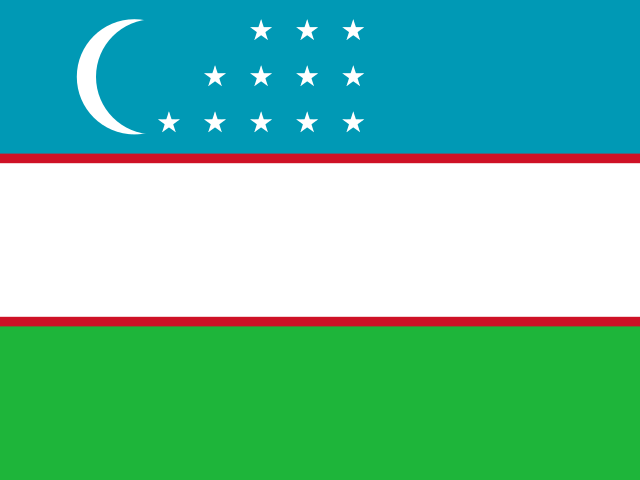
The Flag of Uzbekistan
Asia · Adopted 18 November 1991
Uzbekistan adopted its current flag on 18 November 1991, roughly two months after declaring independence from the collapsing Soviet Union, replacing the Uzbek Soviet Socialist Republic's flag, a red field bearing the Soviet hammer-and-sickle and a horizontal blue stripe near the bottom edge. The new design abandoned Soviet iconography entirely in favor of a horizontal tricolor of blue, white, and green, separated by thin red fimbriations (border lines), with a white crescent moon and twelve white five-pointed stars positioned in the upper hoist canton.
Blue, the top and most prominent stripe, is officially explained as representing water and sky, a resonant symbolic choice in a country that is one of only two doubly landlocked nations in the world (bordered entirely by other landlocked countries) and where water scarcity, particularly around the shrinking Aral Sea, is a genuine and pressing national concern rather than an abstract poetic reference; blue is also tied by some Uzbek officials to the legacy of Amir Timur (Tamerlane), the 14th-century conqueror and Uzbek national hero whose empire's flags and monuments are strongly associated with the color turquoise-blue.
White represents peace and the pursuit of moral purity, and green — the bottom stripe — represents nature and, in the Islamic symbolic tradition widely used across Central Asia, is also linked to the region's Islamic heritage and to fertility and renewal; the thin red lines separating the three main stripes are officially described as representing the life force that runs through and unites all living things, a somewhat more abstract vitalist symbolism than the more historically specific readings given to the other colors.
The crescent moon in the canton is generally read both as a reference to Uzbekistan's Islamic heritage and, in some official explanations, as symbolizing the country's rebirth as a newly independent nation — a 'new moon' framing consistent with how several other post-Soviet Muslim-majority republics linked crescent imagery to national renewal rather than purely religious meaning at the moment of independence.
The twelve stars are officially explained in Uzbek government sources as representing the twelve months of the solar Hijri calendar, or alternatively the twelve constellations of the zodiac in an interpretation tied to pre-Islamic Central Asian astronomical tradition — Uzbek officials have offered both readings at different points, and unlike some other national symbols the government has not settled on one canonical explanation over the other, an honest ambiguity rather than a single fixed answer.
Uzbekistan's flag proportions and color specifications were fixed by law at adoption in 1991 and have not been redesigned since, giving the country flag stability through more than three decades that included a change of president (from Islam Karimov, who ruled 1991–2016, to Shavkat Mirziyoyev) and a significant post-2016 shift toward greater economic openness, none of which prompted any alteration to the national flag itself.
Because several Central Asian and Turkic-heritage nations use blue prominently and combine it with crescent-and-star Islamic symbolism, Uzbekistan's flag is occasionally confused at a glance with others in the region, but its specific blue-white-green tricolor with red fimbriations and a canton crescent-and-twelve-stars combination is unique among Central Asian flags — no neighboring country uses the identical color sequence or star count.
The particular shade of turquoise-blue used on the flag is often described in Uzbek sources as directly echoing the color of the glazed tilework covering the domes and portals of Samarkand and Bukhara's famous Timurid-era Islamic architecture, monuments built under and after Amir Timur's rule that remain among Central Asia's most recognizable historic landmarks — making the flag's blue a reference to a specific, visually iconic national architectural heritage rather than an abstract color choice alone.
Uzbekistan's twelve stars are arranged in three rows of four across the canton alongside the crescent, a layout distinct from the single-arc star arrangements used on flags like Turkmenistan's or the scattered constellations sometimes seen on other national flags, giving the canton a more geometrically ordered appearance consistent with the overall structured, symmetrical design philosophy of the flag as a whole.
Uzbekistan is one of only two doubly landlocked countries in the world — meaning every neighboring country is itself landlocked — the other being Liechtenstein in Europe, a genuinely unusual geographic fact the flag's water-and-sky blue symbolism sits somewhat poignantly alongside, since access to open water is a real and long-standing practical constraint on the country's trade and development rather than a purely symbolic concern.
The flag's designers reportedly considered several alternative color schemes during the 1991 design process before settling on the blue-white-green tricolor, and the choice of blue as the dominant color, rather than the green more commonly associated with Islamic-heritage flags across the wider region, is sometimes cited as a deliberate attempt to visually distinguish Uzbekistan's flag from Turkmenistan's and other neighboring green-dominant designs adopted around the same period of Central Asian independence.
Uzbekistan marks 18 November as State Flag Day, a separate national observance from Independence Day on 1 September, giving the flag its own dedicated annual ceremony distinct from the broader independence commemoration — a distinction not every post-Soviet republic bothers to draw, since several neighboring states fold flag-related ceremony into their single independence-day observances rather than giving the flag its own date.
The national flag law fixes the overall proportions at 1:2 and specifies the crescent and stars in pure white against the blue field, with the twelve stars set in three evenly spaced rows of four running alongside the crescent rather than arcing around it — a tighter, grid-like canton layout that stands out next to the single-arc star arrangements used on Turkmenistan's flag or Uzbekistan's own Karakalpakstan autonomous republic flag, which carries a crescent-and-stars canton of its own within Uzbekistan's federal structure.
Twelve stars and thin red lines
- Detail-accurate printed flag — Twelve small stars sit in three rows beside the crescent, and thin red lines separate the bands; both the star count and those hairlines are what a loose print gets wrong.
As an Amazon Associate we earn from qualifying purchases made through these links, at no extra cost to you.
Uzbekistan at a glance
- Capital
- Tashkent
- Population
- 36.4 million (2024)
- Currency
- Uzbekistani Som (UZS)
- Language(s)
- Uzbek (official); Russian widely used in business and government
Population figure as of 2024, source: UN World Population Prospects (2024 revision). See methodology for how facts are sourced and kept current.