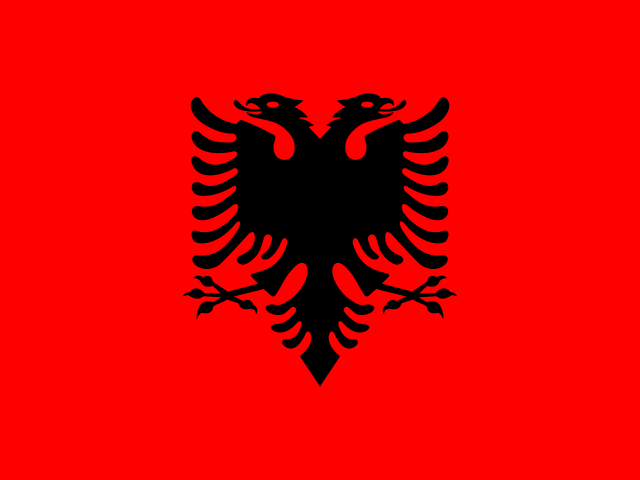
Tirana — Capital of Albania
Tirana is a relatively young capital by European standards. The settlement traces back to an Ottoman-era market town founded in 1614 by Sulejman Bargjini, a local Ottoman official, around a mosque, bakery, and hammam built at a crossroads — but it only became Albania's capital in 1920, chosen by a national congress at Lushnjë as a compromise site partly because it sat roughly in the geographic middle of the country and had no strong prior association with any single regional power base, unlike Shkodër or Vlorë, both of which had also been proposed.
The city's most architecturally striking period came under Fascist Italian influence in the 1930s, when Italian architects including Armando Brasini and Florestano Di Fausto laid out Tirana's central boulevard and government district in a monumental, rationalist style intended to evoke a modern European capital — many of those buildings, including the current Prime Minister's office, still stand and remain in government use today. Communist rule after 1944 then added its own layer, most visibly the vast Skanderbeg Square at the city's heart and grey Soviet-style apartment blocks that still house much of the population.
Tirana's most recognizable recent transformation came under mayor (later prime minister) Edi Rama in the early 2000s, when hundreds of the city's drab communist-era apartment façades were repainted in bright, often abstract patterns of orange, purple, and yellow — an inexpensive public-art initiative that drew international attention and became closely associated with the city's post-communist reinvention, even as much of the underlying urban infrastructure remained unchanged for years afterward.
The Pyramid of Tirana, originally built in 1988 as a museum honoring dictator Enver Hoxha, has itself become a symbol of the city's layered history: abandoned and graffitied for years after communism fell, used briefly as a NATO base during the 1999 Kosovo crisis, and reopened in 2023 after renovation as a youth technology and education center — a physical monument to totalitarian personality cult repurposed for an entirely different era.
As Albania's political, economic, and cultural hub, Tirana hosts the country's parliament, main university (founded 1957), and the bulk of its foreign embassies, and its population has grown rapidly since the early 1990s as rural Albanians migrated to the city following the collapse of collective agriculture — a shift that turned Tirana from a modest administrative town into by far Albania's largest urban area within a single generation.
Tirana's selection over Shkodër and Vlorë in 1920 came in the aftermath of a genuinely fragile period for Albanian sovereignty: the country had only narrowly avoided being partitioned between its neighbors following the collapse of the short-lived 1914 princely government under Wilhelm of Wied, and the Lushnjë congress that chose Tirana was itself convened partly to reassert Albanian territorial claims against Italian, Greek, and Yugoslav pressure in the aftermath of the First World War — meaning the capital's location was picked as much for political neutrality among competing internal factions as for geography alone.
The city's Blloku district, once a restricted, walled-off neighborhood reserved exclusively for communist-era Communist Party officials and off-limits to ordinary citizens under Enver Hoxha's regime, has been reopened since the early 1990s and transformed into one of Tirana's most fashionable areas for cafes, bars, and nightlife — a striking inversion of the district's original purpose that Tirana residents themselves often cite as emblematic of the city's broader post-communist reinvention.
Quick facts
- UN population estimates put Tirana's metropolitan area at roughly 900,000 people as of 2024, a total concentrated increasingly in suburban and satellite municipalities rather than the older city core.
- The city sits at the foot of Mount Dajti, whose slopes are reachable by a cable car (the Dajti Ekspres) opened in 2005, a popular day trip for Tirana residents.
- Tirana was not Albania's capital until 1920 — earlier Albanian administrative centers under Ottoman and early-independence rule were based in Shkodër, Vlorë, and briefly Durrës.
- Skanderbeg Square, the city's central plaza, is named for the same 15th-century national hero whose double-headed eagle appears on the Albanian flag.
- Et'hem Bey Mosque, completed in 1821 on Skanderbeg Square, survived the communist government's 1967 campaign to close all religious buildings and remains an active mosque today.