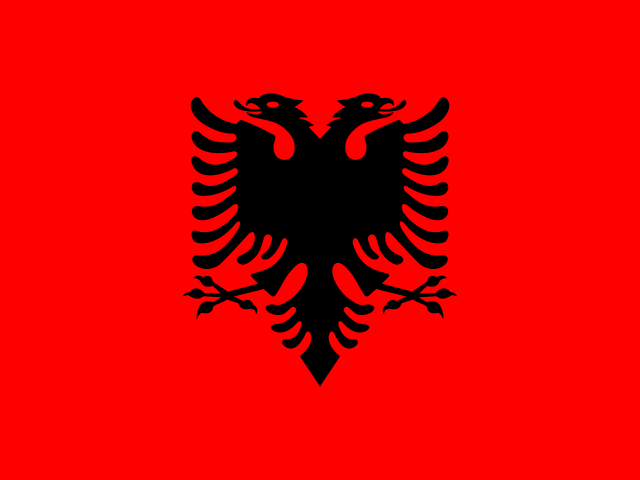
The Flag of Albania
Europe · Adopted 7 April 1992 (current civil/state form); eagle motif dates to the 15th century
Albania's flag is built around a single figure that has represented the country, in one form or another, since well before Albania existed as a modern state: the black double-headed eagle, taken directly from the personal seal of Gjergj Kastrioti Skanderbeg, the 15th-century nobleman who led a decades-long revolt against Ottoman rule from his mountain stronghold at Krujë. Skanderbeg's own banner is recorded as a black eagle on red, and when Albanian nationalists began agitating for independence from the Ottoman Empire in the late 19th century, they reached back to his emblem rather than inventing a new one, treating the eagle as proof that Albanian resistance to foreign rule had a five-century pedigree.
The modern flag was first raised as a state symbol on 28 November 1912 in the city of Vlorë, when Ismail Qemali declared Albanian independence from a crumbling Ottoman Empire and hoisted a red flag bearing Skanderbeg's black eagle from the balcony of a rented building — an event still marked annually as Flag Day. That same red-and-black combination has persisted through every subsequent Albanian government despite the country living through monarchy, Italian and German occupation in the Second World War, over four decades of one of Europe's most isolated Stalinist dictatorships under Enver Hoxha, and a democratic transition in the early 1990s — an unusual degree of symbolic continuity given how much the state built around the flag changed.
Communist Albania did not discard the eagle, but it altered the flag to fit the regime: from 1946 the design carried a gold-bordered red star above the eagle's heads, a standard addition across the Eastern Bloc signaling the state's socialist orientation. That star was removed by parliamentary decree on 7 April 1992, after the fall of the Hoxha-successor government, restoring the flag to the plain red-and-black form used in 1912 — making 1992 the date of the current design even though the eagle-on-red concept itself is decades older still.
Red is generally explained in Albania as a symbol of the bravery, strength, and blood sacrificed by those who fought Ottoman rule and, later, 20th-century occupiers, while black stands for the double-headed eagle itself and, by extension, for Albania's sovereignty and freedom as a nation. The double head is read two ways in Albanian tradition: as a link to the Byzantine imperial eagle Skanderbeg's family used, and, more popularly, as representing the union of the country's two historical regions, Gegëria in the north and Toskëria in the south — a reading that gives the ancient symbol a distinctly Albanian national meaning beyond its Byzantine origin.
The flag went through one further, less-remembered alteration under Italian occupation between 1939 and 1943, when Fascist Italy annexed Albania in a personal union with the Italian crown: the eagle was retained but crowned and paired with the Roman fasces, the bundle-of-rods symbol of Italian fascism, on the canton — a visible graft of occupying-power iconography onto the existing national emblem rather than a wholesale replacement, and one erased again once occupation ended, first by German forces after Italy's 1943 surrender and then permanently after the war.
Skanderbeg's own historical standing gives the eagle emblem weight well beyond decoration: his League of Lezhë, formed in 1444, briefly united Albania's fractious regional princes under a single military command against Ottoman expansion, and though the alliance and the resistance it sustained eventually collapsed after his 1468 death, Skanderbeg is still taught in Albanian schools as the figure who proved organized Albanian resistance to foreign domination was possible — the same claim the 1912 independence flag was designed to invoke by reusing his personal emblem rather than adopting a wholly new symbol.
Albania's eagle is visually close to a small cluster of other national and historical flags that also draw on the Byzantine double-headed eagle tradition — Montenegro's, Serbia's, and the flag once used by the Byzantine Empire itself all show the same basic bird — but Albania's is the only one paired with a plain, unbroken red field and no other charges, coat-of-arms shield, or crown, which keeps it visually distinct once you know to look for it.
The current civil and state flag proportions and exact shade of red were fixed in Albania's 2002 law on national symbols, alongside a related but separate state flag carrying additional heraldic detail used on some official buildings; the plain eagle-on-red version is what flies over ordinary civic life, from apartment balconies to football matches, and is the version Albanians overwhelmingly recognize as 'the flag.'
Albanians living abroad, particularly across Kosovo, North Macedonia's Albanian-majority areas, and diaspora communities in Italy, Switzerland, and the United States, fly the same red-and-black eagle as a marker of ethnic Albanian identity that extends well beyond the borders of the Albanian state itself — a use that sometimes causes diplomatic friction with neighboring governments but that Albanians themselves generally see as an uncontroversial expression of shared heritage rather than a territorial claim.
Kosovo, despite its overwhelmingly ethnic-Albanian population and deep cultural ties to Albania, deliberately chose not to adopt the same red-and-black eagle as its own state flag upon declaring independence in 2008, opting instead for a blue field with a gold silhouette map of Kosovo and six stars — a choice driven partly by international mediators pushing for a more neutral, multi-ethnic-inclusive symbol, leaving Albania's eagle flag as something flown widely and enthusiastically by Kosovo Albanians in an unofficial, cultural capacity rather than as Kosovo's own state emblem.
The red behind the eagle
- Colourfast outdoor flag — A black figure on a plain red field shows fading more plainly than any striped design does, because there is no second colour to compare it against once the red has drifted toward orange.
As an Amazon Associate we earn from qualifying purchases made through these links, at no extra cost to you.
Often confused with
- Montenegro — also centers a gold double-headed eagle, but Montenegro's sits inside a golden border on a red field with a crowned shield and lion beneath it, adding heraldic detail Albania's plain eagle omits. Compare side by side →
Albania at a glance
- Capital
- Tirana
- Population
- 2.7 million (2024)
- Currency
- Albanian Lek (ALL)
- Language(s)
- Albanian (official)
Population figure as of 2024, source: UN World Population Prospects (2024 revision). See methodology for how facts are sourced and kept current.