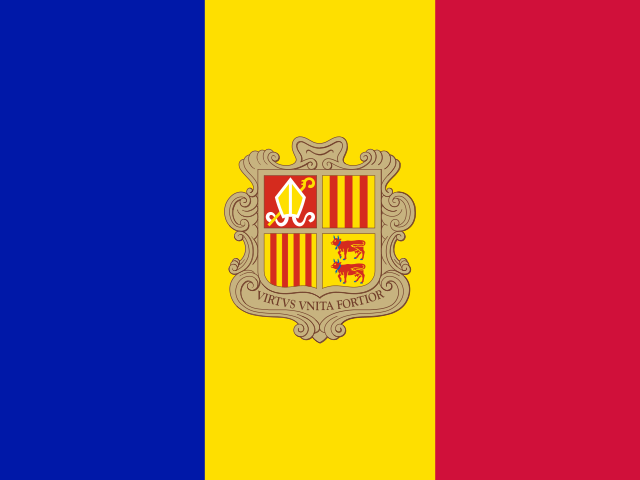
Andorra la Vella — Capital of Andorra
Andorra la Vella sits at roughly 1,023 meters above sea level in a valley where the Valira del Nord and Valira del Orient rivers meet, making it the highest capital city in Europe by elevation. The settlement's origins go back to at least the 9th century, when Charlemagne's grandson Charles the Bald is traditionally credited with granting the valley's residents a charter in gratitude for their help against Moorish incursions — a story central to Andorran founding myth even where the precise historical documentation is thin.
For most of its history Andorra la Vella was a modest mountain town whose economy centered on livestock, subsistence farming, and smuggling across the nearby French and Spanish borders, a trade that took on particular importance during periods when tariffs or wartime shortages made cross-border price differences worth the risk. The town's political importance came not from size but from its role as the seat of the Consell de la Terra, Andorra's centuries-old representative council, which has met in the Casa de la Vall — a stone building dating to 1580 — since the council's modern form took shape, making it one of the oldest continuously used parliament buildings in Europe.
Andorra la Vella's transformation from sleepy mountain town to prosperous capital happened almost entirely in the second half of the 20th century, driven by two forces: a tax-haven status that for decades imposed no income tax and drew both wealthy residents and cross-border shoppers, and the growth of skiing tourism in the surrounding Pyrenees, which turned Andorra into a winter-sports destination for visitors from France and Spain. Duty-free shopping along the city's central Avinguda Meritxell remains one of its defining features today, though Andorra has since moved toward more conventional taxation under pressure from the EU.
Because Andorra has no armed forces of its own beyond a small ceremonial force, and because its two co-princes — the President of France and the Bishop of Urgell — both reside outside the country, Andorra la Vella functions as a capital without ever having needed the fortifications, palaces, or military installations typical of most European seats of government; its skyline is dominated instead by banks, ski-tourism infrastructure, and, more recently, Casa de la Vall's modern successor buildings for the Consell General.
Andorra la Vella was never seriously threatened militarily even during the region's most turbulent periods, including the Spanish Civil War and the Second World War, when Andorra's neutrality and rugged mountain isolation allowed the town to remain largely untouched even as fighting and occupation reshaped much of the surrounding French and Spanish territory — a continuity that let the town's historic core, including the Romanesque Sant Esteve church dating to the 11th and 12th centuries, survive intact into the present day.
The city has also become a notable venue for cross-border cooperation given its position: Andorra la Vella and the surrounding parishes rely on both French and Spanish infrastructure for electricity, telecommunications, and transport in ways few other European capitals need to from two separate neighboring states simultaneously, a practical daily expression of the same dual-sovereignty arrangement that shapes the country's flag and constitutional structure.
Tourism dwarfs the resident population in Andorra la Vella in a way few other capitals experience: the country as a whole receives well over eight million visitor-days a year, drawn largely by duty-free shopping, spa resorts, and the surrounding ski areas, meaning the capital's shops, hotels, and restaurants are built to serve a seasonal crowd many times the size of the town's own roughly 23,000 residents. That imbalance shapes daily life in the center of town, where pharmacies, electronics retailers, and perfumeries cluster far more densely along the Avinguda Meritxell than the resident population alone would ever support.
Just outside Andorra la Vella, the Meritxell Basilica — rebuilt in a strikingly modern style after a 1972 fire destroyed the original Romanesque sanctuary — houses the shrine of Our Lady of Meritxell, Andorra's patron saint, and remains the site of the country's official national holiday each September 8, when the government and much of the population make a pilgrimage from the capital to the sanctuary.
Quick facts
- Andorra la Vella counted roughly 23,000 residents in the UN's 2024 population data, a small figure that still represents close to a quarter of Andorra's entire national population living within one town.
- At over 1,000 meters elevation, it is the highest-altitude national capital in Europe.
- The Casa de la Vall, built in 1580 as a noble family's fortified house before becoming the seat of Andorra's parliament, served in that role until the Consell General moved to a newer building in 2011.
- Andorra la Vella has no airport or rail connection; visitors reach it by road from France or Spain, a legacy of the surrounding Pyrenean terrain.
- The city's name translates simply as 'Andorra the Old,' distinguishing the original town core from later expansion.
- Caldea, opened in Andorra la Vella in 1994, is one of Europe's largest thermal spa and leisure complexes, drawing on the region's natural hot springs beneath a distinctive glass-and-steel needle-shaped tower that has become a recognizable part of the capital's skyline.