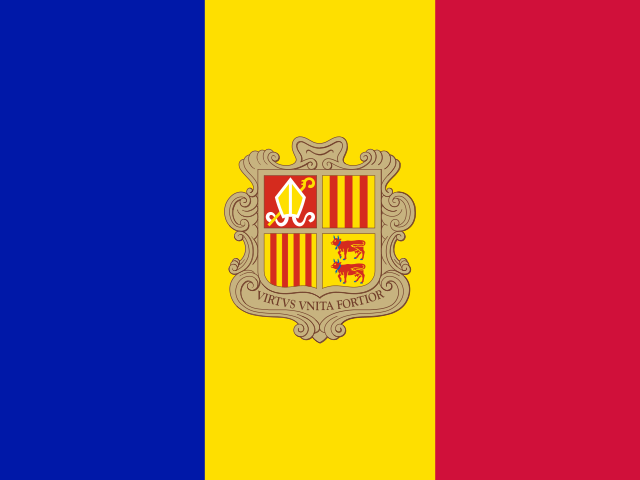
The Flag of Andorra
Europe · Adopted 1866 (tricolor established); coat of arms standardized 1971
Andorra's blue-yellow-red vertical tricolor is a genuinely unusual case among European flags: it exists largely because a 19th-century bishop-co-prince wanted the tiny Pyrenean principality to look distinctly Andorran rather than like an extension of either of the two much larger states that have jointly governed it since 1278. Andorra has been a co-principality shared between the French head of state and the Spanish Bishop of Urgell for over seven centuries, an arrangement with no real equivalent elsewhere in Europe, and its flag reflects that dual patronage directly: blue and red are drawn from France's tricolor, yellow and red from Spain's, giving Andorra a flag that visually announces its position between its two much larger neighbors rather than concealing it.
The tricolor is generally dated to 1866, introduced under the episcopal co-prince Bishop Josep Caixal as part of a broader push to give Andorra clearer national symbols during a period when the country's traditional governing council, the Consell de la Terra, was being reformed. Andorra had flown other, less standardized banners before that, but the blue-yellow-red arrangement is the one that stuck and has remained the flag ever since, making it one of the older continuously-used flag designs in Europe even though it took until the 20th century for its exact proportions to be legally fixed.
What distinguishes Andorra's flag from a simple France-Spain color mashup is the coat of arms placed in the center of the yellow band — a shield quartered into four sections, each representing one of the historical powers with a claim over Andorran territory: a mitre and crosier for the Bishop of Urgell, three red vertical bars for the Counts of Foix (whose title passed to the French crown and eventually the French presidency), two cows for the historic viscounty of Béarn, and four red-and-gold bars, the arms of Catalonia, for the Bishop of Urgell's connection to the wider Catalan-speaking region. Below the shield runs the national motto 'Virtus Unita Fortior' — Latin for 'strength united is stronger' — a fitting emblem for a country whose entire political identity rests on shared sovereignty rather than a single ruling house.
The coat of arms and its exact composition were formally standardized in 1971 under co-prince arrangements that also regularized other aspects of Andorran state symbolism, though the core four-quarter design long predates that codification and appears on Andorran documents and buildings well back into the 19th century. Unlike many European states that redesigned their flags after revolutions or regime changes, Andorra's evolution has been incremental — refining and legally fixing a design rather than replacing it.
Andorra's unusual dual-sovereignty arrangement, the Pareatges (Pareages) agreed in 1278 between the Count of Foix and the Bishop of Urgell to settle a territorial dispute, is the direct institutional root of the flag's whole design logic: because Andorra was never a conquest or a unilateral founding by one power, but a negotiated settlement between two rival claimants, its national symbol had to visually accommodate both lineages rather than assert the primacy of either — a genuinely rare case of a flag's structure being dictated by a centuries-old legal settlement rather than by war, revolution, or a single ruling dynasty's arms.
The Counts of Foix title that supplies one quarter of the shield eventually passed, through a chain of inheritance and political change, to the Kings of Navarre and then to the French crown itself, and after the French Revolution abolished the monarchy the co-princely role passed to the French head of state in whatever form that took — meaning the President of France has held the Andorran co-princely title since 1993, an arrangement in which the flag of a small mountain principality still visually encodes a feudal inheritance chain running back over seven centuries into French royal history.
Because Andorra's blue-yellow-red bands are unequal in the country's official version — narrower blue and red stripes flanking a wider central yellow band bearing the coat of arms — it is sometimes confused at a glance with Romania's or Moldova's flags, which are also blue-yellow-red vertical tricolors but with equal-width stripes and, in Moldova's case, a different coat of arms; Andorra's noticeably wider yellow center band is the quickest way to tell them apart even without examining the emblem closely.
Andorra flies its flag over government buildings in the capital, Andorra la Vella, and civil versions without the coat of arms are also used informally, though the coat-of-arms version remains the one recognized internationally and used at events like the Olympics, where Andorra has competed as an independent nation since 1976.
Andorra's own constitutional modernization did not arrive until 1993, when a new constitution formally established a parliamentary co-principality with clearly defined democratic institutions alongside the two co-princes, whose roles became largely ceremonial and symbolic from that point onward — a transition that left the flag's centuries-old dual-lineage design untouched even as the underlying political system it represented was substantially modernized around it, another instance of Andorra updating its governance while treating its flag as a fixed inheritance rather than something to redesign alongside constitutional change.
A lettered ribbon at flag scale
- Full-colour printed flag — The arms carry four quartered devices and a ribbon of small lettering underneath, which is about the smallest thing any flag asks a printer to reproduce legibly.
As an Amazon Associate we earn from qualifying purchases made through these links, at no extra cost to you.
Often confused with
- Romania — shares the same blue-yellow-red vertical order, but Romania's three stripes are equal width and carry no coat of arms, unlike Andorra's wider central yellow band bearing its four-quarter shield. Compare side by side →
- Moldova — also a blue-yellow-red tricolor with a coat of arms centered on yellow, but Moldova's stripes are equal width and its emblem is an eagle holding a shield, quite different from Andorra's four-quarter heraldic shield. Compare side by side →
Andorra at a glance
- Capital
- Andorra la Vella
- Population
- 81,000 (2024)
- Currency
- Euro (EUR)
- Language(s)
- Catalan (official)
Population figure as of 2024, source: UN World Population Prospects (2024 revision). See methodology for how facts are sourced and kept current.