St. John's — Capital of Antigua and Barbuda
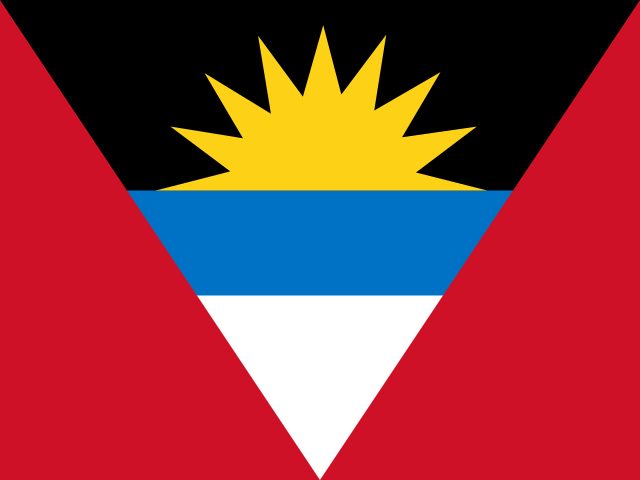
See the flag of Antigua and Barbuda →
St. John's sits on the northwestern coast of Antigua, on a natural harbor that made it the obvious administrative center from the earliest days of English settlement in the 1630s, and it has never had to compete with a rival town for capital status the way many Caribbean capitals eventually did — Antigua's small size and St. John's protected anchorage settled the question early and permanently. The English established the settlement as their colonial base as the island's sugar economy developed through the 17th and 18th centuries, and the city grew around the harbor as the hub for exporting sugar grown on plantations worked by enslaved Africans across the island.
St. John's Cathedral, whose current twin-towered structure dates to 1845 after two earlier church buildings on the same site were destroyed — one by an earthquake in 1683 and its 18th-century replacement by another earthquake in 1843 — is the most recognizable landmark in the city's skyline and a rare example in the Eastern Caribbean of a cathedral rebuilt in the same baroque-revival style twice after natural disasters.
The city's role expanded rather than changed at independence in 1981: it remained the seat of national government for the newly sovereign state exactly as it had been the colonial administrative center, so unlike capitals built or relocated at independence elsewhere in the world, St. John's continuity is unbroken back to the 17th century.
Modern St. John's is built substantially around cruise tourism, with Heritage Quay and Redcliffe Quay — restored 18th- and 19th-century warehouse districts near the harbor, originally built to store sugar, molasses, and rum for export — now converted into shopping and dining areas that cater to the large cruise ships that dock in the deep-water harbor, a striking transformation of buildings whose original purpose was tied directly to the plantation economy the flag's black stripe commemorates the end of.
The city also houses the country's national museum, set in the former courthouse building dating to 1747, and serves as the base for Antigua and Barbuda's government ministries, its main hospital, and the regional campus facilities that give St. John's an administrative weight far beyond what its modest population alone would suggest for an Eastern Caribbean capital of its size.
Nelson's Dockyard, a restored 18th-century Royal Navy base at English Harbour on the opposite side of the island from St. John's, is where Admiral Horatio Nelson was stationed in the 1780s, and though it isn't in the capital itself, it remains administratively and touristically tied to St. John's as the seat of the national government agencies that manage the site, now a UNESCO World Heritage Site inscribed in 2016 for its exceptional preservation of Georgian-era naval architecture.
St. John's has weathered numerous hurricanes over its history, including significant damage during the 1995 Hurricane Luis season, and the city's low-lying harborfront areas remain a recurring focus of Antigua and Barbuda's disaster preparedness planning, a concern shared broadly across the hurricane-exposed Eastern Caribbean but felt acutely in a capital whose commercial core sits directly at sea level around the harbor.
Quick facts
- About 22,000 people live within St. John's city limits, with the surrounding urban fringe pushing the total closer to 27,000 — a quarter of Antigua and Barbuda's entire population concentrated in one town.
- The current St. John's Cathedral, completed in 1845, was built with an interior timber shell inside stone walls specifically as an earthquake-resistant design after two prior churches on the site were destroyed.
- Heritage Quay and Redcliffe Quay, now tourist shopping districts, were originally built as warehouses for the sugar, rum, and molasses trade that dominated Antigua's colonial economy.
- St. John's Harbour is a natural deep-water harbor, which is why the English chose the site for their earliest colonial settlement on Antigua in the 1630s.
- The city is the seat of the University of the West Indies' Antigua and Barbuda site, part of a regional university system shared across several English-speaking Caribbean nations.