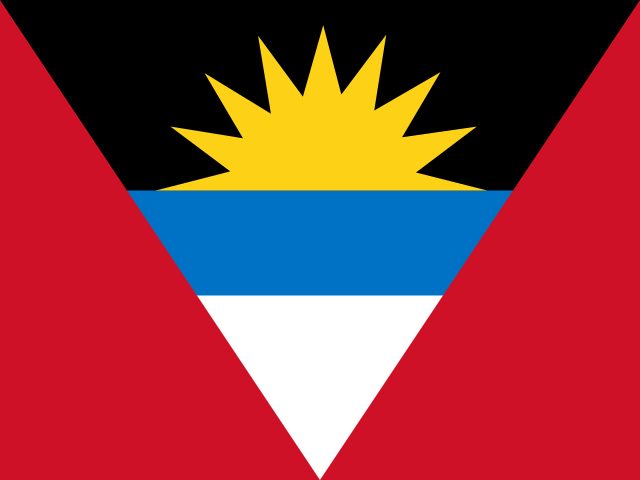
The Flag of Antigua and Barbuda
North America · Adopted 27 February 1967
Antigua and Barbuda's flag was chosen by a competition rather than commissioned from a single designer. The government invited citizens to submit designs as the islands prepared for statehood in association with the United Kingdom, and a local artist and teacher, Sir Reginald Samuel, won with a layout that was formally hoisted on 27 February 1967, when Antigua and Barbuda became an Associated State. The same design carried through unchanged when full independence from Britain arrived on 1 November 1981, which is unusual — many former British Caribbean territories adjusted or entirely replaced their pre-independence flags at the moment of full sovereignty, but Antigua and Barbuda simply kept Samuel's winning entry as the national flag of the new state.
The flag's most-discussed feature is the rising sun: a golden-yellow sun rising out of a black band at the top of a V-shaped panel, itself set inside a red field, with blue and white bands below. Samuel's own explanation, still repeated by the Antiguan government, reads each element specifically — black represents the African heritage of the majority of the population, descended from people brought to the islands in the transatlantic slave trade to work the sugar plantations that defined the islands' colonial economy for two centuries. The sun symbolizes the dawn of a new era, a common motif for Caribbean states leaving colonial status, but paired here with a literal historical claim: local guides and government materials describe it as marking the ending of slavery and the start of a new day for the islands' people.
Blue stands for the surrounding Caribbean Sea, red for the dynamism and energy of the Antiguan and Barbudan people, and the combination of blue and white repeated in the lower bands is also read as a nod to the Redcoat-and-white uniforms of the historic Royal Naval Dockyard at English Harbour, though this secondary reading is less consistently emphasized than the sun-and-slavery narrative in official descriptions. The V-shape formed by the sun's rays is sometimes described locally as standing for 'Victory,' a reading that gained currency after independence even though it wasn't part of Samuel's original 1967 submission notes.
Antigua and Barbuda's flag has not been redesigned since 1967, making it one of the more stable national symbols to emerge from Britain's Caribbean decolonization wave of the 1960s and 1970s — several neighboring islands went through additional design changes around their independence dates, but Antigua and Barbuda's has stood for over half a century without alteration to its layout, though minor standardizations of the exact shades used have occurred as reproduction technology changed.
The government maintains detailed specifications for the flag's construction, including the precise angle and proportions of the sun's rays and the V-panel, and Antiguan and Barbudan law treats the flag as a protected national symbol, with guidance issued on correct display for national holidays such as Independence Day on 1 November and V.C. Bird Day, honoring the country's first prime minister.
Because the design is a genuine local competition winner rather than an adaptation of an existing colonial ensign, Antigua and Barbuda's flag doesn't share direct design lineage with most of its Caribbean neighbors' flags, even though several were adopted within a few years of one another during the same era of British decolonization in the region.
The flag is flown across government buildings and schools throughout both islands and is a fixture of Antigua's cricket culture, appearing prominently at matches and carried by supporters — cricket having been one of the few institutions that historically united Antigua and the much smaller, less populous island of Barbuda under a shared public identity before and after independence.
Sir Reginald Samuel was a schoolteacher at the time he submitted his design, and he went on to a long career in Antiguan public life, eventually being knighted for his contribution to the nation's identity; his original submission sketches are held by the Antigua and Barbuda national archives, and schoolchildren are taught his name specifically, unlike in many countries where the individual designer of the national flag has been lost to history or was never a single identifiable person at all.
The choice to keep Barbuda's name and identity visible in the country's full title, rather than simply calling the nation 'Antigua' as is sometimes done informally abroad, mirrors a broader tension the flag itself does not resolve directly: Barbuda, with a far smaller population than Antigua and its own distinct land-tenure traditions, has periodically pushed for greater autonomy within the union, most visibly after Hurricane Irma devastated the island in 2017 and forced a full evacuation of its roughly 1,800 residents to Antigua, reigniting long-standing debates about Barbudan self-governance that predate and continue alongside the shared national flag.
Antigua and Barbuda's government has occasionally revisited flag protocol in the decades since 1967 without touching the design itself — updating guidance, for instance, on flying the flag at half-mast for national mourning and clarifying its use alongside the Union Jack at official Commonwealth functions, since the country retains the British monarch as head of state represented locally by a governor-general, unlike republics such as Dominica or, since 2021, Barbados.
The angle of the sun's rays
- Geometry-accurate flag — The rays and the V-shaped panel both have specified angles, and the usual fault in a redrawn version is rays fanned too wide so the sun stops sitting inside the V.
As an Amazon Associate we earn from qualifying purchases made through these links, at no extra cost to you.
Often confused with
- Dominica — also uses a striped field with a central emblem, but Dominica's is a green field with a cross of yellow, black, and white stripes and a red disc bearing a sisserou parrot — the color palette and central motif are entirely different from Antigua and Barbuda's rising sun. Compare side by side →
Antigua and Barbuda at a glance
- Capital
- St. John's
- Population
- 94,000 (2024)
- Currency
- Eastern Caribbean Dollar (XCD)
- Language(s)
- English (official); Antiguan Creole widely spoken
Population figure as of 2024, source: UN World Population Prospects (2024 revision). See methodology for how facts are sourced and kept current.