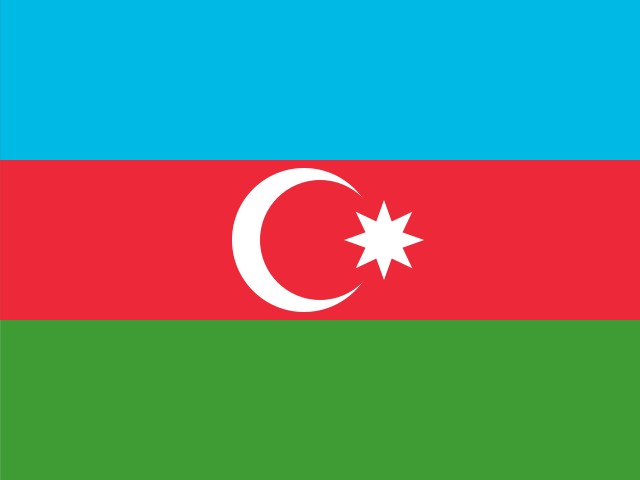
Baku — Capital of Azerbaijan
Baku sits on the Absheron Peninsula jutting into the Caspian Sea, and its natural harbor together with the region's long-known oil seeps made it a significant settlement well before the modern industrial oil age. The walled Old City (Icherisheher), with roots going back to at least the 12th century and possibly earlier, still stands largely intact at Baku's center, surrounded by the much larger modern city that grew up around it during two separate oil booms.
The first oil boom, from the 1870s onward under the Russian Empire, transformed Baku almost overnight from a modest walled town into one of the world's leading oil-producing centers, drawing international investors including the Nobel brothers and the Rothschild family and giving the city much of its ornate late-19th-century architecture, built with oil wealth in styles borrowed from European capitals. Baku briefly served as the capital of the independent Azerbaijan Democratic Republic from 1918 to 1920, before Soviet annexation, and then continued as the capital of Soviet Azerbaijan and independent Azerbaijan after 1991 without interruption.
A second oil boom followed independence in the 1990s and 2000s, as Azerbaijan signed major international production-sharing agreements — most notably the 1994 'Contract of the Century' with a consortium of Western oil companies — that funded a further wave of construction, including the Flame Towers skyscraper complex completed in 2012, whose LED-lit exteriors have become the city's most recognizable modern landmark.
Baku hosted the 2015 European Games and the Formula 1 Azerbaijan Grand Prix, which runs partly through the streets of the Old City and the modern waterfront, part of a deliberate government push over the past two decades to position Baku as an international events and tourism destination distinct from its earlier identity as primarily an industrial oil city.
The city's Maiden Tower, part of the Old City's fortifications and dating in its current form to roughly the 12th century, has an uncertain original purpose that historians still debate — theories range from a defensive structure to a Zoroastrian fire temple site — and it remains part of the Old City complex, which has held UNESCO World Heritage status since 2000.
The Heydar Aliyev Center, designed by architect Zaha Hadid and completed in 2012, is one of Baku's most internationally recognized modern buildings, its flowing white curves deliberately avoiding sharp angles or straight lines to break from the rigid geometry of Soviet-era architecture still visible elsewhere in the city; the building won the London Design Museum's Design of the Year award in 2014 and is named for the country's former president and the current president's father.
The Baku Metro opened in 1967, making it the first underground rail system in the Caucasus region, and its stations, built in the elaborate Soviet tradition of using metro architecture for civic display, feature marble, chandeliers, and mosaics depicting scenes from Azerbaijani history and literature, a style shared with other former Soviet metro systems in Moscow and elsewhere.
Baku's seaside boulevard, running for several kilometers along the Caspian waterfront and first laid out in the early 20th century, has been repeatedly expanded and now anchors much of the city's public recreational space, including parks, an amusement park, and venues built for international events such as the 2015 European Games and Formula 1 Grand Prix races through the adjoining street circuit.
Ateshgah, a fire temple on Baku's outskirts historically used by Zoroastrian, Hindu, and Sikh traders for fire worship connected to the region's natural gas seeps, reflects Baku's long pre-Islamic association with fire and flame — a symbolic thread that also underlies Azerbaijan's modern nickname, the 'Land of Fire.'
Quick facts
- Greater Baku is home to more than 2.3 million people according to 2024 estimates — by a wide margin the largest urban area anywhere in the South Caucasus.
- Baku lies below sea level, at roughly 28 meters (92 feet) below sea level, one of the lowest-elevation major cities in the world.
- UNESCO World Heritage status came to the Old City, Maiden Tower, and Shirvanshahs' Palace in 2000, recognition of the ensemble's unbroken Ottoman-era streetscape.
- Baku briefly served as capital of the short-lived Azerbaijan Democratic Republic (1918–1920), the first parliamentary republic in the Muslim world.
- The city is nicknamed the 'City of Winds' for the strong northerly khazri and southerly gilavar winds that blow across the Absheron Peninsula.