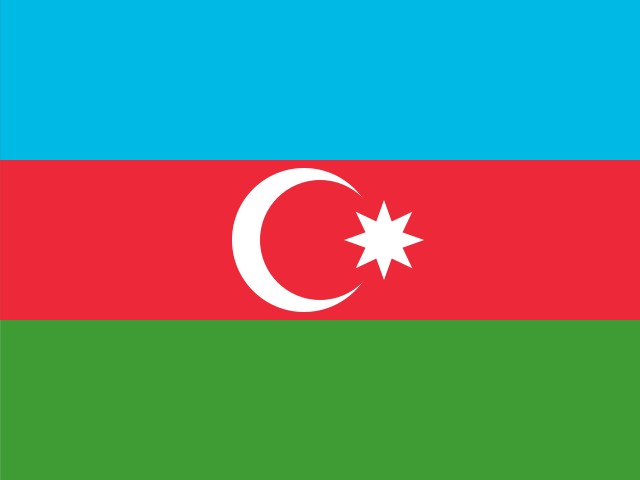
The Flag of Azerbaijan
Asia · Adopted 5 February 1991
Azerbaijan's flag — horizontal bands of blue, red, and green with a white crescent and eight-pointed star centered on the red — was formally readopted on 5 February 1991, months before the country's full independence from the Soviet Union that December, but the design itself dates to 1918, when it was flown by the Azerbaijan Democratic Republic, the first secular parliamentary republic in the Muslim world. That first republic lasted barely two years before the Red Army invaded in 1920 and imposed Soviet rule, after which the tricolor was banned for seven decades in favor of Soviet Azerbaijan's red flag.
The three colors are tied, in the standard Azerbaijani explanation, to three overlapping strands of national identity rather than to a single theme: blue represents the country's Turkic heritage and is linked to the wider Turkic world; red stands for progress and modernization, and by extension for Azerbaijan's early-20th-century push toward secular, Western-style statehood; and green represents Islam. That three-part formula — Turkic, modern/secular, and Islamic — was an explicit ideological statement by the 1918 republic's founders, who wanted a flag that held those three identities in visible balance rather than privileging one over the others.
The white crescent and eight-pointed star sit on the red band. The crescent is a widely used Islamic symbol, echoed on flags from Turkey to Pakistan, but the eight points of the star carry a specific local meaning: they are usually explained as representing the eight Turkic peoples or, in an alternate reading favored by some 1918-era sources, the eight letters of the word 'Azerbaijan' when spelled in the Arabic script once used to write Azerbaijani before the later switch to Latin and then Cyrillic and back to Latin scripts across the 20th century.
Between 1920 and 1991, Soviet Azerbaijan flew a red flag with a hammer, sickle, and star in gold, along with the word for the republic rendered in the Azerbaijani Cyrillic script of the period — a design that, like other Soviet republican flags, subordinated any distinct national symbolism to the standard Soviet visual template, which is why the return of the 1918 tricolor in 1991 was framed domestically as a restoration of independence-era identity rather than a new creation.
The flag has not changed in design since its 1991 return, though Azerbaijani law does specify exact construction details, including the flag's 1:2 ratio and precise color values, along with strict rules on its ceremonial display and criminal penalties for its desecration or improper handling.
Because the crescent-and-star motif recurs on many other flags associated with Turkic or Islamic-majority nations, Azerbaijan's flag is sometimes visually grouped with Turkey's in casual conversation, but the resemblance stops at the crescent-and-star device itself — Turkey's flag is solid red with no horizontal bands and a five-pointed rather than eight-pointed star, making the two flags straightforward to distinguish once compared directly.
The 1918 Azerbaijan Democratic Republic's original flag was not the current tricolor from the very start of the republic — for its first months the republic flew a plain green flag with a white crescent and star, reflecting its origins as an Islamic-oriented breakaway from the short-lived Transcaucasian Democratic Federative Republic, and only in November 1918, as the republic's parliament sought a design representing Azerbaijan's Turkic and secular-modernizing character more fully alongside its Islamic identity, did lawmakers add the blue and red bands to create the tricolor still used today.
Azerbaijan's relationship with Turkey is officially summarized in the phrase 'one nation, two states,' reflecting close linguistic and cultural ties between Azerbaijani and Turkish, and the two countries' similar crescent-and-star flags are often invoked in Azerbaijani political rhetoric as a visual expression of that same closeness — a rare case where a flag resemblance between two countries is treated domestically as a deliberate point of pride rather than a source of confusion to be minimized.
The flag's return in 1991 came during an especially difficult period for the new republic: the war with Armenia over the Nagorno-Karabakh region had already begun, and Azerbaijan's early independence years were marked by heavy fighting and displacement before a 1994 ceasefire, followed decades later by renewed conflict in 2020 and a final Azerbaijani military campaign in 2023 that brought the entire disputed territory back under Baku's control — meaning the tricolor flew throughout as the flag of a state fighting to secure the borders it claimed rather than over a settled, uncontested territory.
Azerbaijan's flag law also specifies a unique national requirement that the flag be flown continuously, day and night, over the presidential residence, parliament, and a handful of other key state buildings, illuminated after dark rather than lowered at sunset as is customary in many other countries, a rule that underscores the symbolic weight the post-Soviet state places on constant, uninterrupted flag display.
Baku's National Flag Square, opened in 2010 on the Caspian Sea waterfront, once held the record for the world's tallest freestanding flagpole at 162 meters before being surpassed by taller poles built in Saudi Arabia and Tajikistan soon after, and the giant flag it flies, reportedly among the largest national flags ever manufactured for regular use, has needed periodic replacement due to wind damage — a visible, monumental extension of the same 2002-era legal emphasis on constant flag display into physical infrastructure built specifically to showcase the tricolor at an unusually large scale.
Counting the points on the star
- Detail-accurate printed flag — The star has a fixed number of points rather than the usual five, and that count is the first thing a loose reproduction rounds off. Count the points in the listing photograph before buying.
As an Amazon Associate we earn from qualifying purchases made through these links, at no extra cost to you.
Often confused with
- Turkey — shares the white crescent-and-star device on red, but Turkey's flag is solid red with no blue or green bands and uses a five-pointed star rather than Azerbaijan's eight-pointed one. Compare side by side →
- Turkmenistan — also uses a green field with a white crescent and stars, but Turkmenistan's design is dominated by a vertical carpet-pattern stripe near the hoist that Azerbaijan's flag has no equivalent of. Compare side by side →
Azerbaijan at a glance
- Capital
- Baku
- Population
- 10.3 million (2024)
- Currency
- Azerbaijani Manat (AZN)
- Language(s)
- Azerbaijani (official)
Population figure as of 2024, source: UN World Population Prospects (2024 revision). See methodology for how facts are sourced and kept current.