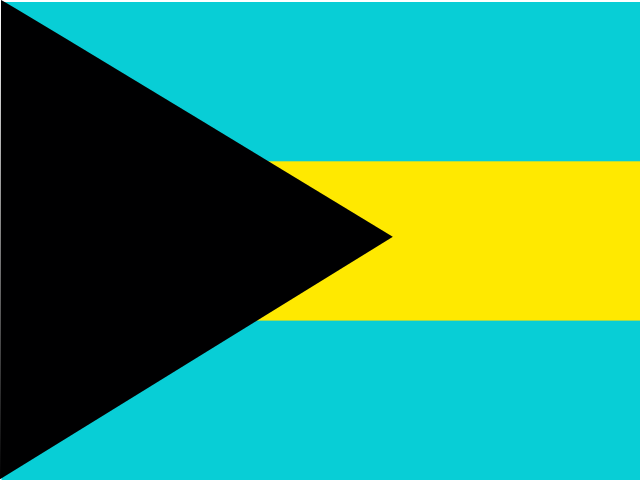
Nassau — Capital of Bahamas
Nassau sits on New Providence Island and has been the capital of the Bahamas since English settlers formally established the town in 1670 under a royal charter granted to the Lords Proprietors of Carolina, who administered the Bahamas as an extension of their Carolina colony for several decades before the Crown took direct control. The settlement was originally named Charles Town after King Charles II, but it was rebuilt and renamed Nassau in the 1690s in honor of William III, Prince of Orange-Nassau, after French and Spanish raids had left the earlier town largely destroyed.
In the early 18th century Nassau earned a lasting reputation as a pirate haven: with weak colonial governance and a well-protected harbor, the town became a base for figures including Blackbeard and Calico Jack Rackham during what's often called the Golden Age of Piracy, until Britain appointed Woodes Rogers as the first royal governor in 1718 specifically to suppress piracy and reassert crown control — a campaign commemorated today in the city's unofficial motto, adapted from Rogers's own seal, 'Expulsis Piratis, Restituta Commercia' ('Pirates expelled, commerce restored').
The city's role as capital carried through unchanged from the colonial period into full independence in 1973, and Nassau today houses Parliament, the Supreme Court, and the country's main government offices, alongside a modern economy built substantially around cruise tourism and offshore financial services rather than the piracy and privateering that shaped its earliest reputation.
Fort Charlotte, completed in 1794 under British governor Lord Dunmore and never actually used in combat, remains one of the largest colonial-era fortifications in the Bahamas and overlooks Nassau's harbor, a reminder of the defensive concerns that shaped the city's layout even though the fort itself never fired a shot in anger.
Modern Nassau is connected by bridge to the adjacent resort development of Paradise Island, and the wider Nassau metropolitan area contains the large majority of the entire country's population, concentrating Bahamian political, economic, and cultural life in a way unusual even among small island nations.
The Queen's Staircase, 66 steps carved by enslaved laborers from a single limestone ridge in the late 18th century to provide a route between Fort Fincastle and the city below, was renamed in the 1890s in honor of Queen Victoria's 66-year reign and remains one of Nassau's most-visited historic sites, a monument whose construction history — carved manually, without dynamite, over more than a decade — is frequently cited in Bahamian heritage tourism materials alongside its more romanticized colonial-era name.
Nassau's financial services sector grew rapidly from the mid-20th century onward as the Bahamas developed into an offshore banking center, drawing on favorable tax laws and the country's proximity to the United States, a shift that transformed the city's economy well beyond its earlier reliance on shipping, wrecking, and, during the U.S. Prohibition era of the 1920s, rum-running to the American coast just a short sail away.
The Government House, official residence of the Bahamian governor-general, sits atop one of Nassau's highest points and has hosted the ceremonial handover of authority at every constitutional milestone since the mid-20th century, including the 1973 independence transition, when the outgoing British colonial governor formally passed authority to the newly self-governing Bahamian state in a ceremony held on the surrounding grounds.
Quick facts
- Roughly two-thirds of all Bahamians, an estimated 274,000 people, live in or around Nassau, a concentration of population in a single metro area that few other Caribbean nations approach.
- The city was originally named Charles Town in the 1670s and was renamed Nassau in the 1690s after William III of Orange-Nassau.
- Nassau served as a base for pirates including Blackbeard in the early 1700s before Britain's first royal governor, Woodes Rogers, suppressed piracy there from 1718 onward.
- Fort Charlotte, completed in 1794, is the largest of several colonial-era forts built to defend Nassau's harbor and never saw combat.
- Nassau is linked by two bridges to Paradise Island, home to major cruise and resort tourism developments central to the modern Bahamian economy.