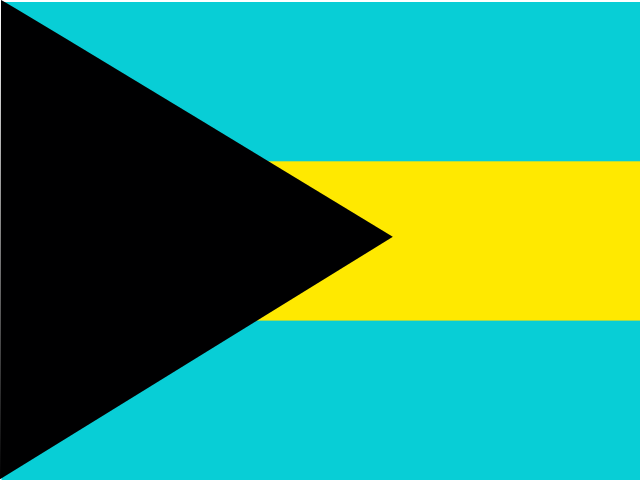
The Flag of Bahamas
North America · Adopted 10 July 1973
The Bahamian flag was adopted on 10 July 1973, the exact day the Bahamas gained independence from the United Kingdom, replacing a colonial Blue Ensign defaced with the territorial badge that had flown over the islands throughout British rule. Like several of its Caribbean neighbors, the Bahamas ran a public design competition ahead of independence, and the winning concept — credited to a joint effort refined by a government committee rather than a single named designer, drawing on submissions from the public — settled on three horizontal bands of aquamarine, gold, and aquamarine with a black equilateral triangle at the hoist.
The color choices are tied directly to the Bahamian landscape and economy rather than to a historical struggle narrative: the aquamarine bands represent the surrounding sea, for which the islands' tourism-driven economy is largely known, and the gold band represents the sand of the islands' beaches. The black triangle at the hoist stands for the unity and strength of the Bahamian people, with black specifically chosen to represent the African heritage of the majority-Black population descended from enslaved and free Black settlers who came to the islands from the 17th century onward, including a significant wave of free Black Loyalists and enslaved people brought by Loyalist planters fleeing the United States after the American Revolution.
Unlike many post-independence Caribbean flags that lead with a historical-liberation narrative, Bahamian government materials frame the design around forward-looking national resources — sea, sun, and sand — reflecting the islands' self-conception as a nation whose modern identity and economy are inseparable from its geography, since tourism built around exactly those beaches and waters has been the dominant sector of the Bahamian economy since the mid-20th century.
The flag has not been redesigned since 1973, and its specifications are set by law, including the exact aquamarine and gold shades and triangle proportions; the design is deliberately simple by Caribbean-flag standards, with no crest, no central emblem, and no text, a departure from several neighboring islands that incorporated maps, wildlife, or historical symbols into their post-independence flags.
Because the aquamarine-gold-aquamarine banding is a genuinely uncommon combination worldwide, the Bahamian flag has few close look-alikes among sovereign states, though its color palette is sometimes echoed informally in regional tourism branding across the wider Caribbean given how strongly it's associated with turquoise water and white sand in popular imagery.
Bahamian law designates 10 July as Independence Day, with flag-raising ceremonies held nationally, and the flag appears widely in the country's Junkanoo festival celebrations, a street parade tradition with roots in West African and Caribbean masquerade customs that predates independence but has become closely entwined with modern Bahamian national identity and, by extension, with the flag itself.
The design committee that finalized the 1973 flag drew on entries submitted through a public competition run by the pre-independence government, but chose not to credit a single winning designer the way Antigua and Barbuda or Barbados did with their own competitions around the same period — official Bahamian accounts describe the final design as a synthesis of several submissions rather than one person's concept, a detail that distinguishes its adoption story from most of its Eastern Caribbean neighbors.
The black hoist triangle's angle and the exact proportion of aquamarine to gold banding are fixed by the Bahamas Independence Order of 1973 and subsequent flag regulations, which also specify correct orientation — the triangle must point toward the fly, not the hoist, a detail occasionally reversed in error on informally produced flags and merchandise, prompting periodic government reminders about correct display.
Because the Bahamas comprises more than 700 islands and cays spread across a large stretch of ocean, the flag's sea-and-sand symbolism carries a literalness some other national flags' color choices lack — Bahamian civic materials frequently point out that the design was meant to be recognizable and meaningful equally to a resident of populous New Providence and to someone living on one of the much smaller Family Islands, where the connection to surrounding water is even more immediate to daily life.
Junkanoo itself long predates the 1973 flag by centuries, tracing to masquerade and music traditions brought by enslaved Africans and adapted in the Bahamas from at least the 18th century onward, and the modern Boxing Day and New Year's Day Junkanoo parades in Nassau now routinely feature costumes, banners, and float designs built explicitly around the flag's aquamarine, gold, and black palette, a fusion of an older cultural tradition with a comparatively young national symbol that Bahamians themselves often note as a distinctly homegrown pairing.
The Bahamas' path to the 1973 flag was notably calmer than several of its Caribbean neighbors' independence transitions, having gained internal self-government in 1964 and majority-rule government in 1967 without the level of armed conflict or prolonged political crisis seen elsewhere in the region during decolonization, a comparatively gradual process that Bahamian officials sometimes cite when explaining why the flag's messaging emphasizes shared natural resources and unity rather than a struggle-and-liberation narrative more common among flags adopted after harder-fought independence movements.
Government House and other official buildings in Nassau fly the flag alongside a separate governor-general's standard on ceremonial occasions, since the Bahamas retains the British monarch as head of state represented by a locally appointed governor-general, a constitutional arrangement the country has kept unchanged since 1973 even as some other former British Caribbean territories, including Barbados, have since moved to full republican status.
An aquamarine that has to hold
- Dyed-through flag — There is no emblem or lettering anywhere on this flag, so colour and the triangle's proportions are the entire specification, and a printed aquamarine washes toward pale grey- blue in a season.
As an Amazon Associate we earn from qualifying purchases made through these links, at no extra cost to you.
Bahamas at a glance
- Capital
- Nassau
- Population
- 412,000 (2024)
- Currency
- Bahamian Dollar (BSD)
- Language(s)
- English (official); Bahamian Creole widely spoken
Population figure as of 2024, source: UN World Population Prospects (2024 revision). See methodology for how facts are sourced and kept current.