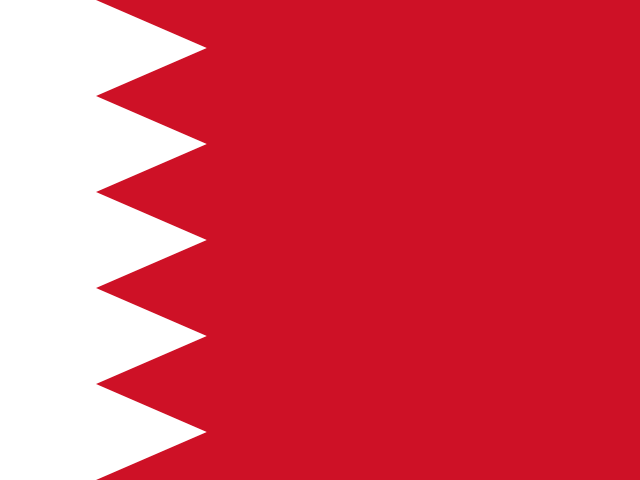
Manama — Capital of Bahrain
Manama occupies the northeastern tip of Bahrain's main island, a location that put it at the center of Gulf pearling and trade routes for centuries before oil was discovered. The city's name is first recorded in Islamic-era geographical texts as early as the 14th century, and archaeological evidence around the wider island points to continuous habitation and trade activity going back millennia, tied to Bahrain's ancient identity as the likely site of Dilmun, a trading civilization mentioned in Sumerian texts.
Manama became the seat of Al Khalifa rule after the family took control of Bahrain in 1783, and it has remained the political capital continuously since, through the period of British protection (1861–1971), full independence in 1971, and the 2002 shift from emirate to constitutional kingdom — a long, uninterrupted run as capital that distinguishes Bahrain from Gulf neighbors whose capitals shifted location or status more dramatically over the same period.
Bahrain's pearling industry, historically centered on Manama's harbor, was one of the most important in the world before the development of Japanese cultured pearls in the early 20th century collapsed the natural-pearl market; the Bahrain Pearling Trail, a set of oyster beds, harbor sites, and merchant houses in and around Manama, joined the UNESCO World Heritage list in 2012, a designation created specifically to preserve the memory of that pre-oil economy.
Oil was discovered in Bahrain in 1932 — the first commercial oil find on the Arab side of the Gulf — and Manama grew rapidly afterward as the new industry's administrative and financial center; the city later leveraged that early start to become one of the Gulf's leading banking and finance hubs from the 1970s onward, a role it has kept even as Bahrain's own oil reserves, more modest than those of some neighbors, have been gradually depleted.
Manama hosts the Bahrain International Circuit's promotional and organizational offices and sits close to the causeway connecting Bahrain to Saudi Arabia, opened in 1986, which turned the city into a regular weekend destination for visitors from Saudi Arabia's Eastern Province.
The Bahrain World Trade Center, completed in Manama in 2008, was the first commercial skyscraper in the world to integrate large-scale wind turbines directly into its structure, with three turbines mounted on sky-bridges between its twin towers generating a portion of the building's own electricity — a design that became a widely cited example of Gulf architecture experimenting with sustainability rather than relying solely on air conditioning and glass curtain walls.
Manama's old souq, threaded through narrow lanes near the Bab Al Bahrain gateway built by the British in 1949, remains a working commercial district selling gold, textiles, and spices rather than a purely tourist-oriented reconstruction, and it sits only a short walk from the glass office towers of the modern financial district, giving the city center an unusually sharp visual contrast between eras within a few hundred meters.
Manama's Pearl Roundabout became the focal point of Bahrain's 2011 Arab Spring protests, when demonstrators occupied the square for weeks demanding political reform before security forces cleared it in March 2011; the roundabout's central monument was subsequently demolished, and the site remains a sensitive point in the country's recent political history.
Bahrain's population is unusual among Gulf states for being majority non-citizen, and Manama itself reflects that mix directly, with large South Asian, Southeast Asian, and other expatriate communities living alongside Bahraini nationals and forming the bulk of the private-sector workforce in the city's construction, retail, and domestic-service sectors.
Qal'at al-Bahrain, an archaeological mound on the coast a short distance from central Manama, contains layers of settlement stretching from roughly 2300 BCE through the Portuguese fort built atop it in the 16th century; UNESCO recognized the mound in 2005, a listing that points to the same deep, pre-Islamic Dilmun-era history that also underlies Manama's own ancient roots as a Gulf trading center.
Quick facts
- Roughly 650,000 residents live within Manama's official city limits per 2024 estimates; the built-up area blends into Muharraq and other towns without a sharp boundary, so the functional urban population runs considerably higher.
- The city's name is thought to derive from an Arabic phrase meaning roughly 'the resting place' or 'the sleeping place,' though sources differ on the precise etymology.
- The Bahrain Pearling Trail's 2012 UNESCO listing covers a chain of oyster beds, harbor buildings, and merchant houses running from Manama's old port out to the offshore oyster beds themselves.
- Manama has served as Bahrain's capital continuously since the Al Khalifa family took control of the island in 1783.
- The Al Fateh Grand Mosque in Manama, completed in 1988 with capacity for roughly 7,000 worshippers, ranks among the largest mosques in the world and also houses a library and Islamic-studies center that welcomes non-Muslim visitors.