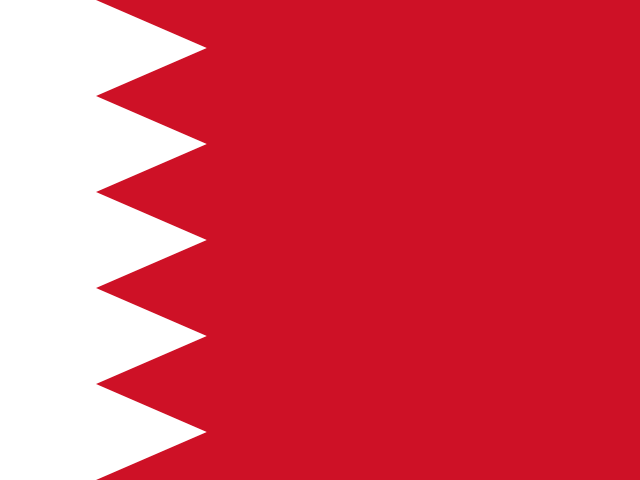
The Flag of Bahrain
Asia · Adopted 14 February 2002
Bahrain's flag — red with a white band along the hoist separated by a serrated line of five white triangles — reached its current, precisely defined form on 14 February 2002, the day the country's constitution was amended and Bahrain was proclaimed a kingdom rather than an emirate. But the red-and-white combination itself goes back much further, to 19th-century treaties between Bahrain's ruling Al Khalifa family and the British government, which required Gulf states under British protection to add white to their traditionally plain red flags so British ships could distinguish friendly vessels from those flying plain red, a color associated at the time with Kharijite Islam and used widely and confusingly across the Gulf's maritime traffic.
Before 2002, Bahrain's flag had used a straight vertical line between the red and white fields, changing to eight serrations (points) at various times through the 20th century as the ruling family adjusted the design; the number of points was reduced specifically to five in 2002 to symbolize the five pillars of Islam, a change made deliberately alongside the constitutional shift to a kingdom, tying a religious symbolic update to the same reform moment as the political one.
Red is generally explained in Bahrain, as in several neighboring Gulf states, as the traditional Kharijite color long associated with the region and its historic maritime trade, rather than carrying a war or bloodshed meaning as it does on many other national flags. White, per the 19th-century British treaty requirement, has no deeper local symbolic meaning beyond that original diplomatic function, though it has since become simply the second half of the national color scheme in its own right.
The serrated boundary between the two colors is what most reliably distinguishes Bahrain's flag from Qatar's, which uses the same maroon-and-white combination with a serrated line but has nine points rather than five and a noticeably longer, lower-ratio flag shape — a distinction rooted in the same 19th-century British-imposed convention that both countries' ruling families adapted slightly differently over the following century.
Bahrain's flag law specifies the flag's proportions (3:5) and the precise geometry of the five serrations, along with formal rules for display on government buildings, ships, and during state occasions, consistent with the broader 2002 constitutional reforms that formalized many previously informal royal-era customs into codified law.
Because the red-white-serrated pattern is unique to Bahrain and Qatar among world flags, confusion between the two is common enough that Gulf-region reference materials routinely include a side-by-side comparison; the quickest visual check is the serration count — five for Bahrain, nine for Qatar.
The 19th-century treaty that produced the white band was part of the broader General Maritime Treaty of 1820 and subsequent agreements Britain imposed on the Gulf sheikhdoms — collectively remembered locally as the 'Trucial' arrangements — aimed at suppressing raiding along British India's shipping lanes; plain red flags had been used widely enough across the Gulf's small ports and dhow fleets that the Royal Navy reportedly could not reliably tell an allied vessel from a hostile one at a distance, and adding a white band, with each ruling family free to choose its own dividing pattern, solved that identification problem at a stroke. Bahrain's ruling Al Khalifa family chose serrations rather than a straight line at some point in the 19th or early 20th century, though the exact date of that specific choice is not precisely fixed in surviving records the way the 2002 change to five points is.
Before the serration count was fixed permanently at five, Bahraini flags photographed and recorded across the 20th century show real inconsistency — some official uses show eight points, others show as many as twenty-eight smaller serrations, reflecting the fact that for most of the century the exact number was a matter of custom and available cloth rather than binding law. The 2002 constitutional reform ended that variability by making five points, tied explicitly to the five pillars of Islam, the only legally correct version, and modern Bahraini flag manufacturers must now follow government-specified templates rather than the more improvisational tailoring common in earlier decades.
Bahrain's National Day, 16 December, marking the 1971 end of the British protectorate treaty relationship, and its Kingdom Day, 14 February, marking the 2002 monarchy proclamation that also fixed the current flag, are treated as separate holidays with distinct flag ceremonies — an unusual arrangement in which a country's independence-from-Britain anniversary and its current-flag anniversary fall nearly two months apart and commemorate two different constitutional milestones rather than a single founding moment.
Bahrain's ruling Al Khalifa family, which has governed the archipelago since conquering it from Persian-aligned rulers in 1783, used the red field for generations before the British treaties existed at all — red had already marked Bahraini vessels and settlements as distinctly regional within the Gulf's wider trading network, and the family's continuous rule since the 18th century is part of why Bahraini officials have generally framed the 2002 changes as constitutional modernization built on an old foundation, formalizing a kingdom around a ruling house whose tenure long predates the country's various 19th- and 20th-century flag adjustments.
As a small archipelago of more than 30 islands connected to Saudi Arabia by the King Fahd Causeway since 1986, Bahrain has historically depended on maritime trade and, since the 1930s, on oil — the first Gulf state to strike commercially significant oil, at the Jebel Dukhan field in 1932 — and the flag's red field is occasionally described in more recent tourism and government material as also evoking that seafaring, trade-oriented history predating the hydrocarbon economy, layering a modern economic narrative on top of the flag's original Kharijite-era color association.
Five points, not nine
- Flag with the correct serration count — The zigzag between the white and maroon is what separates this flag from Qatar's, and the two differ only by how many points that line has, so the count is the whole check on a listing.
As an Amazon Associate we earn from qualifying purchases made through these links, at no extra cost to you.
Often confused with
- Qatar — uses the same red/white serrated-boundary design inherited from the same 19th-century British Gulf treaties, but Qatar's flag has nine serrations rather than five, uses a darker maroon rather than red, and is proportioned much longer and narrower. Compare side by side →
Bahrain at a glance
- Capital
- Manama
- Population
- 1.5 million (2024)
- Currency
- Bahraini Dinar (BHD)
- Language(s)
- Arabic (official)
Population figure as of 2024, source: UN World Population Prospects (2024 revision). See methodology for how facts are sourced and kept current.