Minsk — Capital of Belarus
Minsk's recorded history stretches back to at least 1067, when it appears in the Primary Chronicle in connection with a battle on the Nyamiha River between rival princes of Kievan Rus' — making it, on paper, nearly a thousand years old, though almost nothing of that medieval city survives visibly today. Over the following centuries Minsk passed through the Grand Duchy of Lithuania, the Polish-Lithuanian Commonwealth, and the Russian Empire (after Poland's partitions in the late 18th century), each period leaving administrative and architectural traces before the 20th century erased most of them.
The city Minsk residents and visitors see today is overwhelmingly a product of postwar reconstruction rather than deep historical layering, because Minsk was almost completely destroyed during the Second World War: it was occupied by Nazi Germany from 1941 to 1944, suffered massive destruction in the fighting and occupation, and lost the vast majority of its prewar buildings, along with a large share of its population, including most of its substantial prewar Jewish community, murdered in the Minsk ghetto and surrounding killing sites. Belarus as a whole is estimated to have lost roughly a quarter of its population in the war, and Minsk's postwar rebuilding — wide Stalinist-era boulevards, monumental government buildings, and a rebuilt central Independence Avenue — reflects a city reconstructed almost from scratch under Soviet direction in the late 1940s and 1950s.
Minsk became capital of the Belarusian Soviet Socialist Republic in 1919, cementing its administrative role decades before Belarus became independent, and it retained that status automatically when Belarus declared independence in 1991 — one of relatively few former Soviet republic capitals to carry over its role without dispute or relocation. It also became the headquarters city of the Commonwealth of Independent States, the loose organization formed by several former Soviet republics after the USSR's dissolution, a role it has held since 1991.
Today Minsk functions as Belarus's political, industrial, and educational center, home to the Belarusian State University (founded 1921) and the bulk of the country's government institutions, and its Soviet-era urban planning — wide avenues, large public squares like Independence Square, and extensive metro system opened in 1984 — remains largely intact and is often noted by visitors as an unusually well-preserved example of mid-20th-century Soviet city planning, a direct consequence of the near-total postwar reconstruction that shaped the modern city.
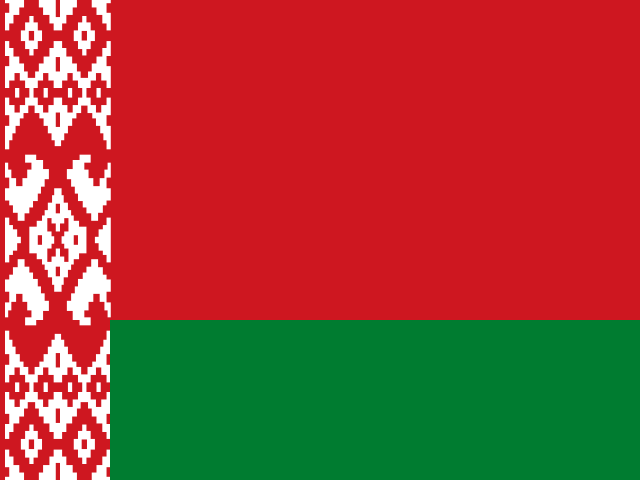
Minsk was also the site of large-scale pro-democracy demonstrations following the disputed August 2020 presidential election, when hundreds of thousands of residents marched through the city's central streets in what became the largest protest movement in Belarusian history, carrying the historic white-red-white flag rather than the current state flag as a marker of opposition to President Alexander Lukashenko's rule — protests that were ultimately suppressed through mass arrests and a sustained security crackdown centered on the capital.
The city's Jewish history predates its wartime destruction by centuries: Minsk had one of the largest Jewish populations of any city in the Russian Empire's Pale of Settlement before the twentieth century, and though the Minsk ghetto's destruction during Nazi occupation devastated that community, modern Minsk retains memorial sites including the Yama ('The Pit') monument, marking a 1942 massacre site, as a permanent record of that history within the largely rebuilt postwar city.
Quick facts
- Minsk's 2024 population of roughly 2 million exceeds that of Gomel, Belarus's next-largest city, by a factor of close to four.
- The city was almost entirely destroyed in World War II and rebuilt from 1944 onward under Soviet urban planning, giving it a markedly uniform mid-20th-century architectural character.
- Minsk has served as the headquarters of the Commonwealth of Independent States since the organization's founding in 1991.
- The Minsk Metro, opened in 1984, was the last metro system commissioned in the Soviet Union before its dissolution.
- Independence Avenue, the city's 15-kilometer main boulevard, sits on UNESCO's tentative list pending full World Heritage consideration for its Stalinist-era architectural ensemble.