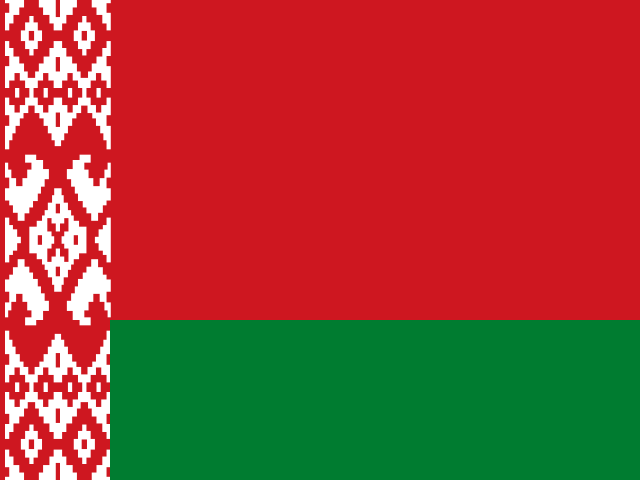
The Flag of Belarus
Europe · Adopted 7 June 1995 (ornament redrawn 2012)
Belarus is the clearest case in Europe of a country voting, after independence, to bring back a flag closely derived from its Soviet-era design rather than break from it. Following the 1991 dissolution of the USSR, newly independent Belarus initially adopted a white-red-white flag with the historic Pahonia (a mounted knight) coat of arms — a design tracing back to the medieval Grand Duchy of Lithuania, of which Belarusian lands had been a core part, and one that had also briefly flown during a short-lived 1918 Belarusian People's Republic and been used by anti-Soviet partisans and postwar émigré communities.
That white-red-white flag lasted only a few years. In a May 1995 referendum called by President Alexander Lukashenko, who had been elected the previous year, Belarusian voters were asked whether to replace it, and a majority backed returning to a redesigned version of the Belarusian Soviet Socialist Republic's flag — red over green with a decorative woven-pattern strip near the pole — with the hammer and sickle removed. The new flag was formally adopted on 7 June 1995, and its critics, including much of the pro-independence opposition, have long argued the referendum took place under conditions that favored the government's preferred outcome; the vote nonetheless remains the flag's legal basis.
The result keeps the same red-over-green color arrangement Soviet Belarus used from 1951 onward, a design that itself replaced an earlier, plainer red Soviet-Belarusian flag. Red is officially tied to Belarus's Soviet-era war record, honoring the immense losses — historians estimate around a quarter of the republic's population — suffered during the Nazi occupation of Belarus in the Second World War, while green represents the country's forests and, more broadly, its agricultural land and rural life.
The vertical decorative strip running along the hoist side is a rushnyk pattern, a traditional Belarusian woven-textile ornament historically used on ceremonial cloths for weddings, funerals, and other rituals; the 1995 flag redrew the specific pattern used on the Soviet-era flag, and in 2012 the government commissioned a further refinement of the ornament's exact geometry, a technical redesign rather than a change to the flag's overall look. Supporters of the design frame the rushnyk as a genuine link to Belarusian folk-textile tradition predating Soviet rule by centuries, even though the flag's overall color scheme and proportions are directly descended from the Soviet republic's banner.
The white-red-white flag has not disappeared; it became the flag most associated with pro-democracy and anti-Lukashenko protest movements, worn and waved in large numbers during the disputed 2020 presidential election protests, and the Belarusian government has since treated public display of the white-red-white flag as a punishable offense in many contexts — turning Belarus into a rare case where two rival flags, both with genuine historical claims, actively compete for the title of national symbol depending on one's political alignment.
The Pahonia knight design that lost out in 1995 has its own long and genuinely contested history: it originated as the heraldic emblem of the Grand Duchy of Lithuania, a medieval state that at its height encompassed most of modern Belarus, and both Lithuania and Belarusian nationalists claim it as part of their own national heritage — Lithuania still uses a version of the same mounted knight on its own state coat of arms today, making the symbol one of relatively few in Europe actively claimed as founding heritage by two different modern nations descended from the same medieval polity.
The 1995 referendum that restored the Soviet-derived flag was held alongside other questions, including one on granting Russian equal status with Belarusian as an official language and one on closer integration with Russia, and observers at the time and since have generally read the flag question as part of a broader Lukashenko-era political project of re-orienting Belarus toward Russia rather than toward the Western-facing, historically-rooted nationalism the white-red-white flag and Pahonia arms had come to represent among the pro-independence opposition of the early 1990s.
Internationally, Belarus's flag is visually close to a small number of other red-and-green Slavic-region flags, but its specific ornament strip is unique to Belarus, and government specifications fix the exact red and green shades along with the precise weave pattern used on official versions, giving the design a level of technical codification consistent with its mid-20th-century Soviet origins.
The 2020 protests brought the white-red-white flag's political visibility to a scale not seen since the early 1990s, with demonstrators marching under it in the hundreds of thousands across Minsk and other Belarusian cities following a presidential election widely regarded internationally as fraudulent; the government's subsequent crackdown extended to reclassifying the historic flag itself as 'extremist symbolism' in some contexts, a legal step that turned simple possession or display of a flag design with roots in a 1918 independence movement into a potential criminal matter within Belarus's own borders.
Belarusian exile and opposition groups based abroad, along with the country's National Olympic Committee's own long-running disputes with the International Olympic Committee, have kept the white-red-white flag visible internationally even where the current Belarusian state has worked to suppress it domestically, making Belarus one of the clearer contemporary examples in Europe of a national flag question that remains genuinely, actively unresolved rather than settled by the 1995 referendum result alone.
A woven pattern down the hoist
- High-resolution printed flag — The strip against the pole reproduces a woven textile motif, which means fine repeated geometry rather than a solid shape, and it is the first part of this flag a low-resolution print destroys.
As an Amazon Associate we earn from qualifying purchases made through these links, at no extra cost to you.
Often confused with
- Bulgaria — shares no direct color scheme overlap in ordering, but both are sometimes grouped loosely by casual observers as 'Slavic red-and-green' flags despite Bulgaria's white-green-red horizontal tricolor being structurally unrelated to Belarus's red-over-green with ornament. Compare side by side →
Belarus at a glance
- Capital
- Minsk
- Population
- 9.1 million (2024)
- Currency
- Belarusian Ruble (BYN)
- Language(s)
- Belarusian and Russian (both official)
Population figure as of 2024, source: UN World Population Prospects (2024 revision). See methodology for how facts are sourced and kept current.