Brussels — Capital of Belgium
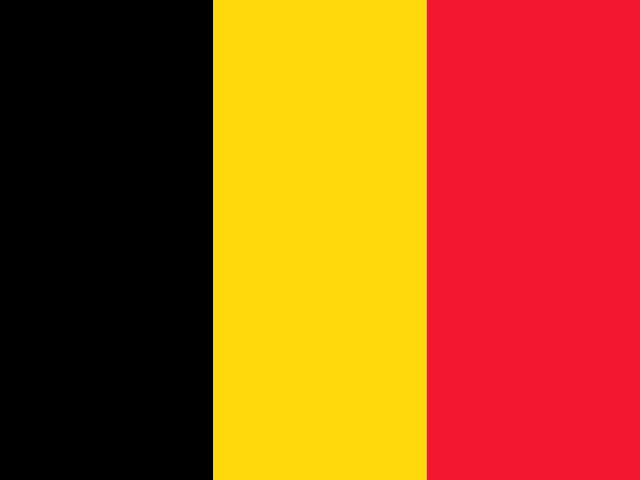
Brussels grew from a small settlement on an island in the River Senne, traditionally dated to around 979 CE when Charles, Duke of Lower Lorraine, is said to have built a fortress there — a marshy, defensible site that gave the city its name, generally traced to the Old Dutch 'Broeksele,' meaning 'settlement in the marsh.' It grew through the medieval and early modern periods as a prosperous cloth-trading city and, later, as the seat of the Dukes of Brabant, whose black-lion coat of arms would eventually supply the colors for the modern Belgian flag.
Brussels became capital of the new Kingdom of Belgium immediately upon the country's founding in 1830–1831, a natural choice given its existing role as the administrative center of the southern Netherlands under both Austrian Habsburg and later Dutch rule; unlike some capitals chosen as compromises, Brussels' position stemmed directly from its established status as the region's principal city for centuries beforehand. The city's grand central square, the Grand-Place, rebuilt in ornate Baroque style after a devastating 1695 French bombardment destroyed most of the medieval original, remains one of Europe's best-preserved historic squares; UNESCO added it to the World Heritage List in 1998, citing how its guildhalls fuse Baroque, Gothic, and Louis XIV influences within a single unified square.
Brussels' modern international profile dates largely to the second half of the 20th century, when the city became host to the headquarters of the European Economic Community (the forerunner of the European Union) starting in 1958 and later NATO's headquarters, relocated there in 1967 — choices driven partly by Belgium's central geographic position and its status as a small, non-dominant power acceptable to larger neighboring states as a neutral administrative host. That role has since made Brussels a genuine second capital of sorts, often described as the 'capital of Europe' alongside its role as capital of Belgium.
The city's linguistic status is itself distinctive within Belgium: although situated within the Flemish Region and historically Dutch-speaking, Brussels became majority French-speaking over the 19th and 20th centuries through demographic and administrative shifts and today operates as an officially bilingual French-Dutch region — its own political entity separate from both Flanders and Wallonia, a structural reflection of the same linguistic complexity that keeps Belgium's regional flags so prominent alongside the national tricolor.
Brussels is also known for the Atomium, a 102-meter steel structure representing an iron crystal magnified 165 billion times, built for the 1958 World's Fair (Expo 58) and retained afterward as one of the city's most recognizable modern landmarks — a striking contrast to the Grand-Place's centuries-older Baroque architecture just a few kilometers away.
Brussels' selection as host for the EEC's institutions in the 1950s was not automatic or uncontested — Strasbourg and Luxembourg were also serious contenders, and Brussels' win owed much to Belgium's deliberate diplomatic push during the founding negotiations, along with the city's existing international infrastructure and its position at a linguistic and cultural crossroads between Latin and Germanic Europe, a positioning some at the time saw as symbolically fitting for a body meant to unite postwar Western Europe.
The city's culinary reputation, resting heavily on Belgian waffles, chocolate, and beer, has itself become bound up with Brussels specifically even where the products' true origins are more diffusely Belgian: Brussels-style waffles (lighter and larger than the denser Liège variety) take their name directly from the city, and Brussels sprouts, first cultivated in the region since at least the 16th century, carry the city's name internationally despite being a comparatively minor part of the modern local diet.
Quick facts
- As of 2024, the Brussels-Capital Region itself counted approximately 1.25 million residents — a figure that only tells part of the story, since the broader metropolitan area spilling into both Flemish and Walloon territory is considerably larger.
- Brussels hosts the headquarters of the European Commission, European Council, and Council of the European Union, as well as NATO's political headquarters.
- What impressed UNESCO's assessors most about the Grand-Place was less any single building than the coordinated speed of the rebuild: nearly every guildhall around the square went up within about five years of the 1695 bombardment.
- Brussels is one of only a few officially bilingual regions in Belgium, with services provided in both French and Dutch.
- The Manneken Pis, a small bronze fountain statue dating in some form to at least the early 17th century, is one of the city's best-known and most whimsical landmarks.