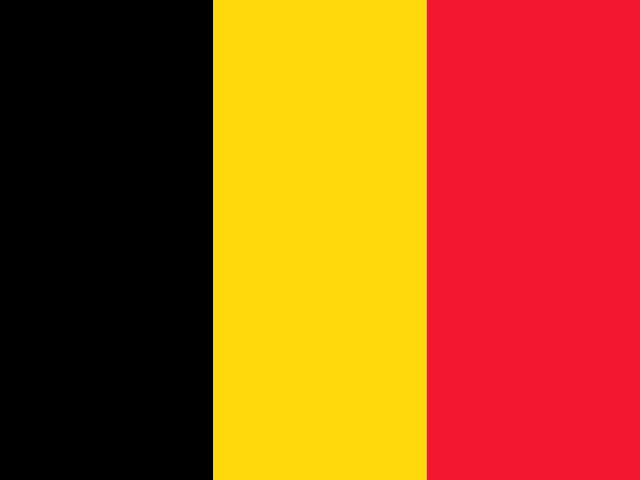
The Flag of Belgium
Europe · Adopted 23 January 1831
Belgium's black-yellow-red vertical tricolor was adopted within months of the country's founding, formalized by the newly convened National Congress on 23 January 1831 during the aftermath of the Belgian Revolution, the 1830 uprising in which the southern, mostly Catholic provinces of the United Kingdom of the Netherlands broke away from Dutch rule under King William I. The colors themselves, however, predate the country by decades: they are drawn directly from the coat of arms of the Duchy of Brabant, the historic region encompassing Brussels, which had displayed a black lion with red claws and tongue on a gold field since at least the medieval period.
Those Brabant colors had already been used as a revolutionary flag once before, during the short-lived Brabant Revolution of 1789–1790, when the southern Austrian Netherlands briefly rebelled against Habsburg Emperor Joseph II and declared the short-lived 'United States of Belgium' under a black-yellow-red banner — making the 1830 revolutionaries' choice a deliberate revival of an earlier failed independence movement's symbol rather than an invention from scratch. That continuity gave the new Belgian state an implicit claim to a longer national tradition than its literal 1830 founding date would suggest.
Belgium's first 1830 flags were actually horizontal tricolors, arranged red-yellow-black from top to bottom in imitation of the French tricolor's format, and it was only the 1831 National Congress decision that fixed the current vertical black-yellow-red arrangement (reading black at the hoist, red at the fly) as the permanent official design — a detail sometimes surprising given how strongly the vertical format is now associated with Belgium specifically.
The colors carry no single official symbolic meaning of the kind some newer national flags assign to their fields; Belgian civic material generally treats the flag's significance as resting on its direct inheritance from the Brabant arms and its role as the symbol chosen at the country's founding, rather than on interpretive readings of black, yellow, and red as standing for particular virtues or historical events.
Because Belgium is a federal state with three linguistic communities — Flemish, French-speaking (Walloon), and a small German-speaking community — the national tricolor exists alongside regional flags that carry far more day-to-day symbolic weight in some contexts: the Flemish Region's black lion on yellow (itself also drawn from Brabant heraldry) and Wallonia's rooster flag are both widely flown, and the national tricolor is sometimes described, only half-jokingly, as less visible in everyday Belgian life than either regional banner, a reflection of the country's real internal linguistic and political divisions.
The Belgian Revolution itself grew out of specific grievances rather than abstract nationalism: the 1815 Congress of Vienna had merged the historically Catholic, French- and Dutch-speaking southern Netherlands with the Protestant, Dutch-speaking north under King William I as a buffer state against France, and southern discontent over Dutch domination of government posts, William's promotion of Dutch as the sole administrative language, and religious tension between the Protestant monarchy and the largely Catholic south boiled over after an August 1830 opera performance in Brussels — Auber's 'La Muette de Portici,' whose plot centers on a Neapolitan revolt — is traditionally credited with helping spark the riots that turned into full revolution within weeks.
Belgium's constitutional monarchy that emerged from the revolution deliberately chose a foreign prince, Leopold of Saxe-Coburg (a widower of a British princess and uncle to the future Queen Victoria), as its first king in 1831, a choice partly intended to secure British and French diplomatic support for the new state's independence and neutrality — a neutrality guaranteed by European powers that, notably, Germany violated when invading Belgium in 1914, an act that drew Britain into the First World War in Belgium's defense under treaty obligations tied back to that same 1830s settlement.
Belgium's flag is occasionally confused with Germany's, since both use black, red, and yellow (or gold), but the arrangement and orientation differ completely: Germany's is a horizontal tricolor with black on top, red in the middle, and gold at the bottom, while Belgium's is vertical with black at the hoist, yellow in the center, and red at the fly — different stripe direction and different order, though the shared three colors are enough to cause mix-ups among people unfamiliar with either flag.
The flag flies over Belgian government buildings and is prominent around Belgian National Day on 21 July, marking the 1831 accession of King Leopold I as the country's first monarch — a separate anniversary from the January 1831 flag adoption but the date most closely tied in public memory to the country's founding as a constitutional monarchy.
The lion that anchors both the national and Flemish flags' underlying heraldry — the Brabant black lion on gold — is itself one of the most widely copied heraldic charges in European history, appearing in modified form on the arms of numerous other historic Low Countries territories and even influencing the design of the Netherlands' own coat of arms; Belgium's specific use of it, unmodified, as the source of its national tricolor's palette is what makes the connection between the country's medieval regional heraldry and its comparatively young 1830s state flag so direct and traceable.
Vertical bands, not horizontal
- Flag with the bands running vertically — The page records that the earliest versions ran horizontally before the arrangement was fixed the other way, and horizontal black-yellow-red stock still turns up in listings for this flag.
As an Amazon Associate we earn from qualifying purchases made through these links, at no extra cost to you.
Often confused with
- Germany — shares the same three colors, black, red, and gold/yellow, but Germany's flag is a horizontal tricolor (black-red-gold, top to bottom) while Belgium's is vertical (black-yellow-red, hoist to fly) — different orientation and order. Compare side by side →
Belgium at a glance
- Capital
- Brussels
- Population
- 11.8 million (2024)
- Currency
- Euro (EUR)
- Language(s)
- Dutch, French, and German (all official)
Population figure as of 2024, source: UN World Population Prospects (2024 revision). See methodology for how facts are sourced and kept current.