Sarajevo — Capital of Bosnia and Herzegovina
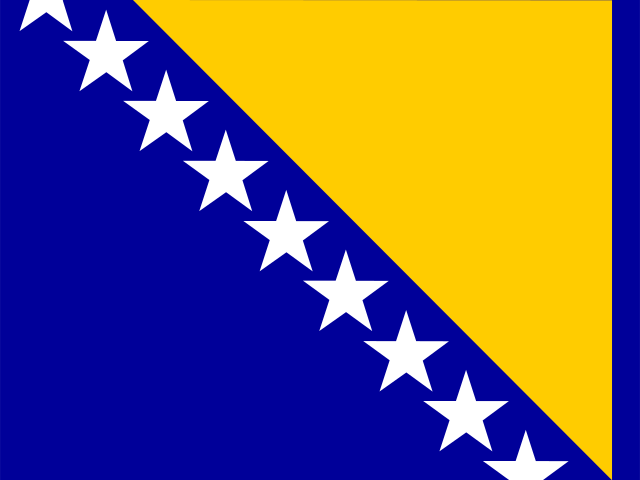
See the flag of Bosnia and Herzegovina →
Sarajevo developed as a major urban center under Ottoman rule beginning in the 15th century, after the Ottoman governor Isa-Beg Isaković established a settlement around a fortress and market complex in the 1450s-60s; the city grew rapidly into one of the Ottoman Balkans' most important trading and administrative hubs, and its old quarter, Baščaršija, with its Ottoman-era mosques, covered markets, and narrow lanes, still preserves that layout today. Austro-Hungarian rule from 1878 to 1918 added a second architectural layer just west of the old quarter, giving central Sarajevo a visible east-west divide between Ottoman and Central European building styles that residents and visitors still note as one of the city's most distinctive features.
Sarajevo's single most globally consequential moment came on 28 June 1914, when Archduke Franz Ferdinand of Austria-Hungary, heir to the Habsburg throne, was assassinated in the city by Gavrilo Princip, a Bosnian Serb nationalist — an event that set off the diplomatic crisis leading directly to the outbreak of the First World War barely a month later. The site of the assassination, on the Latin Bridge over the Miljacka River, remains one of the city's most historically weighted locations.
The city became capital of the Socialist Republic of Bosnia and Herzegovina within Yugoslavia after the Second World War and hosted the 1984 Winter Olympics, a high point of international attention that stood in stark contrast to what followed less than a decade later: from 1992 to 1996, Sarajevo endured the longest siege of a capital city in modern warfare history, with Bosnian Serb forces surrounding and shelling the city for approximately 1,425 days during the Bosnian War, killing an estimated 11,000 residents including over 1,500 children, while the population inside survived on limited food, water, and electricity.
Postwar reconstruction has left Sarajevo a city that visibly carries both its Ottoman-Habsburg layered history and the physical and social scars of the 1990s siege — bullet-pocked buildings, the 'Sarajevo Roses' (mortar-shell scars in pavement filled with red resin as informal memorials), and the rebuilt National Library, deliberately destroyed by shelling in 1992 and reopened after extensive reconstruction in 2014 — alongside a resurgent cultural life, including the Sarajevo Film Festival, founded in 1995 during the siege itself as an act of defiance and now one of Southeast Europe's most prominent film events.
Sarajevo's religious diversity earned it the nickname 'Jerusalem of Europe' or 'Jerusalem of the Balkans' well before the 1990s war, reflecting a centuries-old coexistence of Islam, Orthodox and Catholic Christianity, and Judaism within a compact urban area — a Sephardic Jewish community had lived in the city since Jews expelled from Spain in 1492 settled there under Ottoman protection, and though that community was devastated during the Holocaust, synagogues, mosques, an Orthodox cathedral, and a Catholic cathedral still stand within a short walk of each other in the city center today.
The 'Sarajevo Tunnel,' dug by hand beneath the airport runway during the siege to connect the encircled city to the outside world, allowed limited passage of food, medical supplies, weapons, and people during the worst years of the blockade, and a preserved section of it is now open to visitors as the Tunnel of Hope Museum, one of the most visited sites in the city for understanding the practical mechanics of how Sarajevo's population survived nearly four years of encirclement.
Quick facts
- Sarajevo counted roughly 275,000 residents within city limits in 2024, rising to about 555,000 across the wider Sarajevo Canton — still well below its pre-siege 1991 population.
- Snipers firing from surrounding hillsides during the siege made a stretch of the city's main boulevard so dangerous that residents nicknamed it 'Sniper Alley,' a name that has stuck in local memory ever since.
- Sarajevo hosted the 1984 Winter Olympic Games, the first Winter Olympics held in a socialist country.
- The city's Baščaršija old quarter, founded in the 1460s under Ottoman governor Isa-Beg Isaković, remains its historic commercial center.
- The 1914 assassination of Archduke Franz Ferdinand in Sarajevo is widely taught as the immediate trigger for the outbreak of World War I.