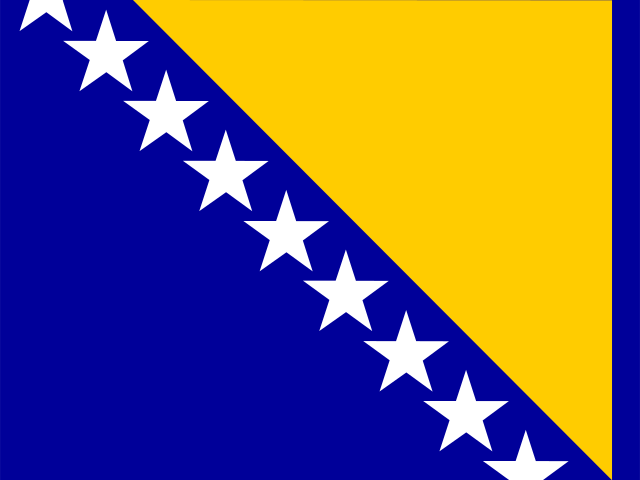
The Flag of Bosnia and Herzegovina
Europe · Adopted 10 February 1998
Bosnia and Herzegovina's current flag — a blue field with a yellow right triangle and a diagonal line of white stars — was not chosen by any Bosnian government or referendum, but imposed by the international community, a fact the country's own citizens are generally well aware of. It was designed and instituted in February 1998 by Carlos Westendorp, the international High Representative overseeing the implementation of the 1995 Dayton Peace Agreement that ended the Bosnian War, after Bosnia's constituent peoples — Bosniaks, Croats, and Serbs — proved unable to agree on a new national flag through their own political process in the years immediately following the war.
The flag it replaced tells much of the story. Bosnia's first post-independence flag, adopted in 1992 shortly after the country declared independence from a disintegrating Yugoslavia, used a white field with a blue shield bearing six gold fleurs-de-lis, a design invoking the medieval Bosnian Kingdom of Tvrtko I. That flag, however, came to be strongly associated during the 1992–1995 war specifically with the Bosniak-led government side rather than being accepted as neutral among all three constituent peoples, particularly Bosnian Serbs and Croats who had fought against forces aligned with that government — making it politically unusable as a unifying postwar symbol.
Westendorp's imposed design was deliberately built to avoid the specific religious and ethnic-nationalist associations that had made the fleur-de-lis flag divisive: it uses no crosses, crescents, or historic dynastic emblems tied to any one of the three constituent peoples, drawing instead on colors already present in the European Union flag's blue-and-yellow palette, a choice widely read as signaling Bosnia's aspiration toward EU membership and integration rather than any specifically Bosnian historical claim.
The stars, arranged in a diagonal line along the yellow triangle's edge and deliberately cut off at top and bottom rather than shown as a complete, countable row, are officially described as representing Europe and, by extension, being unlimited and continuing indefinitely — a design choice widely interpreted as symbolizing an open-ended, unbounded number rather than a fixed count tied to any specific figure like a set number of regions or ethnic groups. The yellow triangle itself is explained as representing the shape of the country's territory on a map along with the three constituent peoples, while the blue field is generally read simply as a peace-oriented, EU-aligned neutral color.
Reaction to the imposed flag within Bosnia has been mixed and largely tracks ethnic lines: it is widely used as the state's official flag and flown on government buildings and at international events including the Olympics, but many Bosnian Serbs in the Republika Srpska entity fly the flag of that entity (itself a Serbian-tricolor-derived design) far more prominently in daily life than the state flag, and many Bosnian Croats similarly favor Croatian-linked symbols in Croat-majority areas — leaving the internationally designed blue-and-yellow flag as a genuinely neutral but not always emotionally embraced national symbol, a direct reflection of Bosnia's continuing internal political divisions along ethnic lines two decades after Dayton.
The two-and-a-half years leading up to the 1998 imposition saw a genuine, if ultimately failed, attempt at a domestic compromise: a 1995 commission tried to combine elements acceptable to all three peoples, and various proposals featuring lilies, historic shields, or combinations of Bosniak, Croat, and Serb heraldic colors circulated in parliament without securing the cross-ethnic consensus Dayton's power-sharing structure required for any state-level symbol to pass — the repeated failure of that domestic process is precisely why the High Representative's office, which held sweeping intervention powers under Dayton's Annex 10, ultimately stepped in and imposed a design unilaterally rather than continuing to wait for local agreement.
The High Representative's authority to impose laws and remove officials — the so-called 'Bonn Powers,' named for a 1997 Peace Implementation Council meeting in Bonn that formally granted them — has been used sparingly over the years since Westendorp's 1998 flag decision but remains a distinctive and controversial feature of Bosnian governance, an outside international official retaining the legal capacity to override the elected domestic political process on matters, like the flag, deemed essential to the peace settlement's survival, a degree of continuing external oversight highly unusual among European states roughly three decades after the war that produced it ended.
Because the flag deliberately avoided referencing any specific national or ethnic emblem, it has no close historical predecessor to be visually confused with; its closest resemblance is simply to the general blue-and-yellow palette of the EU flag itself, which is generally understood as a deliberate echo rather than a coincidence.
Bosnia's earlier 1992 fleur-de-lis flag survives today in a narrower institutional role: it remains recognizable as a symbol closely tied to the wartime Bosnian government and to Bosniak national identity specifically, and versions of the fleur-de-lis and the medieval Kotromanić dynasty's heraldry it drew on still appear on some cantonal and municipal flags within the Federation of Bosnia and Herzegovina entity, keeping the original independence-era design in limited but ongoing public use even though it never regained state-level status after 1998.
The stars are meant to be cut off
- Detail-accurate printed flag — The row of stars is specified to run off the top and bottom edges rather than sit complete within them, so a flag showing a tidy row of whole stars has been redrawn by the maker.
As an Amazon Associate we earn from qualifying purchases made through these links, at no extra cost to you.
Bosnia and Herzegovina at a glance
- Capital
- Sarajevo
- Population
- 3.2 million (2024)
- Currency
- Convertible Mark (BAM)
- Language(s)
- Bosnian, Croatian, and Serbian (all official)
Population figure as of 2024, source: UN World Population Prospects (2024 revision). See methodology for how facts are sourced and kept current.