Bandar Seri Begawan — Capital of Brunei
Bandar Seri Begawan sits on the Brunei River at the site of Kampong Ayer, a settlement of stilt houses built directly over the water that has been inhabited continuously for centuries — early European visitors in the 16th century reportedly nicknamed the area the 'Venice of the East' for its extensive water-borne settlement, and Kampong Ayer remains inhabited today, making it one of the largest and longest-continuously-occupied stilt-house settlements in the world.
The city was known simply as Brunei Town for most of the 20th century, and it only took its current name — Bandar Seri Begawan, meaning roughly 'City of the Illustrious Ruler' — in 1970, in honor of Sultan Omar Ali Saifuddien III after he abdicated in favor of his son, the current Sultan Hassanal Bolkiah, and took the honorific title 'Seri Begawan.' The renaming tied the capital's identity directly to the reigning royal family in a more explicit way than the earlier colonial-era name had.
Brunei Town/Bandar Seri Begawan has been the seat of the Sultanate's government for centuries, through the era of Brunei's much larger historical maritime empire (which once extended influence across parts of Borneo and into the Philippines before contracting sharply from the 17th century onward), the period of British protection from 1888 to 1984, and full independence in 1984 — making it one of Southeast Asia's longer-serving continuous capitals despite the country's dramatic territorial contraction over the centuries.
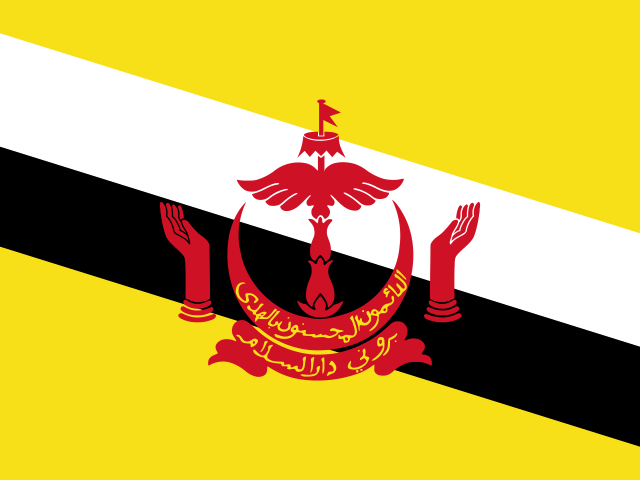
The Sultan Omar Ali Saifuddien Mosque, completed in 1958 and named for the 28th Sultan, dominates the city's skyline with its gold dome, functioning as the visual shorthand most people picture when they think of Bandar Seri Begawan, and it reflects the close intertwining of religious and royal symbolism that also appears on the national flag's crest.
Brunei's oil and gas wealth, discovered in the early 20th century and developed substantially from the 1930s onward, has funded significant modern development in Bandar Seri Begawan, including the Istana Nurul Iman, the Sultan's official residence and reportedly one of the largest residential palaces in the world by floor area, though the city's overall footprint remains modest compared to other Southeast Asian capitals given Brunei's small population.
A second major mosque, the Jame'Asr Hassanil Bolkiah Mosque, was completed in 1994 to mark the 25th anniversary of the current Sultan's reign and features 29 golden domes, one for each of Brunei's sultans to date; together with the older Sultan Omar Ali Saifuddien Mosque, it gives the capital two large-scale royal-commissioned mosques within a few kilometers of each other, an unusually dense concentration for a city of its size.
The Royal Regalia Museum in the city center displays ceremonial items from the current Sultan's 1968 coronation and 1992 silver jubilee, including a golden chariot and jewel-encrusted crowns, and functions as one of the capital's main venues for presenting the monarchy's ceremonial role to both citizens and visitors.
Brunei implemented a Sharia Penal Code in phases beginning in 2014, drawing international attention and criticism over its provisions, and Bandar Seri Begawan, as the seat of both the civil and Islamic legal systems, houses the country's Sharia courts alongside its secular judiciary.
Brunei citizens pay no personal income tax and receive free healthcare and education funded by the country's oil and gas revenue, a welfare system administered out of the capital's government ministries that has made Brunei one of the wealthier countries in Southeast Asia by per-capita income despite its small size and population.
Bandar Seri Begawan's population is ethnically mixed between Malay Bruneians, who make up the country's majority and dominant political class, and significant Chinese and indigenous Dayak-related minority communities, alongside a large temporary foreign workforce drawn to the capital's oil-funded construction and service sectors from South and Southeast Asia.
Quick facts
- Roughly 100,000 people live within Bandar Seri Begawan's city limits, a modest total that still represents close to a quarter of Brunei's entire national population of under half a million.
- Brunei's full official name, Negara Brunei Darussalam ('Abode of Peace'), was formally adopted at independence in 1984 and appears on government buildings across the capital.
- The Brunei Museum, founded in 1965 on a hill overlooking the river, is the country's oldest public museum and holds collections on Bruneian history, Islamic art, and natural history.
- The Yayasan Sultan Haji Hassanal Bolkiah Complex, a shopping and office development in the city center, opened in the 1990s as one of the capital's first large modern retail hubs.
- Bandar Seri Begawan sits almost on the equator and has a hot, humid tropical climate with heavy rainfall spread across most of the year rather than a sharply defined dry season.