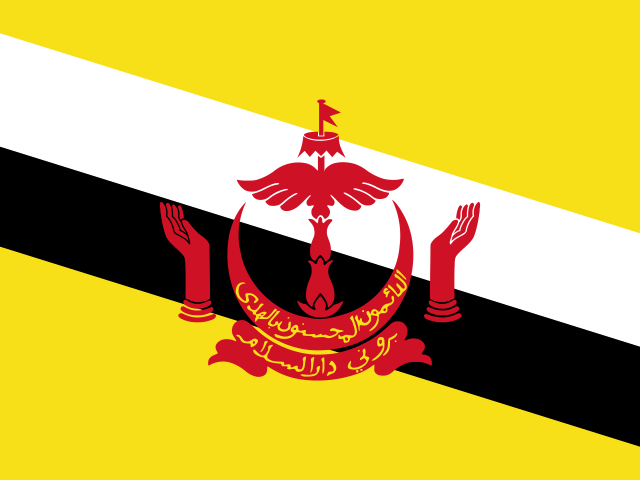
The Flag of Brunei
Asia · Adopted 29 September 1959
Brunei's flag combines a yellow field crossed by two diagonal white and black bands with a red national crest centered on top, and it was formally adopted on 29 September 1959, the same year Brunei's written constitution came into force under British protection, though the yellow field with diagonal stripes had already been in use as the Sultan's flag since 1906. The crest was added in 1959 specifically to mark the new constitutional arrangement, turning what had been a comparatively simple two-tone royal banner into a fuller national flag suited to Brunei's evolving status.
Yellow is the color of Brunei's monarchy — the Sultan of Brunei is traditionally the only person permitted to wear solid yellow — and the field's overall yellow background is a direct assertion of the Sultanate's central authority over the state, a symbolism that predates the 1959 constitution by centuries and connects to Malay royal color traditions found elsewhere in the Malay world. The two diagonal bands, white above black, represent the country's chief ministers, an office structure tracing back to traditional Bruneian governance under the Sultanate.
The red crest at the center is dense with symbolism packed into a single emblem: a crescent moon representing Islam, the state religion; a royal umbrella (payung ubor-ubor) symbolizing the monarchy; wings representing the protection of justice, tranquility, and prosperity; two upraised hands representing the government's pledge to promote welfare; and a ribbon beneath bearing the country's Arabic-script national motto, which translates roughly to 'Always in service with God's guidance.' Each element was chosen deliberately to represent a distinct pillar of the state — religion, monarchy, protection, and governmental duty — rather than being a purely decorative device.
Brunei's full formal name, 'Negara Brunei Darussalam' ('Brunei, Abode of Peace'), and its distinctive political system — Malay Islamic Monarchy (Melayu Islam Beraja), formally adopted as national philosophy in 1990 — are both reflected in the flag's combination of Islamic (crescent), monarchical (umbrella, yellow field), and Malay governance symbolism, making the flag a fairly literal visual summary of the country's official state ideology rather than a more abstractly symbolic design.
The flag has not changed since the 1959 crest addition; the underlying yellow-white-black diagonal field itself has been in continuous use since 1906, making the basic color scheme one of the longer-running unbroken national or proto-national flag traditions in Southeast Asia, even though the country only became fully independent from Britain in 1984.
Brunei's flag has no close look-alikes among current national flags — the specific combination of a yellow field, diagonal white-and-black bands, and a dense red heraldic crest does not closely resemble any other country's design, and confusion with other Southeast Asian flags is rare.
The 1906 origin of the diagonal yellow-white-black pattern coincides with a low point in Brunei's territorial history rather than a moment of strength: by the early 1900s the once-large Bruneian Sultanate had been whittled down for decades by land cessions to the neighboring Brooke family's Kingdom of Sarawak and to the British North Borneo Chartered Company, and 1906 was also the year Brunei accepted a British Resident under a new agreement that placed its internal administration under closer London oversight. Flying a distinct royal banner during that period functioned partly as an assertion that a diminished Brunei still remained a sovereign sultanate in its own right rather than being absorbed outright, as neighboring territories on Borneo effectively had been.
Brunei's Flag and Coat of Arms Act formally sets out construction details rather than leaving them to custom: the white diagonal band is fixed at roughly twice the width of the black band beneath it, both running corner to corner across the yellow field, and the crest is centered precisely on the point where the two diagonal bands cross. The law also specifies flag protocol — the flag is flown at half-mast on the death of a member of the royal family, is never to be flown in a worn or faded state, and must be replaced immediately if damaged, rules enforced with particular care given the flag's status as a direct emblem of the ruling Sultan rather than a more general civic symbol.
Sultan Hassanal Bolkiah, who ascended the throne in 1967 and oversaw the 1984 transition to full independence from Britain, has reigned for well over half a century, making the flag's yellow field — reserved for his exclusive use as an item of clothing — a live personal symbol rather than a purely historical one; state occasions frequently pair the national flag with the Sultan's own royal standard, a related but visually distinct yellow banner bearing the royal crest at a larger scale, underlining the flag's continued function as an emblem of monarchy first and nation second.
Brunei's 1984 independence, arriving nearly four decades after most of its Southeast Asian neighbors had left European colonial rule, was itself delayed largely by internal debate over how the transition should be managed rather than any external obstacle; the country had briefly rejected full membership in the Malaysian federation in the early 1960s, opting instead to remain a separate British protectorate for another two decades while its oil and gas wealth, discovered commercially at Seria in 1929, gave the Sultanate the fiscal independence to negotiate its own eventual, unhurried path to sovereignty rather than being pushed toward it by financial necessity.
A crest with a lot inside it
- Full-colour printed flag — The crest carries a parasol, wings, hands and a lettered ribbon in one device a few inches across at normal flag size, so print resolution decides whether it is a crest or a red smudge.
As an Amazon Associate we earn from qualifying purchases made through these links, at no extra cost to you.
Brunei at a glance
- Capital
- Bandar Seri Begawan
- Population
- 460,000 (2024)
- Currency
- Brunei Dollar (BND)
- Language(s)
- Malay (official)
Population figure as of 2024, source: UN World Population Prospects (2024 revision). See methodology for how facts are sourced and kept current.