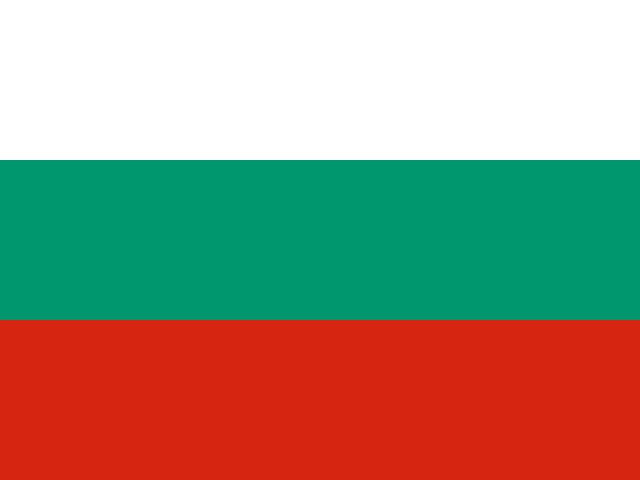
Sofia — Capital of Bulgaria
Sofia sits on a site occupied for millennia, with archaeological remains from a Thracian settlement called Serdica dating back roughly 7,000 years in some form, later developed as a significant Roman city under the same name — Emperor Constantine the Great reportedly considered making Serdica his empire's capital before ultimately choosing Byzantium (Constantinople), reportedly remarking that 'Serdica is my Rome.' Remnants of Roman Serdica, including a rotunda church, ancient street layout, and thermal baths, remain visible in central Sofia today, uncovered in part during 21st-century metro construction.
The city took its current name from the Church of St. Sofia, a 6th-century Byzantine basilica still standing in the city center, with the name 'Sofia' (Greek for 'wisdom') gradually replacing 'Serdica' in common use by around the 14th century, during the period of Ottoman rule that began after the Ottomans captured the city in 1382 and lasted roughly five centuries.
Sofia's selection as capital of the newly liberated Bulgarian state in 1879, just a year after Ottoman rule ended, was a deliberate, debated choice rather than an automatic continuation of any prior Bulgarian capital — earlier medieval Bulgarian states had centered on Pliska, Preslav, and Tarnovo, none of which Sofia had directly succeeded. Sofia's relatively central geographic position within the new state's territory, along with its existing size and infrastructure as a regional Ottoman administrative center, tipped the decision in its favor over rival candidates including Tarnovo, the medieval capital with stronger historical claims but a less central location.
Twentieth-century Sofia was reshaped substantially first by early post-liberation urban planning that gave the city its wide central boulevards, then by Soviet-influenced architecture and urban design after Bulgaria became a communist state in 1946, adding large government buildings, public squares like Battenberg Square, and extensive residential blocks around the historic core. The city's Alexander Nevsky Cathedral, completed in 1912 in a Neo-Byzantine style to commemorate Russian soldiers who died liberating Bulgaria in the 1877–78 war, remains one of the largest Eastern Orthodox cathedrals in the world and a direct architectural echo of the same Russian-Bulgarian relationship reflected in the national flag's color scheme.
Today Sofia functions as Bulgaria's political, economic, and educational hub, home to Sofia University (founded 1888, the country's oldest), and it sits at the foot of Vitosha Mountain, whose slopes are close enough to the city center to make Sofia one of relatively few European capitals offering ski access within a short drive of downtown.
Sofia's history under nearly five centuries of Ottoman rule left the city with substantial Islamic architecture, most of which was removed or repurposed after Bulgarian independence as the new state deliberately reshaped its capital's visual identity away from Ottoman associations; the Banya Bashi Mosque, completed in 1576 and still an active mosque today, is one of the few major Ottoman-era buildings to survive that broader postindependence transformation of the city center.
The city's 21st-century metro expansion, begun in 1998 and still ongoing, has doubled as an unusually productive archaeological project, since tunneling beneath central Sofia repeatedly uncovered substantial remains of Roman Serdica, including sections now preserved and displayed in situ inside the Serdika metro station itself — allowing commuters to walk past excavated Roman streets and building foundations as part of their daily transit through the city center.
Quick facts
- As of 2024, Sofia was home to approximately 1.3 million people — close to a fifth of Bulgaria's entire population living in a single city.
- Archaeological digs around Sofia have turned up evidence of settlement dating back roughly 7,000 years, placing it among the handful of European sites with the longest unbroken record of human habitation.
- Sofia became Bulgaria's capital in 1879, chosen over the historic medieval capital Tarnovo largely for its central location.
- The Alexander Nevsky Cathedral, completed in 1912, was built to honor Russian soldiers killed in the 1877–78 war that ended Ottoman rule over Bulgaria.
- Vitosha Mountain, rising just south of the city, offers hiking and skiing within roughly a 30-minute drive of central Sofia.