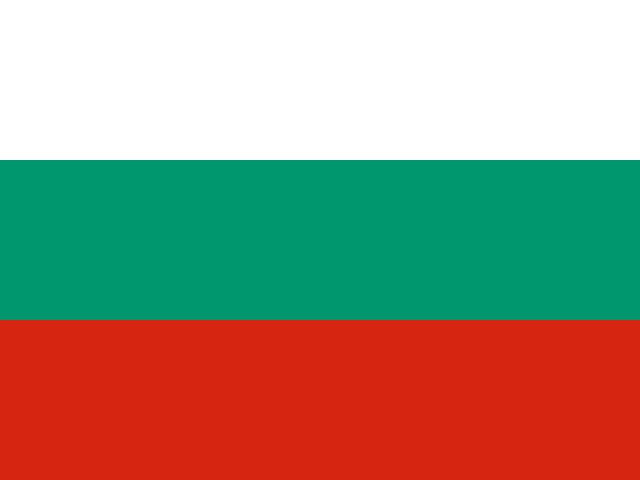
The Flag of Bulgaria
Europe · Adopted 22 November 1990 (design dates to 1878)
Bulgaria's white-green-red horizontal tricolor dates to the country's re-emergence as a state after nearly five centuries under Ottoman rule, adopted informally in the immediate aftermath of the 1877–78 Russo-Turkish War, which ended Ottoman control over most of Bulgarian territory and led to the establishment of the Principality of Bulgaria under the 1878 Treaty of Berlin. The tricolor's white-green-red combination is closely related to the Russian flag's white-blue-red, reflecting Russia's decisive military role in Bulgarian liberation and the strong pan-Slavic sentiment of the period — Bulgarian revolutionaries and the new principality's founders looked to Russia both as liberator and as a model, and the flag's structure echoes that relationship even though the middle color was changed from blue to green.
The switch from Russia's blue to Bulgaria's green is generally explained as a way to visually differentiate the new Bulgarian flag from its Russian model while still signaling the underlying Slavic and pan-Slavic kinship — white for peace, green for the country's agricultural land and, more broadly, nature, and red for the courage and blood of those who fought for liberation from Ottoman rule, a set of meanings taught in Bulgarian schools and repeated consistently across official sources.
Bulgaria's 20th century put the flag through several politically charged alterations without ever discarding the underlying tricolor. Under the People's Republic of Bulgaria after 1946, the state flag carried a coat of arms in the upper hoist corner featuring a lion, a five-pointed red star, wheat sheaves, and a ribbon reading the date 681 (marking the traditional founding of the first Bulgarian state) alongside the years 1944, marking the communist takeover — a fusion of ancient national and contemporary socialist symbolism typical of Eastern Bloc flag design. That emblem was removed following the fall of Bulgaria's communist government, and the plain tricolor was formally reconfirmed as the national flag on 22 November 1990, in the early post-communist transition period.
The plain, unadorned tricolor Bulgaria uses today is notable for lacking any coat of arms or emblem at all on the flag itself, unlike many of its Balkan neighbors — Bulgaria's national coat of arms, featuring a crowned golden lion, exists as a separate state symbol used on official documents and some government buildings, but by law it does not appear on the flag itself, keeping the flag design simple and unchanged in essential form since 1878 aside from the communist-era emblem's addition and removal.
The 1877–78 war that produced Bulgarian independence is remembered in unusually specific and personal terms in Bulgarian national memory, centered on events like the Battle of Shipka Pass, where a small force of Bulgarian volunteers and Russian troops held off a much larger Ottoman army over several days in August 1877, an episode commemorated annually and still cited as formative to Bulgarian national identity in a way that gives the liberation-era flag colors, especially the red representing shed blood, a specific and concrete historical anchor rather than an abstract patriotic gesture.
Bulgaria's brief pre-1878 history included short-lived earlier attempts at national symbols during 19th-century uprisings against Ottoman rule, most notably banners used during the failed April Uprising of 1876, whose brutal suppression by Ottoman irregular forces caused international outcry — reported at the time in the Western press and helping shift European public opinion toward supporting Bulgarian independence — and is generally treated as a direct precursor event to the Russian intervention that followed a year later and ultimately produced the tricolor's official 1878 debut.
Because white-green-red horizontal tricolors are a genuinely distinctive combination internationally, Bulgaria's flag has few close lookalikes; the nearest is Hungary's, which shares red and green but in a different order (red-white-green) and with a notably different, more muted shade of red, making confusion between the two uncommon among anyone who has seen both flags side by side.
Bulgaria's flag is flown prominently around Liberation Day, 3 March, commemorating the 1878 Treaty of San Stefano that first established Bulgarian autonomy from Ottoman rule (later revised by the Treaty of Berlin the same year), an anniversary tied directly to the same liberation struggle that produced the flag's original Russian-influenced design.
One further wrinkle in the flag's post-communist history involves proportion rather than color: the exact ratio of the three stripes and the overall flag dimensions were only precisely re-specified by law in the early 1990s alongside the removal of the communist emblem, since older Bulgarian flag law from the monarchy period had left some of those technical details looser than the more rigorously codified standards adopted by many mid-20th-century flags, a gap the post-communist government closed as part of its broader project of formally re-establishing pre-communist national symbols on a firm legal footing.
Bulgaria's monarchy-era flag, used from 1878 until the communist takeover in 1946, briefly carried its own royal coat of arms bearing a crowned lion above the tricolor on some official versions, a detail dropped once Bulgaria became a people's republic and never revived after 1990 even though the plain lion emblem itself, without a crown, remains part of Bulgaria's separate state coat of arms used on official seals and some government buildings today.
Three bands of the specified depth
- Stitched three-band flag — The page notes the band ratio and overall dimensions were only pinned down comparatively late, which is why loose reproductions of this flag vary in how deep the white band sits.
As an Amazon Associate we earn from qualifying purchases made through these links, at no extra cost to you.
Often confused with
- Hungary — shares red and green with Bulgaria, but in reversed order and different proportion — Hungary's is red-white-green, Bulgaria's white-green-red — and Hungary's red is a notably deeper, more muted shade. Compare side by side →
Bulgaria at a glance
- Capital
- Sofia
- Population
- 6.4 million (2024)
- Currency
- Bulgarian Lev (BGN)
- Language(s)
- Bulgarian (official)
Population figure as of 2024, source: UN World Population Prospects (2024 revision). See methodology for how facts are sourced and kept current.