Ouagadougou — Capital of Burkina Faso
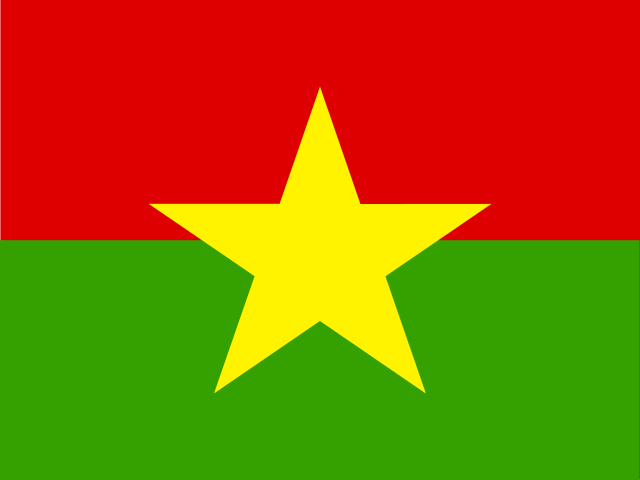
See the flag of Burkina Faso →
Ouagadougou has served as a seat of power since at least the 15th century, when it became the capital of the Mossi Empire of Ouagadougou, one of several Mossi kingdoms that dominated the region for centuries before French colonization — a continuity of political importance that stretches back roughly 500 years longer than most African capitals founded or expanded under colonial rule.
The Mossi monarchy never fully disappeared under French rule: the Mogho Naaba, the traditional Mossi emperor, still holds a ceremonial court in Ouagadougou today, and the weekly Naaba Palace ceremony — in which the Mogho Naaba symbolically prepares for war before his advisors persuade him to remain at peace — continues as a living ritual predating French administration entirely.
France made Ouagadougou the administrative capital of Upper Volta when the colony was reconstituted in 1947 (having briefly been dissolved and its territory split among neighboring colonies between 1932 and 1947), and the city retained that status through independence in 1960 and the 1984 renaming to Burkina Faso.
Since the 1980s, Ouagadougou has also become a significant hub for African cinema, hosting FESPACO (the Pan-African Film and Television Festival of Ouagadougou) since 1969 — the largest film festival on the continent and a rare instance of a landlocked, historically under-resourced capital building genuine cultural soft power on the international stage.
Thomas Sankara, whose revolutionary government renamed the country Burkina Faso in 1984, governed from Ouagadougou and was assassinated there in a 1987 coup; his grave in the city's Dagnoën cemetery became an unofficial pilgrimage site for decades before he was formally reburied with state honors in 2020 after a long legal process to establish accountability for his killing.
As a landlocked capital roughly 500 kilometers from the nearest coastline, Ouagadougou has historically depended on rail and road links through Côte d'Ivoire and Togo for access to seaports, a geographic constraint that has shaped Burkina Faso's economic and diplomatic relationships with its coastal neighbors since the colonial period.
The Ouagadougou–Abidjan railway, built by the French colonial administration in stages between 1904 and 1954, remains one of the primary freight links connecting the landlocked capital to the Atlantic coast, underscoring how much of the city's colonial-era infrastructure investment was aimed specifically at solving the landlocked-access problem.
Since 2015, Ouagadougou has also experienced repeated militant attacks linked to regional Islamist insurgencies operating in Burkina Faso's northern and eastern regions, a security crisis that has significantly strained the capital's resources as displaced populations from affected rural areas have moved into the city.
The city's Grande Mosquée, built in Sudano-Sahelian mudbrick architectural style, is among Ouagadougou's most recognizable landmarks and reflects a regional building tradition shared with historic mosques further north and east across the Sahel, including in Mali and Niger.
Ouagadougou has been the site of all three of Burkina Faso's post-2014 military takeovers, underscoring the capital's continued role as the decisive center of national political power, much as it has been for the Mossi Empire and every government since.
The city is also home to Burkina Faso's national museum and the SIAO (Salon International de l'Artisanat de Ouagadougou), a major biennial pan-African crafts fair that draws artisans and buyers from across West Africa, giving the capital a significant role in the regional handicraft trade alongside its political functions.
Ouagadougou's Bassinko and other markets remain central to daily commerce in the city, alongside a historically significant railway station built during the French colonial period that once anchored the city's role as a transit point on the line connecting the interior Sahel to the Ivorian coast.
Quick facts
- Ouagadougou's population has swelled to roughly 2.7 million as of 2024, growth driven in part by an influx of people displaced by the conflict with jihadist insurgents in Burkina Faso's rural north.
- The city's name is often shortened locally and internationally to 'Ouaga.'
- The Mogho Naaba, traditional emperor of the Mossi people, still holds court weekly in Ouagadougou, a pre-colonial institution that survives alongside the modern state.
- FESPACO, held in Ouagadougou since 1969, is Africa's largest and most prestigious film festival.